
A dairy ERP has to do two jobs that a general-purpose ERP treats as one. It has to buy milk from hundreds or thousands of farmers twice a day, priced by fat and SNF, and it has to run a plant that turns that milk into pasteurised packs, curd, paneer and ghee with a few days of shelf life. This guide is for owners, plant heads and finance leads at private dairies and milk processing units in India with 20-200 staff: what each job needs, how ERPNext handles the plant, and where a milk collection system sits next to it.
TL;DR
- A dairy runs two jobs: collection at the village centre (weight, fat, SNF, rate chart, farmer bills) and the plant (batches, BOMs, quality, dispatch, accounts).
- Two-axis pricing pays a rate per kg of fat plus a rate per kg of SNF. A worked example is below.
- FSSAI's milk processing checklist sets 4°C at collection centres, 5°C or lower for milk from bulk chilling centres, FEFO in storage and record retention of one year or the shelf life, whichever is more.
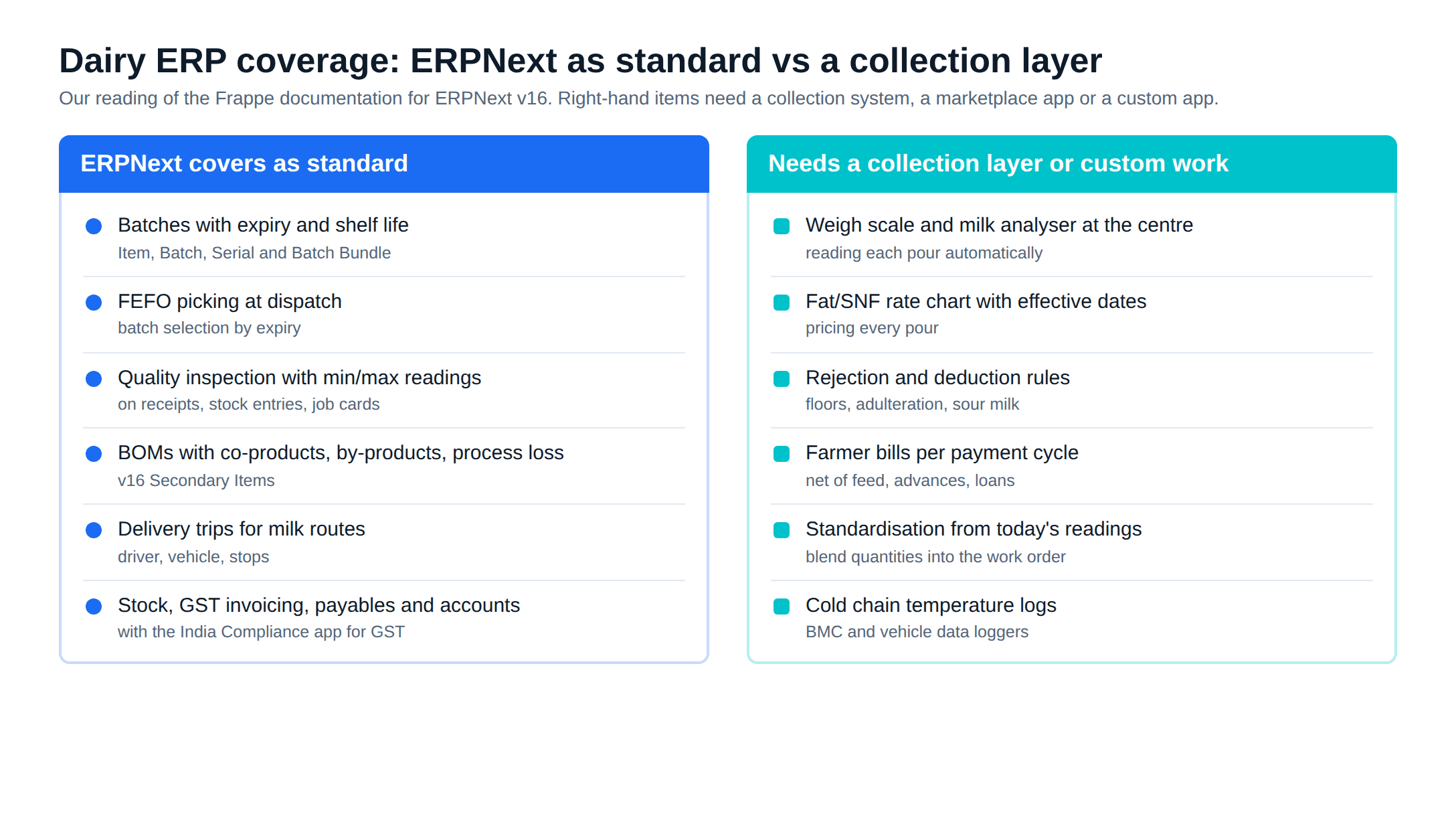
- ERPNext v16 covers batches with expiry, quality inspections with min/max readings, BOMs with co-products and by-products, delivery trips and the accounts. It does not ship a fat/SNF rate chart or a farmer billing cycle.
Free ERPNext fit check
Will ERPNext fit your factory?
Answer a few quick questions. On a short call we tell you whether ERPNext fits how you make, stock and sell, and what the rollout looks like.
Check my fit →What a dairy plant needs that a generic ERP does not
Our guide to ERP for food manufacturing in India covers what every food plant needs: lot numbers, expiry, recipes with loss, quality gates and a recall list. A dairy needs all of that, plus a procurement side that a snack or spice plant does not have.
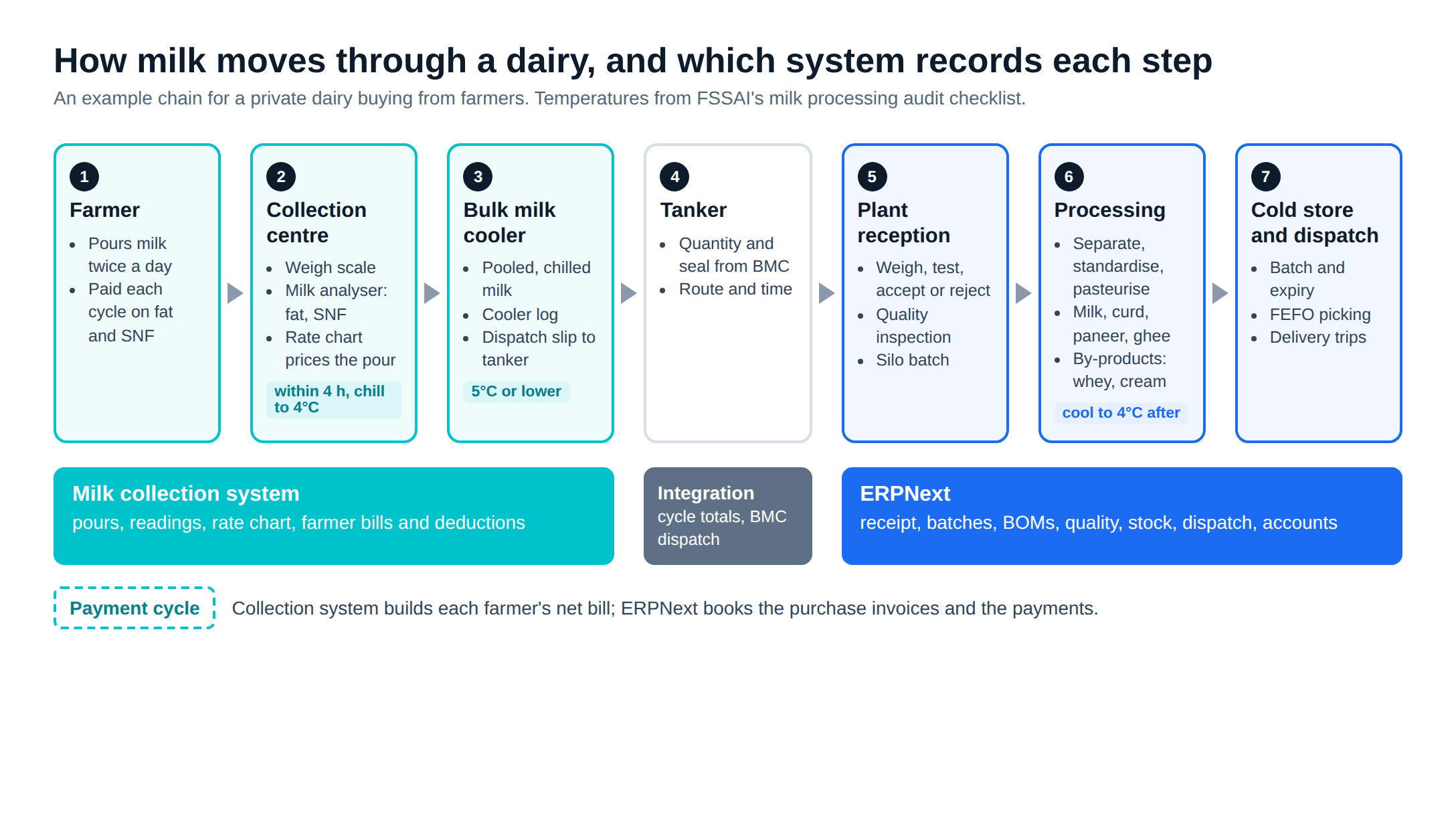
- Thousands of small suppliers: a spice plant buys from a few traders. A dairy buys from farmers, often twice a day, through village collection centres and bulk milk coolers (BMCs).
- Price set by composition: each pour is weighed and tested, and the price comes from its fat and SNF (solids-not-fat) readings, not from a purchase order.
- Farmer payments on a cycle: pours add up to a bill for the payment period, less advances and feed or other supplies, and the net is paid to the farmer's bank account.
- Chilling and tankers: milk is cooled within hours and kept cold through the BMC, the tanker and the plant silo.
- One input, many outputs: raw milk is separated into cream and skim, standardised to a fat and SNF target, and turned into products with by-products: whey from paneer, ghee residue from ghee.
- Shelf life in days: pasteurised milk and curd have a short life, so dispatch picks the earliest expiry first and the plant needs to know each morning what will expire before it sells.
FSSAI rules that shape the records
FSSAI's audit checklist for milk and milk product processing, used by food safety auditors, turns several rules into yes-or-no questions. The ones that decide what your systems must record:
- Milk is brought to the collection centre within 4 hours and immediately chilled to 4°C or lower.
- Raw milk received through bulk chilling centres is kept at 5°C or lower. Milk brought straight to the plant by farmers should reach it within 4 hours of milking and be cooled to 5°C or lower as quickly as possible.
- Pasteurisation time and temperature are maintained (the checklist gives 72°C for 15 seconds for HTST as the ideal), and milk is cooled to 4°C or lower right after pasteurisation. Time and temperature are monitored and recorded.
- Incoming material is procured from approved vendors with records of supplier, batch number and quantity, and milk is inspected at receipt.
- Storage follows FIFO and FEFO (first expired, first out).
- Documentation and records are kept for one year or the product's shelf life, whichever is more.
Note the two temperatures: 4°C at a collection centre, 5°C for milk through bulk chilling centres. The checklist is an audit tool, not the regulation, so confirm the current text of Schedule 4 of the FSS licensing regulations with your food safety consultant.
For recall, FSSAI's food recall guidelines ask covered operators for distribution records with batch code, lot number and traceability from raw material to finished good.
Fat and SNF pricing: how a two-axis rate chart works
Milk with more fat and more SNF makes more paneer, ghee or standardised milk, so dairies pay for those solids. Two-axis pricing sets one rate for each kg of fat and another for each kg of SNF. A National Dairy Research Institute thesis on milk pricing records that NDDB first proposed it for cow milk in a 1970 report for the planned Bangalore dairy, and that SNF was valued at two-thirds of fat because skim milk powder sold at about two-thirds of the value of ghee. The same thesis notes that buffalo milk in the cooperative sector is priced on fat alone, so a chart can have more than one basis.
The arithmetic for one pour:
- Fat in the pour (kg) = milk (kg) × fat % ÷ 100
- SNF in the pour (kg) = milk (kg) × SNF % ÷ 100
- Value = fat kg × fat rate + SNF kg × SNF rate
A worked example (hypothetical rates)
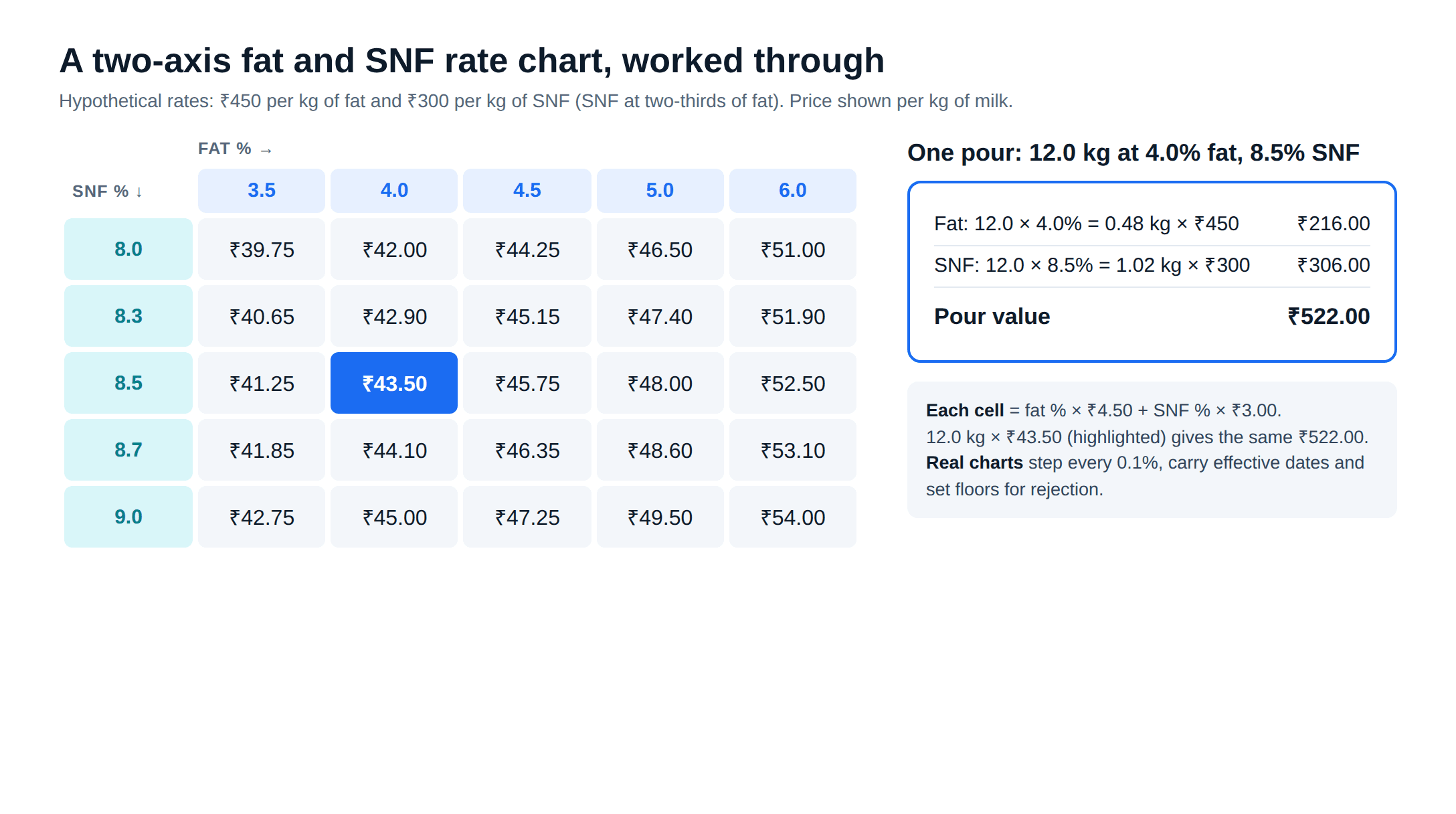
Picture a dairy that pays ₹450 per kg of fat and ₹300 per kg of SNF, keeping the two-thirds ratio. These rates are invented for the example; your own chart, set by your procurement team and your local market, will differ.
A farmer pours 12.0 kg of milk testing 4.0% fat and 8.5% SNF.
- Fat: 12.0 × 4.0 ÷ 100 = 0.48 kg, worth 0.48 × ₹450 = ₹216.00
- SNF: 12.0 × 8.5 ÷ 100 = 1.02 kg, worth 1.02 × ₹300 = ₹306.00
- Pour value: ₹522.00, or ₹43.50 per kg of milk
Run the formula for each pair of readings and you have the rate chart the collection centre uses. Per kg of milk, each cell is (fat % × ₹4.50) + (SNF % × ₹3.00).
Three details a dairy ERP or collection system must handle, beyond the formula:
- Effective dates: rates change, sometimes mid-cycle, so each pour is priced at the chart in force on its date and shift.
- Rejection and deduction rules: milk below a minimum fat or SNF, or failing an adulteration or sourness test, is rejected or paid less, by the dairy's own rules.
- Litres or kg: fat and SNF percentages are by weight, so a centre that measures litres needs a conversion factor in the rules.
Why standardisation matters on the plant side: the FSS standards set minimum fat and SNF for each class of packaged milk. A Consumer Voice test of packaged toned milk, which followed the FSS Regulations, lists the minimums as 3.0% fat and 8.5% SNF for toned milk, 1.5% and 9% for double-toned and 6.0% and 9% for full-cream milk. The plant blends raw milk, skim milk and cream to hit those targets.
Where ERPNext fits: processing, batches, quality and accounts
Inside the plant, a dairy is a food plant on a short clock. ERPNext v16 covers most of that work as standard.
Batches and shelf life
ERPNext's Item documentation has a Has Batch No option that reveals batch number and expiry settings, and a Shelf Life in Days field. The Batch documentation says a batch shows as Expired after its expiry date. The Serial and Batch Bundle documentation lets the user pick batches by FIFO, LIFO or expiry, which is the FEFO picking FSSAI's checklist asks for. A silo of raw milk, a tank of pasteurised milk and a day's paneer can each be a batch.
Quality inspection with readings
The Quality Inspection documentation describes templates with numeric parameters, each with a minimum and maximum value; a reading outside the range is set to Rejected on save. Inspections can be raised against a Purchase Receipt, Delivery Note, Stock Entry or Job Card, among others. That covers tanker receipt (temperature, fat, SNF, acidity, adulteration tests), pasteuriser checks through a Job Card, and finished goods before dispatch.
BOMs with by-products and process loss
Separating milk gives cream and skim; making paneer leaves whey. In v16 the BOM's scrap table became Secondary Items, which adds co-product and by-product types. The documentation says each secondary item can carry a process loss percentage and a share of the raw material cost. A paneer BOM can show whey as a by-product with a value, and a cream separation step can give cream and skim milk as main product and co-product, with the raw milk cost split between them. The BOM documentation also supports percentage-based recipes, where each row is a percentage of the output quantity.
One gap to plan for: a BOM holds fixed ratios. Standardisation depends on the fat and SNF of today's raw milk, so the blend changes every batch. We found no ERPNext feature that calculates the blend from test readings. A small custom calculation that reads the silo's latest inspection and writes the blend quantities into the work order is what we would scope for it. How BOMs feed work orders and the purchase list is in our guide to production planning, BOM and MRP in ERPNext.
Dispatch, routes and accounts
The Delivery Trip documentation says a delivery trip records customer deliveries in one vehicle, with a driver, stops linked to delivery notes and a Google Maps route. That suits the morning milk route. The page does not mention temperature, so a reefer's temperature log comes from the vehicle's own data logger.
Accounts, GST invoicing through the India Compliance app, stock valuation and payables are standard ERPNext; our ERPNext pricing guide covers the yearly running cost.
What needs a milk collection system
The procurement side is where ERPNext needs help. Its standard documents expect a supplier, an item, a quantity and a rate. They do not read a weighing scale and a milk analyser at a village centre, apply a fat/SNF chart, or build a ten-day bill for each of, say, 3,000 farmers with feed advances deducted.
There are three ways to fill the gap. A product sold as dairy software or dairy management software can be any of the three, so ask which one you are being shown.
A dedicated collection system
Milk collection software at the centre or BMC that reads the scale and analyser, prices each pour and runs the farmer bill. NDDB's AMCS is one example, built for cooperative societies. Each cycle's totals post to ERPNext as purchase invoices and payments.
A marketplace dairy app
The Frappe Cloud Marketplace lists a paid Dairy Management app with procurement, analyser and scale integration and fat/SNF calculation. Check version support and see it run your rate chart first.
A custom Frappe app
Your own doctypes for collection centre, pour, rate chart with effective dates and farmer bill, built as an app so ERPNext upgrades stay clean. The most control, and the most to maintain.
NDDB describes its AMCS application as cooperative-society software that integrates the weigh scale and milk analyser, manages rates with an audit trail, tracks bulk milk cooler operations and runs periodic milk billing net of advances, with payment to the pourer's bank account. It is built for cooperatives, so a private dairy should ask how it fits.
The Dairy Management app on the Frappe Cloud Marketplace also lists an RMRD (raw milk reception dock) cycle, vehicle tracking and formula-based CLR, SNF and fat calculation. It is listed as paid, under GPL v3, for ERPNext versions 14 and 15, and the source link on the listing did not open for us. ERPNext's current major version is 16, so ask the publisher about v16 first.
Whichever route you pick, the integration needs its own design. Decide early what crosses the line: per-pour detail or cycle totals per farmer; who owns the farmer master; how a rejected can, a rate correction or a reversed payment flows back. Our ERPNext implementation work starts with that line drawn on paper, before any setup.
A scoping checklist for a dairy ERP
Take this list into every vendor meeting, and ask for each item to be shown on a test site with your own data.
- Number of collection centres and BMCs, pours per day, and whether centres are online or sync later.
- Your rate chart as a file, with fat and SNF steps, floors, rejection rules and how often it changes.
- Payment cycle length, deductions (feed, advances, loans) and the bank upload format your bank accepts.
- Which system owns the farmer master and the farmer bill, and what posts to ERPNext each cycle.
- Tanker receipt at the plant: tests recorded, temperature, quantity variance against the BMC dispatch.
- Batch and shelf-life rules for silos, pasteurised milk and each product.
- BOMs with co-products, by-products and process loss from your own trial batches, and how standardisation quantities come from the day's readings.
- FEFO picking at dispatch, a daily report of stock expiring before it can sell, and route returns of crates and unsold stock.
- A mock recall from one finished batch back to the tanker and BMC, and forward to every customer.
Frequently asked questions
What is the difference between a dairy ERP and milk collection software?+
Milk collection software runs at the village collection centre or bulk milk cooler. It reads the weighing scale and milk analyser, applies the rate chart, and builds each farmer's bill for the payment cycle. A dairy ERP runs the plant: receipt of chilled milk, processing into milk, curd, paneer and ghee, batches and expiry, quality checks, dispatch and the accounts. A dairy that buys straight from farmers needs both, joined by an integration that posts each cycle's totals into the ERP.
Can ERPNext calculate milk prices from fat and SNF?+
Not out of the box. ERPNext stores item prices and can record fat and SNF readings in a quality inspection, but it has no rate chart that turns a fat and SNF reading into a per-kg price for each farmer pour. That needs a custom app, a marketplace dairy app, or a separate collection system that sends priced totals to ERPNext.
How cold must milk be kept under FSSAI rules?+
FSSAI's audit checklist for milk processing says milk brought to a collection centre within 4 hours should be chilled immediately to 4°C or lower, milk received through bulk chilling centres should be kept at 5°C or lower, and milk is cooled to 4°C or lower right after pasteurisation. The checklist also asks that records be kept for one year or the product's shelf life, whichever is more.
Is there a ready-made ERPNext app for dairies?+
The Frappe Cloud Marketplace lists a paid Dairy Management app that covers milk procurement, analyser and weighing scale integration and fat and SNF calculation, for ERPNext versions 14 and 15. ERPNext's current major version is 16, so ask the publisher about v16 support and see a demo on your own rate chart before you plan around it.
Related reading
- ERP for food manufacturing in India: batches, expiry, recipes and the FSSAI recall drill.
- Production planning, BOM and MRP in ERPNext: from sales order to work order.
- ERPNext pricing in India: the yearly cost of running it.
- ERPNext integrations in India: Tally, GST, WhatsApp, payments and the shop floor.
Free ERPNext fit check
Will ERPNext fit your factory?
Answer a few quick questions. On a short call we tell you whether ERPNext fits how you make, stock and sell, and what the rollout looks like.
Check my fit →About the author

- Tags
- erpnext
- erp
- manufacturing
- india
- food beverage
Subscribe to Our Newsletter
The AI Build Brief: practical playbooks on how to build, price and ship AI features, in one short email every other week.