

Picture a 150-person auto components plant in Manesar. Tally and Excel have run out of road, the parent company in Pune mentions SAP, and a reseller has quoted SAP Business One (SAP B1). Someone else in the room says ERPNext does the same job without a licence fee. Who is right? This post compares ERPNext vs SAP Business One for a 50-300 person Indian plant, point by point, from each vendor's own documentation. Metageeks implements ERPNext. We do not sell SAP, so weigh our view with that in mind. Where SAP is the better pick, we say so.
TL;DR
- Both cover BOMs, production orders and MRP. ERPNext adds job cards per operation and a documented subcontracting flow; for job work in SAP Business One, check whether you need an add-on.
- SAP Business One is sold through resellers, per user. We could not find an India list price from SAP, so every SAP cost in this post is "ask for a quote". ERPNext has no licence fee.
- SAP Business One runs on SAP HANA or Microsoft SQL Server, on your servers or hosted by a reseller. ERPNext runs on Frappe Cloud or on any Linux server you control.
- Both handle GST, TDS, e-way bills and e-invoicing for India, through SAP's localisation and Electronic Document Service, or through the free India Compliance app.
- Pick SAP when your parent company, a key customer or an add-on you depend on ties you to it. Otherwise ERPNext saves the licence line and is easier to change in-house.
Free ERPNext fit check
Will ERPNext fit your factory?
Answer a few quick questions. On a short call we tell you whether ERPNext fits how you make, stock and sell, and what the rollout looks like.
Check my fit →ERPNext vs SAP Business One at a glance
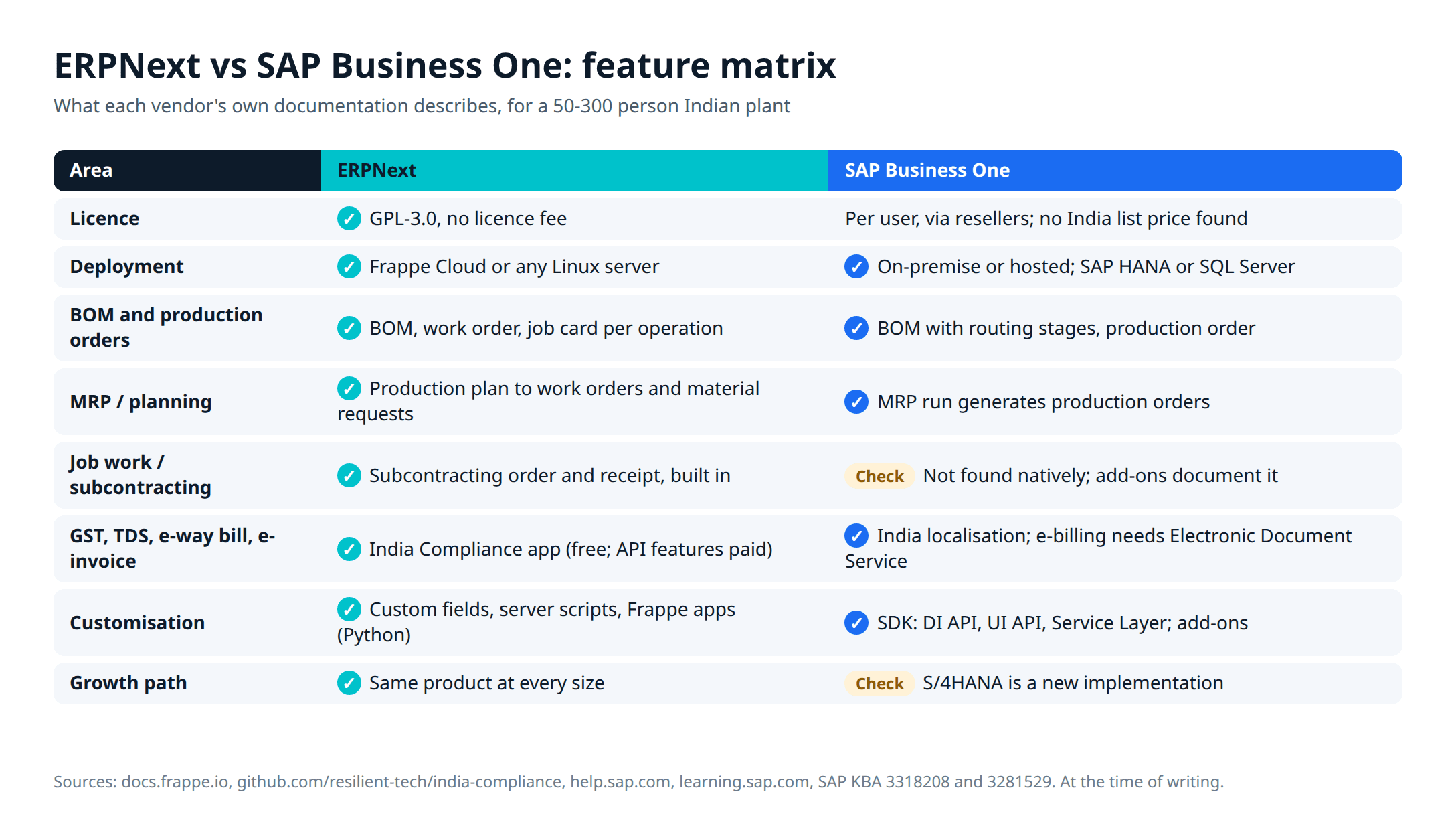
| Area | ERPNext | SAP Business One |
|---|---|---|
| Licence | GPL-3.0, no licence fee | Per-user licences sold by resellers; no India list price found |
| Deployment | Frappe Cloud or any Linux server | On-premise or reseller-hosted, on SAP HANA or SQL Server |
| Manufacturing | BOM, work order, job card, production plan, subcontracting | BOM, production order, MRP, routing stages |
| India compliance | India Compliance app: e-invoice, e-way bill, GSTR-1 | SAP India localisation: GST, TDS, TCS, e-way bill, e-billing |
| Customisation | Custom fields, scripts, Frappe apps in Python | SDK (DI API, UI API), Service Layer, third-party add-ons |
| Growth path | Same product at every size | Re-implementation to S/4HANA |
For the wider field, including Odoo, Business Central and Zoho, see our best ERP for manufacturing in India shortlist.
Licensing: no fee vs a reseller quote
ERPNext is published under GPL-3.0. There is no paid edition and no per-user charge, so adding the stores clerk or a second shift supervisor costs nothing in licences. You pay for hosting, implementation and support, which ERPNext pricing in India breaks down.
SAP Business One is sold through SAP's reseller network. SAP's own terms for resellers that host Business One say the reseller orders subscriptions from SAP per end user and sets its own prices for the end customer. We could not find a Business One list price for India on SAP's site or in its documentation, and SAP's site refused our automated checks while we re-checked for this post. So we print no SAP figure. Ask the reseller for licence, database, add-ons, implementation and annual maintenance as separate lines, and ask whether you are buying perpetual licences or a subscription.
Deployment: HANA or SQL Server vs Linux and the cloud
SAP Business One comes in two versions: one on Microsoft SQL Server and one "version for SAP HANA". SAP's platform support matrix lists SUSE Linux Enterprise Server 15 for the HANA server, and Google Cloud's planning guide confirms SAP supports both databases there, with you bringing your own licence. You run it on your own servers, in a cloud account you rent, or as a subscription hosted by the reseller.
ERPNext runs on a standard Linux stack. Frappe Cloud lists shared sites from ₹410 a month and servers from ₹3,600 a month at the time of writing, or you install it yourself; our ERPNext v16 production install guide covers that path. Either way you hold the full database.
Manufacturing depth
In SAP Business One, SAP's production course describes a production order as "a command to produce (or repair) a production item", sitting in planning until it is released. Components go out on an Issue for Production document, manually or by backflush, and finished goods come in on a Receipt from Production. BOMs can carry routing stages with resources, and production orders can be generated from the MRP run. For job work, we did not find a native feature in SAP's Business One help. Add-ons such as ProcessForce document their own subcontracting flows, so ask the reseller whether your job work needs one and what it costs.
In ERPNext, a BOM holds materials and operations. A Work Order releases it to the floor, and Job Cards record each operation, its time and its operator. A Production Plan turns sales orders into work orders and material requests. Subcontracting is built in: a Subcontracting Order pulls raw materials from the BOM, a "Send to Subcontractor" stock entry moves them to the supplier's warehouse, and the Subcontracting Receipt works "like a backflush for subcontracting". That covers the job work flow behind ITC-04 reporting.
Planning is where both need a hard look. ERPNext's capacity planning places operations against workstation hours, with no optimiser that resequences jobs. SAP's course describes resource capacity and four ways to calculate routing dates, which is scheduling by date, not an optimiser either as far as that page goes. If your floor needs jobs resequenced around breakdowns and rush orders, test that on a trial, or plan for a separate tool beside either ERP, as our MES vs ERP post explains.
India localisation: GST, TDS and e-invoicing
SAP's knowledge base article 3318208 is its handbook for Indian localisation in Business One, covering GST, GST returns, TDS, TCS, the e-way bill and e-billing. SAP's e-billing guide says electronic billing depends on the Electronic Document Service being installed and set up.
For ERPNext, the free India Compliance app adds e-invoice and e-way bill integration with the government portal, GSTR-1 preparation and purchase reconciliation against GSTR-2A and 2B. Its government API features need a paid India Compliance account. TDS is part of ERPNext's own accounting.
On both, the question is the same: who holds the GSP credentials, and who answers when the portal rejects an invoice? Our e-invoicing from your ERP post covers what to automate first.
Customisation model
SAP lists three APIs for Business One in knowledge base article 3281529: the DI API, the UI API and the Service Layer API. The Service Layer is available for both HANA and SQL Server. Add-ons from different vendors run side by side against these APIs, and that article is SAP's checklist for troubleshooting them. Ask the reseller who writes and maintains SDK code for you, and whether that code is yours.
ERPNext changes come in layers. Customize Form and custom fields need no code. Server scripts add rules in Python from the browser. Anything larger goes in a separate Frappe app, which keeps your changes apart from the core and makes upgrades testable. The source code is public, so any Python developer can read what the system does. Our ERPNext development page describes how we build those apps.
Ecosystem and upgrades
SAP Business One is sold and supported by resellers, with third-party add-ons for specific industries. ERPNext has Frappe, an open community and independent implementers whose quality varies. On both sides, the person who matters is the consultant who will run your project, so ask for a reference plant with a process like yours.
Upgrades work differently. SAP's upgrade strategy overview says SAP gives its resellers the upgrade tools and packages, and releases come as feature packages, service packages and patch levels. ERPNext has no upgrade fee, but Frappe's supported versions page shows each major version has an end of life: version 15 at the end of 2027 and version 16 at the end of 2029, both planned. Custom apps on either product need testing before each move.
The bigger question is what happens if the company triples. SAP's larger ERP is S/4HANA, and firms that implement both, such as LeverX, describe the move as "a new implementation rather than a direct system conversion", with add-ons and custom developments needing a fresh assessment. ERPNext is the same product at 50 users and at 500, so growth means more hardware and more configuration, not a new system.
Total cost drivers
We will not invent SAP prices, so the second figure compares what drives the bill, not the bill itself.
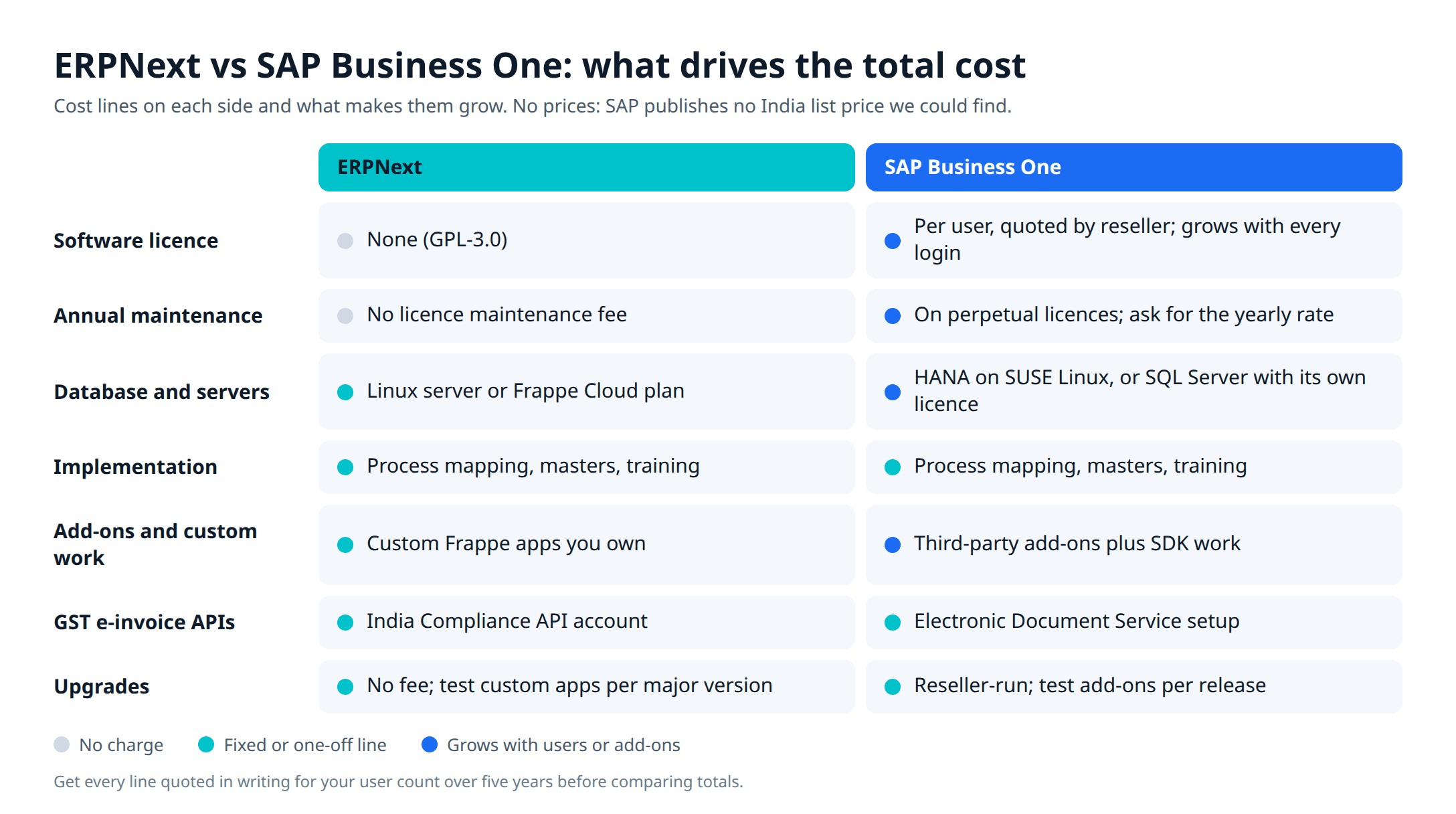
- Licences: none for ERPNext. SAP Business One charges per user, plus the database licence where it applies and annual maintenance on perpetual licences.
- Infrastructure: HANA needs a sized Linux server or a hosting subscription; SQL Server needs its own licensing. ERPNext runs on a modest Linux server or Frappe Cloud.
- Implementation: both need process mapping, masters, opening balances and training. ERPNext implementation cost in India gives market ranges with sources.
- Add-ons and customisation: third-party add-ons and SDK work on SAP; custom app development on ERPNext.
- Support and upgrades: both need someone on call and testing at each major version.
Example: picture a 120-person plant where 45 people need to log in. With SAP Business One, the licence line grows with every one of those 45 logins; with ERPNext it stays at zero, and the cost sits in setup and support instead. Whether that gap is large depends on the quote, which is why you need one.
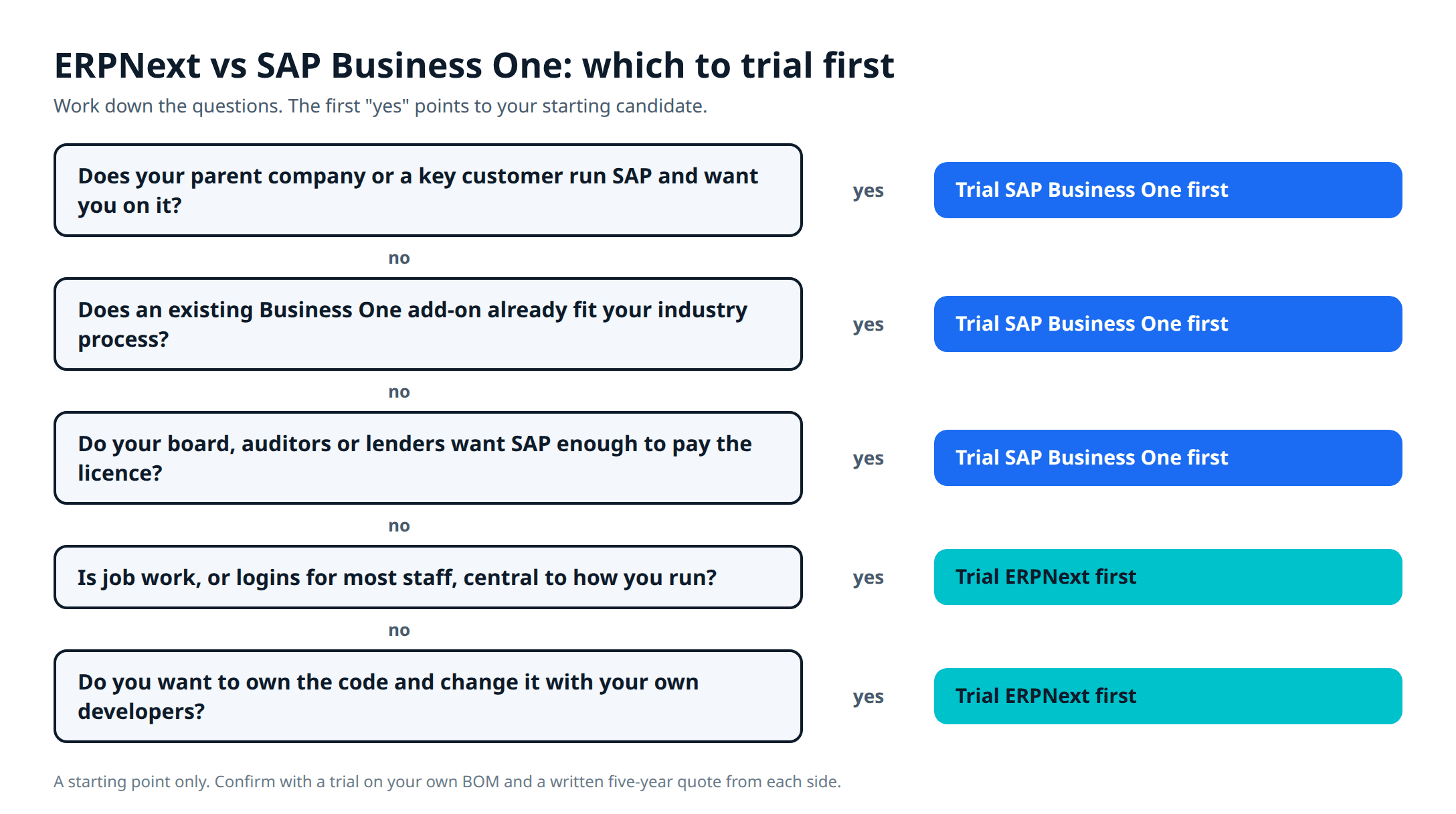
When SAP Business One is the better pick
Because we implement ERPNext, these are the cases where we would point a plant to SAP:
- Your parent company or a key customer runs SAP and wants your data in the same family, or plans to roll you onto S/4HANA later.
- An existing Business One add-on already fits your industry, and you would rather license it than build the same thing.
- Your board, auditors or lenders are more comfortable with SAP, and that comfort is worth the licence bill to them.
- The best local implementer near you is an SAP reseller who knows your industry. A strong team on SAP beats a weak team on ERPNext.
When ERPNext is the better pick
- You want no per-user licence, so everyone from the gate to the dispatch bay can log in.
- Job work and subcontracting are central to your process, and you want them in the standard product.
- You want to own the code and the database and choose your own support provider.
- You expect to keep changing processes and want changes made in Python by your own or a hired developer.
How to decide in two weeks
- Write down your five hardest processes: BOM depth, job work, batch or serial rules, quality checks and how you plan the floor.
- Run both on a trial with your own data: one real BOM, one job work cycle and one GST invoice through to e-invoice.
- Get a written five-year quote from the SAP reseller and the ERPNext implementer, with licence, database, hosting, add-ons, support and upgrades on separate lines.
- Ask each in writing who holds the GSP credentials and what data export you get if you leave.
If ERPNext comes out ahead, ERPNext implementation for manufacturers explains how Metageeks, an independent ERPNext implementer, scopes a plant before setup starts, and ERPNext support covers life after go-live. For the open-source alternative to both, read ERPNext vs Odoo, and for a blunt look at ERPNext's gaps, our ERPNext review.
Frequently asked questions
Is ERPNext cheaper than SAP Business One?+
On licences, yes: ERPNext has no licence fee, and SAP Business One licences are sold per user through SAP's resellers. SAP publishes no India list price for Business One that we could find, so get a written quote. Both still need implementation, hosting and support, and those lines can outweigh the licence, so compare five-year totals rather than licence alone.
Does SAP Business One handle GST and e-invoicing in India?+
Yes. SAP's India localisation handbook for Business One covers GST, GST returns, TDS, TCS, the e-way bill and electronic billing. SAP's e-billing guide says the feature depends on the Electronic Document Service being installed and set up, so ask your reseller who sets it up and who supports it.
Can ERPNext handle job work and subcontracting?+
Yes. ERPNext's Subcontracting Order pulls raw materials from the BOM, a Send to Subcontractor stock entry moves them to the supplier's warehouse, and a Subcontracting Receipt consumes them when finished goods come back. We did not find a native job work feature in SAP's Business One help, though third-party add-ons document one.
Can I move from SAP Business One to S/4HANA later?+
You can, but SAP resellers that sell both describe it as a new implementation rather than a direct system conversion, and add-ons and custom developments need a fresh assessment. Business One does not upgrade into S/4HANA the way one Business One release upgrades to the next.
When should a plant pick SAP Business One over ERPNext?+
When the parent company or a key customer runs SAP and wants your books in the same family, when you depend on a Business One add-on that already does what your process needs, or when your board and auditors are more comfortable with SAP. If none of those applies, ERPNext carries no licence bill and your own developers can change it.
Related reading
- Best ERP for manufacturing in India: six options, including SAP Business One, compared.
- ERPNext vs Odoo for Indian manufacturers: the two open-source options, with five-year costs.
- ERPNext pricing in India: hosting, support and what a licence-free ERP still costs.
- ERPNext implementation cost in India: market ranges for the work itself.
Free ERPNext fit check
Will ERPNext fit your factory?
Answer a few quick questions. On a short call we tell you whether ERPNext fits how you make, stock and sell, and what the rollout looks like.
Check my fit →About the author

- Tags
- erpnext
- erp
- manufacturing
- india
- comparison
Subscribe to Our Newsletter
The AI Build Brief: practical playbooks on how to build, price and ship AI features, in one short email every other week.