
Picture a plant owner in Ludhiana who has read three ERPNext review sites, each scoring it out of five with no explanation, and still cannot tell whether it will run a two-level BOM with job work to a plating vendor. This review is written for that owner. A disclosure first: Metageeks implements ERPNext and earns money when plants choose it. Read the gaps section with that in mind. Every product claim below links to Frappe's own documentation or the app's source.
TL;DR
- ERPNext's strengths for an Indian plant: no licence fee (GPL-3.0), real manufacturing depth (BOMs, work orders, job cards, subcontracting), GST e-invoicing and returns through the free India Compliance app, customisation without editing core code, and full ownership of your data.
- Its gaps: no scheduling optimiser, a learning curve for Tally users, a no-code report builder that covers one document type at a time, upgrade work when you have custom apps, uneven community apps, and a mobile story that is mostly the browser.
- Support quality depends almost entirely on the implementer, because there is no vendor helpdesk behind most installs.
- It fits 10-200 person plants with BOMs and job work and one person willing to own the system. It does not fit plants that need finite scheduling today or a single vendor on one invoice.
Free ERPNext fit check
Will ERPNext fit your factory?
Answer a few quick questions. On a short call we tell you whether ERPNext fits how you make, stock and sell, and what the rollout looks like.
Check my fit →How we wrote this ERPNext review
We are not neutral. We implement ERPNext and we do not resell Odoo, SAP or Microsoft. So we checked each claim against Frappe's documentation or the relevant GitHub repository, not memory. We scored areas against what a 10-200 person Indian plant asks of an ERP, not against an enterprise checklist. We left out star ratings from review sites; the scorecard below is our opinion and says so.
The version reviewed is ERPNext v16, which Frappe's supported versions page lists as stable with planned end of life at the end of 2029.
Strength 1: no licence fee, and the data is yours
ERPNext is published under GPL-3.0. There is no paid edition and no per-user charge, so adding the stores team or a second shift supervisor does not add a licence line. The costs that remain are hosting, implementation, support and any custom work. ERPNext pricing in India breaks those down with hosting prices at the time of writing.
The licence has a second effect that matters more after five years than in the first month: you can run ERPNext on your own server, take a full database backup whenever you want, and move to another hosting provider or implementer without asking anyone's permission. With a subscription ERP, what you get when you leave is whatever the contract says. Our open-source ERP in India post covers what the licence does and does not promise.
Strength 2: manufacturing depth in the free product
The core manufacturing chain is all in the standard product:
- A BOM holds components, quantities and operations, with multi-level sub-assemblies. In v16, scrap is recorded as secondary items.
- A Work Order releases a BOM to the floor and tracks material transfer and finished output.
- Job Cards record each operation on a workstation, with time logs.
- A Production Plan turns sales orders into work orders and material requests.
- Batches carry expiry dates and quality inspections run at receipt, in process and at delivery.
Job work is the part Indian plants ask about most. ERPNext's subcontracting flow creates a Subcontracting Order from a subcontracted purchase order, moves raw material to the supplier's warehouse with a "Send to Subcontractor" stock entry, and consumes it on the Subcontracting Receipt, either by the BOM or by what was actually transferred. In practice, that means a plant can see how much of its own copper or polymer is sitting at each job worker, which a Tally setup tends to leave to a spreadsheet. The GST side of job work is covered in our ITC-04 and job work guide.
How it compares with the alternatives on the same tasks is in our best ERP for manufacturing in India shortlist.
Strength 3: GST compliance through India Compliance
India-specific tax features sit in a separate free app, India Compliance, also GPL-3.0. Its README lists e-invoice and e-way bill generation through the NIC portal, "automated return preparation" for GSTR-1, invoice management for GSTR-3B, purchase reconciliation against GSTR-2B and GSTR-2A, and GSTIN validation against government APIs.
Two caveats. The README says "there are some costs associated with these APIs", and some automation needs an India Compliance account, so budget for API credits. And because it is a separate app, it has its own release cycle that has to stay in step with ERPNext's. Our e-invoice and e-way bill from your ERP post covers the setup.
Strength 4: customisation without editing core code
Most changes a plant needs can be made without touching ERPNext's own code. Customize Form adds custom fields, changes labels and layouts, and sets print formats from the browser. Server Scripts run Python on document events or as API endpoints. Note that from v15 they are disabled by default and Frappe Cloud allows them only on a private bench, per the same page.
Anything bigger, such as new document types, integrations or a shop-floor screen, goes into a separate custom app. Keeping changes out of the core is what makes upgrades possible later, and it is the first thing we check when we take over an existing install. This is the work our ERPNext development team does.
Gap 1: scheduling is capacity-aware, not optimised
ERPNext's capacity planning allocates each operation to a workstation when the work order is submitted, against the workstation's working hours. The documentation also says "each operation should start and end on the same day", so long operations have to be split. What it does not describe is an optimiser that resequences many orders across machines to cut changeovers or hit due dates.
For a plant whose bottleneck is materials, that is fine. For an injection moulding shop with 30 moulds competing for eight presses and colour changeovers that depend on sequence, it is a gap that needs either a scheduling tool on top or a different ERP. Our production planning software for small plants post explains how to tell which situation you are in.
Gap 2: a learning curve for Tally users
This one is our opinion from training sessions, not a measured fact. ERPNext asks users to think in documents that link to each other: a purchase order becomes a purchase receipt, then a purchase invoice. An accountant used to Tally's voucher entry and keyboard shortcuts will find the first few weeks slower, and stores staff who never used a system will need role-specific training. What helps: trimmed workspaces per role, fewer visible fields, and a few hours of training on the plant's own transactions.
Gap 3: the no-code report builder has limits
The Report Builder is useful: pick columns, filter, group by and sum, save the view. But Frappe's documentation says it shows "the records of single DocType as well as child records of Child Tables". A report that joins work orders, job cards and purchase receipts in one view needs a Query Report or a Script Report, and Script Reports need developer mode, an administrator and Python. Plan for a handful of custom reports in any implementation.
Gap 4: upgrades take work once you have custom apps
There is no upgrade fee, but major versions do reach end of life: Frappe lists v14 as ended on 31 January 2026 and v15 as ending at the end of 2027. Every custom app and every Server Script has to be tested against the new version before you move. The cleaner your customisation, the cheaper this is. Installing ERPNext v16 for production covers the bench setup that makes staging upgrades practical.
Gap 5: community apps vary in quality
The Frappe Cloud marketplace and GitHub hold many third-party apps. Some are well maintained; others were written for one version and left. Before installing one, check who maintains it, when it was last updated, and whether it supports your ERPNext version. An unmaintained app can block your next upgrade.
Gap 6: support depends on who you hire
Most ERPNext installs run without a vendor helpdesk behind them. Frappe sells support with its own hosting plans, but for a self-hosted system or one built by a third party, the quality of help you get is the quality of your implementer. Ask for named consultants, response times in writing and a reference plant with a similar process. ERPNext support sets out how we handle this after go-live.
Gap 7: mobile is mostly the browser
Frappe's mobile page describes ERPNext as responsive and usable in a phone browser across all modules, rather than a dedicated native app. That works for approvals and lookups. For barcode scanning in the store or offline use on a shop floor with poor Wi-Fi, expect to test carefully or build something. Third-party apps exist, but they are not Frappe's, so check them before rollout.
ERPNext scorecard by area (our opinion)
These scores are ours, for a 10-200 person Indian plant, based on the documentation above and our implementation work. They are not user ratings.
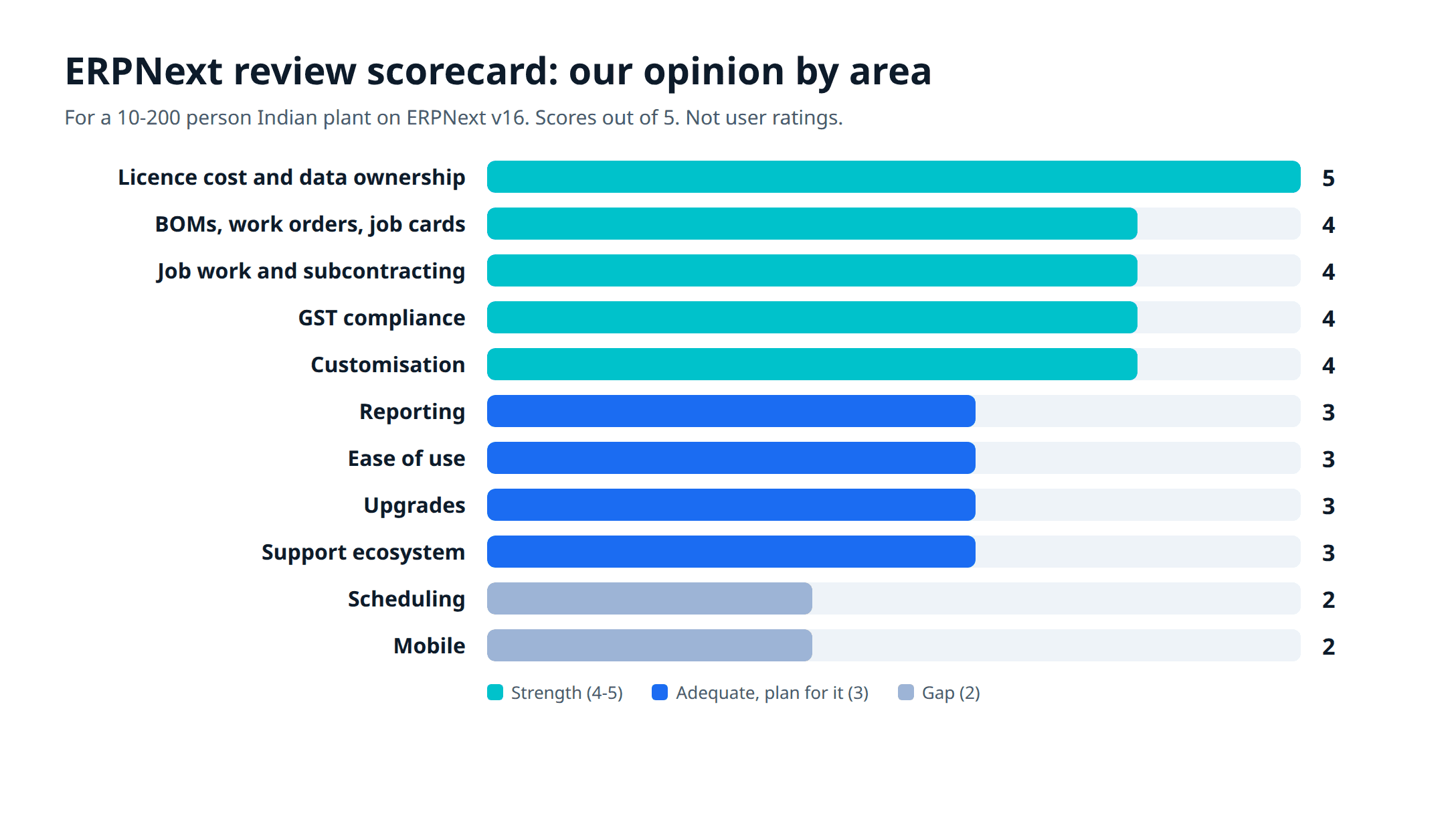
| Area | Our score (out of 5) | Why |
|---|---|---|
| Licence cost and data ownership | 5 | GPL-3.0, no per-user fee, full database access |
| BOMs, work orders, job cards | 4 | Complete chain in the standard product |
| Job work and subcontracting | 4 | Supplier warehouse tracking and backflush |
| GST compliance | 4 | India Compliance app; API credits extra |
| Customisation | 4 | No-code forms, scripts and custom apps |
| Reporting | 3 | Report Builder is single-document; joins need code |
| Ease of use | 3 | Document-flow thinking takes training |
| Upgrades | 3 | Free, but custom apps need testing |
| Support ecosystem | 3 | Depends on the implementer |
| Scheduling | 2 | Capacity-aware, no optimiser |
| Mobile | 2 | Responsive browser; native apps are third-party |
Who ERPNext fits, and who it does not
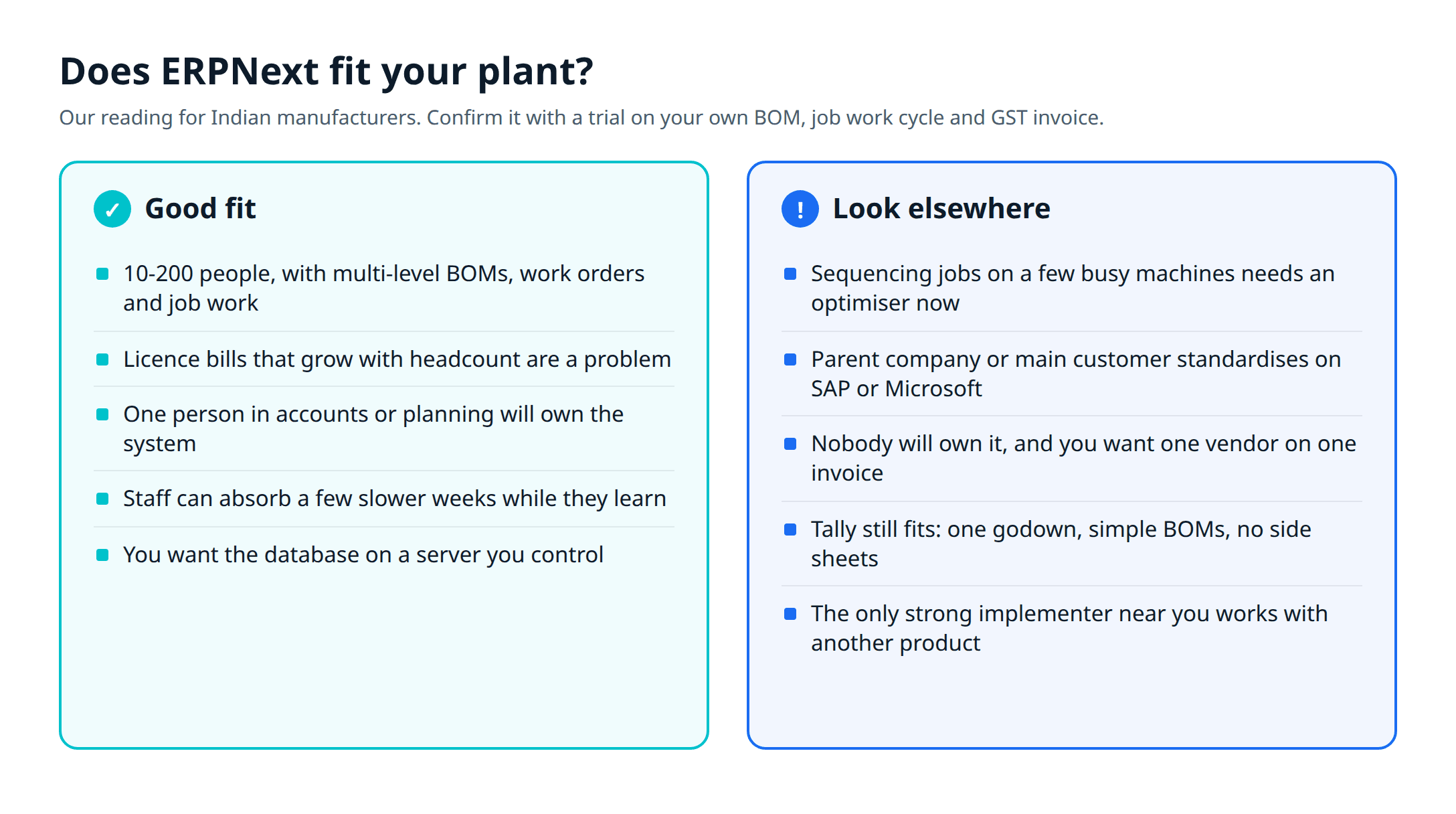
ERPNext fits a plant that:
- Has 10-200 people, with BOMs, work orders and job work it cannot track in Tally
- Wants to stop paying more each time it adds a user
- Has one person, often in accounts or planning, who will own the system after go-live
- Can tolerate a few weeks of slower data entry while staff learn the document flow
- Wants its data on a server it controls
Look elsewhere if:
When we would not recommend ERPNext
- Your bottleneck is sequencing jobs on a few busy machines and you need a scheduling optimiser now
- Your parent company or main customer standardises on SAP or Microsoft
- Nobody in the plant will own the system, and you want one vendor on one invoice
- Tally still fits: one godown, simple BOMs and no side spreadsheets
- The only strong implementer near you works with another product
If Odoo is the other name on your list, ERPNext vs Odoo compares the two on planning, GST and five-year cost.
The verdict
For a 10-200 person Indian plant with real BOMs and job work, ERPNext is the product we would put on a trial first. No per-user fee plus BOMs, job cards and subcontracting in the free product is hard to match at that size. It is not the right pick when the floor needs an optimiser or the business wants a vendor rather than a system it owns. Test it on one real BOM, one job work cycle and one GST invoice before you decide.
If it passes, ERPNext implementation explains how Metageeks, an independent ERPNext implementer, scopes a plant before setup starts.
Frequently asked questions
Is ERPNext good for manufacturing?+
For a discrete or batch plant of roughly 10-200 people, yes. It covers BOMs, work orders, job cards, subcontracting, batches and quality inspection in the free product. Its weak area is detailed scheduling: it slots operations into free workstation time but has no optimiser that resequences jobs across machines.
Is ERPNext really free?+
The software is. ERPNext is published under the GPL-3.0 licence with no paid edition and no per-user fee. You still pay for hosting, implementation, training, support and any custom development, and the India Compliance app's government API calls carry a cost.
Does ERPNext handle GST e-invoicing and e-way bills?+
Yes, through the free India Compliance app. Its documentation lists e-invoice and e-way bill generation with the NIC portal, GSTR-1 preparation, GSTIN validation and purchase reconciliation against GSTR-2A and GSTR-2B. Some of these features need an India Compliance account and API credits.
What are the main disadvantages of ERPNext?+
In our experience: no finite-capacity optimiser, a learning curve for users who come from Tally, a no-code report builder that works on one document type at a time, upgrade testing when you have custom apps, uneven quality among community apps, and support that is only as good as the implementer you pick.
Is there an ERPNext mobile app?+
Frappe presents ERPNext's mobile access as a responsive web interface that runs in the phone's browser and covers all modules. Third-party Android and iOS apps exist, but they are not published by Frappe, so check their permissions, reviews and maintenance before you rely on one.
Related reading
- ERPNext pricing in India: hosting, implementation and support costs.
- ERPNext vs Odoo: the two open-source ERPs compared for Indian plants.
- Best ERP for manufacturing in India: six options on one table.
- ERPNext tutorial for manufacturing: item master to first work order.
- Installing ERPNext v16 for production: the server setup.
Free ERPNext fit check
Will ERPNext fit your factory?
Answer a few quick questions. On a short call we tell you whether ERPNext fits how you make, stock and sell, and what the rollout looks like.
Check my fit →About the author

- Tags
- erpnext
- erp
- manufacturing
- india
- review
Subscribe to Our Newsletter
The AI Build Brief: practical playbooks on how to build, price and ship AI features, in one short email every other week.