
Picture a 50-person corrugated box plant in Manesar, or a flexible packaging unit in Daman, where every order is slightly different. New artwork, a box 10 mm longer, a laminate with one film swapped, and an estimator who works it all out in a spreadsheet only he understands. An ERP for packaging manufacturers has to cope with hundreds of job-specific items, quotes built from GSM, ply or microns, reels bought by the kilo, goods sold by the piece, and trim nobody records. This post covers corrugated boxes, mono cartons, flexible laminates and rigid plastic containers, and says which parts ERPNext v16 handles as standard and which need custom work.
TL;DR
- Packaging is make-to-order. Each customer size or artwork is its own item and BOM, so creating them has to take minutes.
- ERPNext covers alternate units of measure, item variants, multi-level BOMs with scrap, work orders, batches and subcontracting as standard. That handles reels by weight, multi-stage film jobs, lot traceability and job work for printing or lamination.
- The estimate that turns board GSM and ply, or film microns and layers, into a price and a BOM is not a standard ERPNext feature. Plan for a custom costing app or a controlled spreadsheet.
- Plastic packaging producers carry EPR obligations under the Plastic Waste Management Rules. The ERP should hold weight sold by EPR category and by brand-owner customer, so the CPCB return comes from records.
Free ERPNext fit check
Will ERPNext fit your factory?
Answer a few quick questions. On a short call we tell you whether ERPNext fits how you make, stock and sell, and what the rollout looks like.
Check my fit →What packaging plants need that a generic ERP setup misses
A default ERP setup assumes a fixed catalogue with stable BOMs, bought and sold in the same unit. Packaging breaks each assumption.
Every job is a new item
Quotes start from geometry
Bought by weight, sold by count
Trim and setup waste
Tooling per customer
Lot traceability and EPR
If you also run moulding, our guide to ERP for plastics manufacturers covers resin, regrind and machine job cards. For the broader question of whether a plant needs an ERP at all, start with ERP for manufacturing in India.
Job-specific items and BOMs per customer artwork
In ERPNext, an Item Variant is a version of a template item with different attributes, and the documentation says numeric attributes can use a range with an increment. A box template with length, width, height, ply and flute attributes can generate sizes without retyping. But you "cannot make Transactions against a Template", so every saleable size becomes a real variant.
Variants do not create the BOM. The Bill of Materials is still made per item, and the BOM Creator builds a multi-level BOM on one screen and generates the sub-assembly BOMs when you submit it. For a laminate, the tree runs printed PET, laminated roll, slit roll, pouch.
The Item master also has a customer reference code field, because "the Customer may identify an Item with a different Item Code". If your buyers send POs with their own part numbers, fill it in.
What ERPNext does not do is work out BOM quantities from the box or pouch dimensions. That is the estimate.
Quoting by GSM, ply, sheet size and microns
A packaging estimate is a chain of arithmetic. These two worked examples use stated assumptions; they are not a costing standard.
Example: a 5-ply corrugated box. A regular slotted carton of 400 x 300 x 250 mm. Blank length is 2 x (400 + 300) plus a 35 mm glue flap, so 1,435 mm. Blank width is height plus width (the top and bottom flaps), so 550 mm. Sheet area is 0.789 sq m. Take liners of 150, 120 and 150 GSM and two flutes of 120 GSM, with a flute take-up factor of 1.5 (an assumption; your corrugator's figure will differ). Board weight is 420 + 360 = 780 GSM, so the box weighs about 616 g before trim. Two blanks on a 1,150 mm reel use 1,100 mm and lose 50 mm, about 4.3% deckle trim.
Example: a printed laminate pouch. A 12-micron PET film laminated to 50-micron LDPE. Taking PET at about 1.4 g per cubic cm and LDPE at about 0.92, that is 16.8 + 46 GSM, plus an assumed 2.5 GSM adhesive and 1.5 GSM ink, so about 67 GSM. A three-side-seal pouch of 150 x 220 mm uses 0.066 sq m, about 4.4 g, or roughly 227 pouches per kg before waste. At an assumed 8% process waste, that drops to about 209.
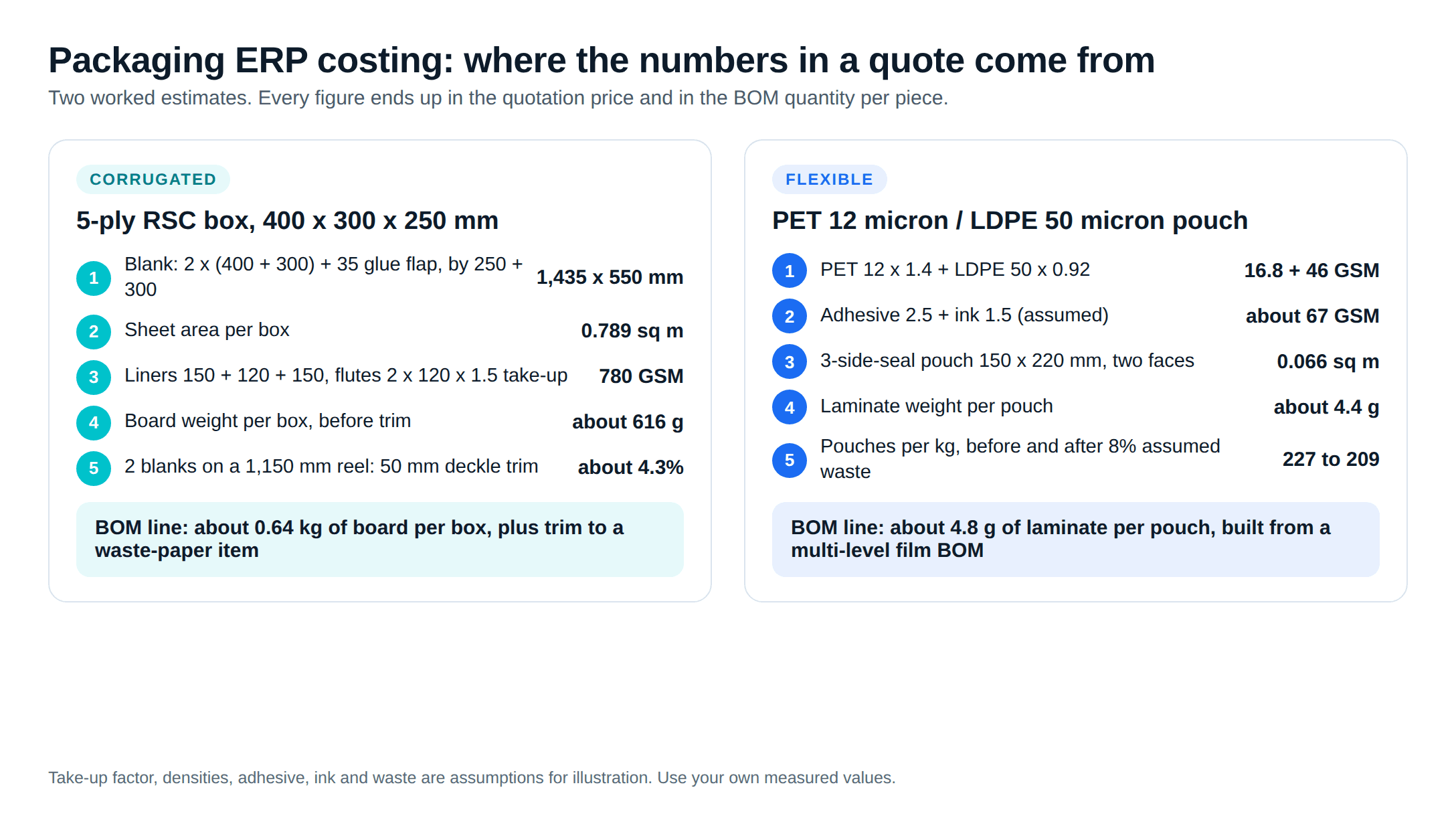
Each of those numbers belongs in two places: the quotation price and the BOM quantity of reel or film per piece. Keep them in separate files and they drift apart. ERPNext's BOM costs materials from valuation, last purchase or price list rates, plus operating cost from hourly rates. It has no form that takes ply, flute and dimensions, or film layers and microns, and returns board weight, trim, BOM and quote.
This is the part we would build as a small custom app on top of ERPNext: an estimate form that stores the spec, runs your plant's formulas, creates the variant and BOM, and drafts the quotation. That is custom ERPNext development work. We think it decides whether your estimator ever gives up the old spreadsheet. A cheaper start is a locked spreadsheet whose output is keyed into the BOM by hand.
Reels, rolls and multiple units of measure
ERPNext lets you add alternate units to an item with a conversion factor; the documentation's example is setting kilogram as an alternate unit for screws with a factor of 500. For packaging, that means kraft paper stocked in kg, boxes in pieces with a kg factor, and laminate in kg with a metre unit for slitting. The Item master's Weight Per Unit field gives dispatch weight for e-way bills.
The conversion factor sits on the item, though, not on each reel. Metres per kg vary with each reel's actual GSM. The workable pattern is to make each reel or roll a batch, receive it at its weighed kg, issue it by weight to the work order, and let the BOM's per-piece figure be corrected from actual consumption over time. If you need metres per reel tracked live, that is a custom field and a small calculation, not a standard feature.
Wastage, trim and process loss
The ERPNext BOM lets you enter a scrap percentage per raw material and list scrap items with a rate, for when trim is sold rather than thrown away. In v16 the documentation notes the Scrap Items table is replaced by Secondary Items. If the scrap item is the same as the item being made, ERPNext treats it as process loss and subtracts it from the output.
Deckle trim, side trim and setup sheets can land in a waste-paper item that is weighed and sold; slitting edge trim and printer start-up waste work the same way. Weigh it per job, and the gap between the estimate's assumed waste and the real figure becomes visible job by job, which is what feeds the next quote.
Multi-stage jobs and job work for printing and lamination
Flexible packaging runs as a chain: extrusion or bought-in film, printing, lamination, curing, slitting, pouch making. Corrugated runs through the corrugator, printing, die-cutting or slotting, and stitching or gluing. Each stage can be a sub-assembly in a multi-level BOM, run through a Work Order with job cards per operation.
When a stage goes outside, such as printing at a rotogravure printer or lamination at a converter, ERPNext's subcontracting flow records it. A Subcontracting Order follows the purchase order, a Send to Subcontractor stock entry moves the film out, and a Subcontracting Receipt brings back the printed material and scrap, backflushing what was used. Version 16 adds stock reservation and several Subcontracting Orders per purchase order.
Under GST, film or board sent this way goes on a job work challan under Section 143 of the CGST Act, inputs must come back within one year, and the movements are reported in ITC-04. Our ITC-04 and job work guide covers the limits and the tables. If you are the job worker, note that the subcontracting documentation describes outward subcontracting only. If customers send you their film to print, receive it as a customer-provided item through a Material Receipt and settle the flow in a trial.
Batch and lot traceability for food-contact packaging
The FSSAI Packaging Regulations, 2018 say plastic packaging materials must pass an overall migration limit of 60 mg/kg or 10 mg/dm² when tested as per IS 9845, and printing inks on food packages must conform to IS 15495. The regulations have been amended since 2018, so check the current consolidated text for your product.
A test report is only useful if you can tie it to what shipped. In ERPNext, batch items need a batch number on every stock transaction, from purchase receipt to delivery note. Batch the incoming film and ink, batch each printed and laminated roll, and the pouches dispatched to a customer can be walked back to the film lots and the test certificates attached to them. The feature is standard. Entering batches at every stage is the hard part.
Cylinders, plates and dies
Gravure cylinders, flexo plates and cutting dies belong to one artwork and one customer, and who paid for them decides how they are recorded. A plant-owned cylinder can be an item marked Is Fixed Asset. A cylinder the customer has paid for is better as a serialised stock item in a "customer tooling" warehouse, so the repeat order can find it and its storage location.
Revision control, the link from cylinder to artwork version, and the count of impressions before re-chroming are not standard fields. They take a few custom fields and a report.
EPR data for plastic packaging producers
Under the Guidelines on Extended Producer Responsibility for Plastic Packaging (Schedule II of the Plastic Waste Management Rules, notified as G.S.R. 133(E) on 16 February 2022), a Producer of plastic packaging is an obligated entity alongside importers and brand owners. The guidelines set four categories: rigid (I), flexible single or multilayer plastic (II), multilayered packaging with at least one non-plastic layer (III), and compostable sheets and carry bags (IV). Producers register on CPCB's centralised EPR portal, and registered entities "shall not deal with any entity not registered" through it.
What matters for an ERP is the Producer's target calculation. Its eligible quantity is the average weight of plastic packaging sold over the last two years, category-wise, plus pre-consumer plastic packaging waste, minus the quantity supplied to brand owners in the previous year. Annual returns are due by 30 June of the next financial year, and from 2025-26 the guidelines also set minimum recycled content: 30% for Category I, 10% for Category II and 5% for Category III, rising in later years. The rules have been amended since 2022, so check the current text and deadlines on the CPCB portal before you rely on any figure.
This is where a packaging ERP differs from a generic ERP for the plastic industry: the return depends on who you sold to. To build those figures from records, ERPNext needs an EPR category and plastic weight on each item, brand-owner status and EPR registration number on each customer, and a custom report of weight sold by category and customer type. The return is still filed on the CPCB portal.
What ERPNext v16 covers, and what needs custom work
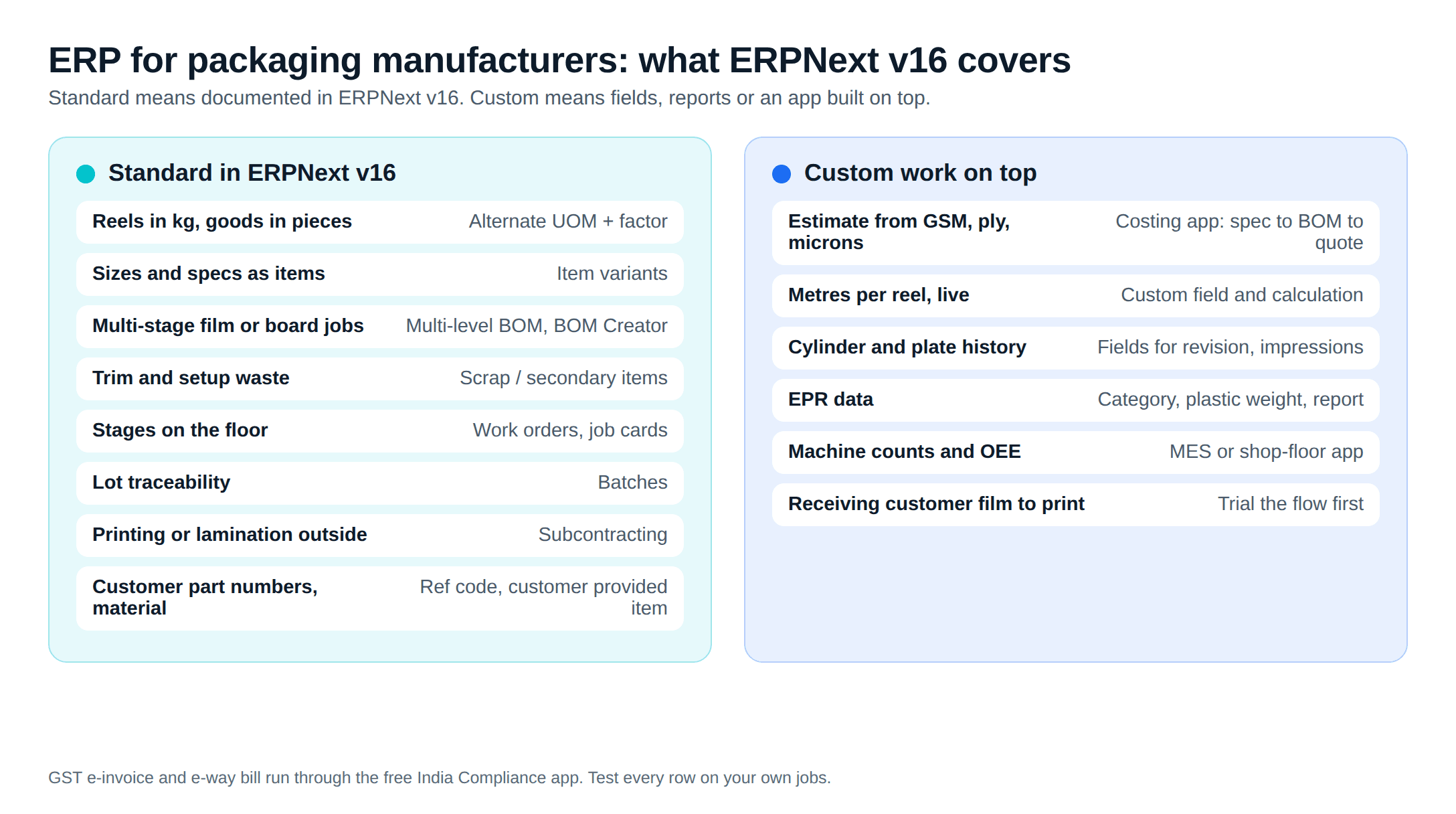
GST e-invoices and e-way bills come through the free India Compliance app; our e-invoice and e-way bill guide covers that side. For machine counts and uptime, read MES vs ERP before you assume the ERP should do it.
For a packaging plant, we would run a structured ERPNext implementation that puts the standard half live on real jobs first, then adds the estimate app. Our ERPNext implementation cost guide explains how to scope that in writing.
Questions to put to any packaging ERP vendor
Ask for these on your own jobs, not a demo company:
- Take one of our box or pouch specs and show me the variant, the BOM quantities and the quotation it produces.
- Receive three kraft reels or film rolls at their weighed kg, issue them to a work order, and show me the balance per reel.
- Show me trim and setup waste from a job landing as a saleable waste item, and the job cost with it.
- Send printed film to a job worker, bring it back with scrap, and show me the ITC-04 data.
- Trace one dispatched pouch back to its film lots and the test report.
- Find the cylinder for a repeat order, and show me who owns it.
- Produce plastic weight sold last year by EPR category and by brand-owner customer.
Metageeks is an independent ERPNext implementer in Delhi NCR. If you make boxes, cartons, laminates or containers, tell us how you quote today and how material moves through the floor, and we will tell you what runs as standard and what we would have to build.
Frequently asked questions
Is there a packaging ERP that works out of the box for corrugated or flexible plants?+
Not in ERPNext. Its standard modules cover units of measure, variants, BOMs, work orders, batches and subcontracting, which handle the stock and production side. The estimate that turns board GSM, ply, sheet size or film microns into a price and a BOM is not a standard feature, so plan for a custom costing app or a disciplined spreadsheet that feeds the BOM.
Can ERPNext stock reels by weight and sell boxes or pouches by the piece?+
Yes. An item can carry alternate units of measure with a conversion factor, and the BOM states how much reel goes into one box or one pouch. The conversion factor is set on the item, not on each reel, so if running metres per kg vary from reel to reel, record the reel as a batch with its actual weight and adjust the BOM figure from real consumption.
How should a packaging plant track printing cylinders and plates?+
Treat each cylinder or plate set as a tracked item tied to the customer and artwork, either as a serialised item or, if the plant owns it, as an asset. ERPNext also has an Is Customer Provided Item setting for material a customer supplies. Location, condition and revision history beyond that take a few custom fields.
Does ERPNext file EPR returns for plastic packaging?+
No. EPR registration and annual returns are filed on CPCB's centralised portal. What an ERP can do is hold the figures the return needs, such as the weight of plastic packaging sold by category and the quantity supplied to registered brand owners, so the return is built from records instead of estimates.
Do I need a separate ERP from the one for plastics moulding?+
No. A moulding unit and a laminate or pouch line can run in the same ERPNext site. The difference is in setup: packaging leans harder on job-specific items, multi-stage BOMs, reel batches and a costing estimate, while moulding leans on machine job cards and regrind.
Related reading
- ERP for plastics manufacturers: resin, regrind, machine job cards and job work for moulders.
- ITC-04 and job work under GST: challans, time limits and the return.
- MES vs ERP: where shop-floor tracking and OEE belong.
- ERP for manufacturing in India: the pillar guide to choosing and implementing an ERP.
Free ERPNext fit check
Will ERPNext fit your factory?
Answer a few quick questions. On a short call we tell you whether ERPNext fits how you make, stock and sell, and what the rollout looks like.
Check my fit →About the author

- Tags
- erpnext
- erp
- manufacturing
- india
- plastics packaging
Subscribe to Our Newsletter
The AI Build Brief: practical playbooks on how to build, price and ship AI features, in one short email every other week.