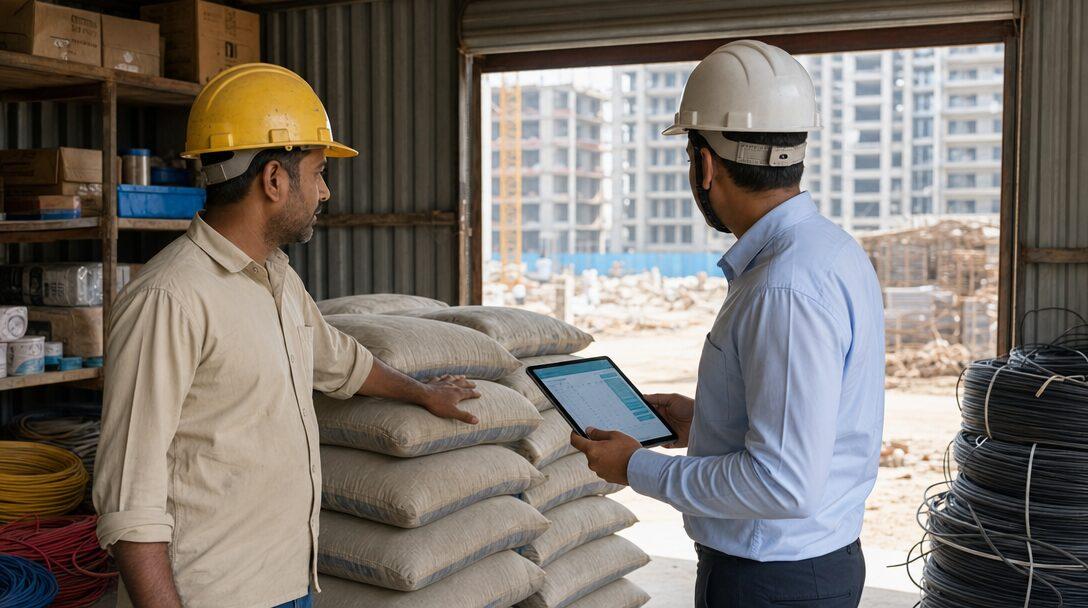


Picture an electrical subcontractor with four live sites and one billing engineer. At month end the engineer collects measurement sheets from the site supervisors, keys them into last month's Excel RA bill, fixes the cumulative columns by hand, recomputes retention and advance recovery, and emails the PDF. The accountant then types the same totals into Tally. One copied row in the wrong column and the client's quantity surveyor sends it back. Below: the chain from BOQ to RA bill, one subcontract worked through two bills, and what ERPNext does out of the box versus what you add.
TL;DR
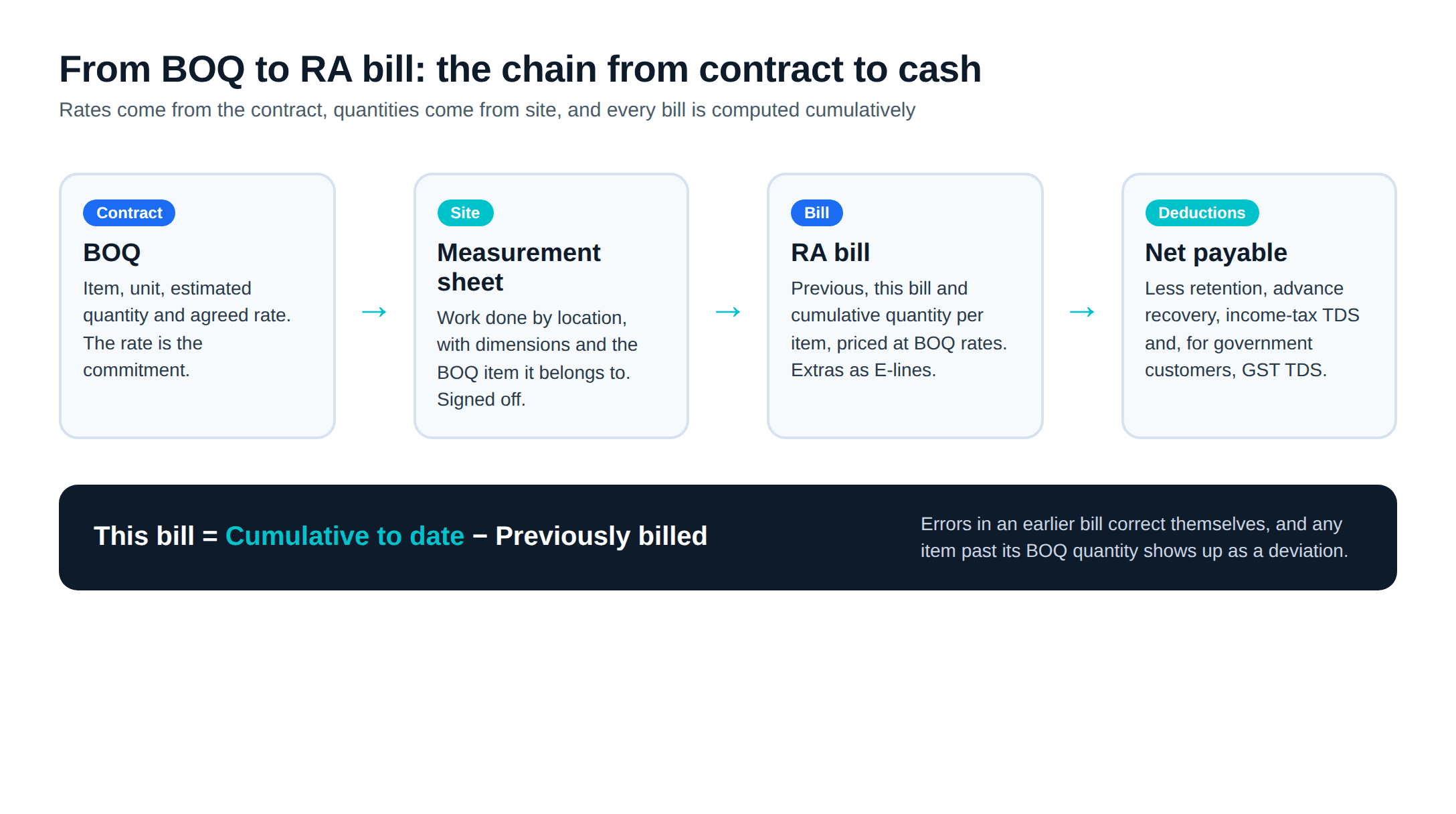
- The BOQ fixes the rate, the measurement sheet fixes the quantity, and the RA bill prices measured quantities at BOQ rates on a cumulative basis: total to date, minus previously billed, equals this bill.
- Deductions come off the gross: retention, mobilisation advance recovery, income-tax TDS, and GST TDS only when the customer is a government body under section 51 of the CGST Act.
- The worked example below runs a five-line electrical subcontract through two RA bills, including an extra item and an advance that runs out mid-bill.
- ERPNext v16 has Projects, Tasks, Sales Invoices against a project and Payment Entry deductions as standard. BOQ, measurement and RA bill documents are not in the manual, so they are a small custom app.
Free ERPNext fit check
Will ERPNext fit your factory?
Answer a few quick questions. On a short call we tell you whether ERPNext fits how you make, stock and sell, and what the rollout looks like.
Check my fit →BOQ, measurement sheet and RA bill: the three documents
The bill of quantities (BOQ) is the priced list of work items in the contract. Each line has an item number, a description, a unit (running metre, number, point, square metre), the estimated quantity and the agreed rate. The BOQ quantity is an estimate; the rate is the commitment.
The measurement sheet, or measurement book, records the work actually done, by location: "Tower B, level 3, riser 2: 42 Rm of cable tray". Each entry carries dimensions or counts, the computed quantity and the BOQ item it belongs to. On government work the measurement book is a formal register signed by the engineer in charge; on private work, the contract names who signs the measurement sheet.
The RA (running account) bill is the interim bill raised during the job. For every BOQ item it shows three quantities: previous (billed in earlier RA bills), this bill (measured since), and cumulative (total to date). Amounts are priced at BOQ rates. The bill is numbered in sequence (RA 1, RA 2, and so on) and the last one becomes the final bill.
Cumulative vs this-bill quantities
Every RA bill is cumulative minus previous: measure the total done to date, subtract what was already billed, bill the difference. So errors correct themselves. If RA 1 over-measured 20 Rm of cable, RA 2's cumulative figure is measured correctly and the this-bill quantity comes out 20 Rm lower. Nobody has to raise a credit note for a measurement slip.
Over-runs also show up. When the cumulative quantity of an item passes its BOQ quantity, the excess is a deviation. Contracts set how much variation in quantity is paid at the BOQ rate and what needs a written variation order, so the billing engineer should flag the line rather than bill it silently.
Deviations, extra items and price variation
A deviation is a BOQ item whose executed quantity differs from the contract quantity. An extra item is work that has no BOQ line at all, such as relocating a distribution board after a design change. Extra items need an agreed rate and the client's approval, and they appear on the RA bill as new lines, numbered separately (E1, E2) so the original BOQ stays intact.
Price variation (escalation) is an adjustment to contract rates when material or labour costs move, worked out by a formula in the contract against published indices. Not every contract has one. Where it exists, bill it as its own line or a separate bill and keep it out of the item rates.
Deductions on an RA bill
Several deductions come off the gross value before you are paid. Your contract decides which apply and at what rate.
Retention
Advance recovery
Income-tax TDS
GST TDS
Other recoveries
Final bill
The income-tax section reference is on the Income Tax Department's TDS rates page. The GST TDS rules, deductors and the 2.5 lakh threshold (on contract value excluding GST) are in CBIC's TDS under GST flier. Our post on GST and TDS on works contracts covers rates, thresholds and the exceptions in detail; this post only uses them in the arithmetic.
RA bill format: a worked example over two bills
Example, with stated assumptions: a fictional electrical subcontractor (a private limited company) has a subcontract from a private main contractor for the LT works in one residential tower. All numbers below are invented for the example.
- Contract value 29,64,800 rupees across five BOQ lines.
- Mobilisation advance of 1,50,000 rupees, recovered at 10% of each RA bill's gross value until fully recovered.
- Retention 5% of the gross value of each bill.
- GST at 18% on the gross value, shown separately on the invoice. How GST applies to advances and retention is left out of the example; settle that with your CA.
- Income-tax TDS at 2% (the contractor is a company), worked out on the value before GST.
- GST TDS nil, because a private main contractor is not a deductor under section 51. If the customer were a government department, 2% of the taxable value would also come off.
The BOQ:
| Item | Description | Unit | BOQ qty | Rate (₹) | Amount (₹) |
|---|---|---|---|---|---|
| 1 | 4C x 16 sq mm Al armoured cable, laid | Rm | 1,200 | 420 | 5,04,000 |
| 2 | 8-way TPN distribution board, fixed | Nos | 24 | 18,500 | 4,44,000 |
| 3 | Light point wiring | Point | 1,800 | 650 | 11,70,000 |
| 4 | 300 mm perforated GI cable tray | Rm | 600 | 1,150 | 6,90,000 |
| 5 | Pipe earthing station | Nos | 16 | 9,800 | 1,56,800 |
| Contract value | 29,64,800 |
RA 1 measures 450 Rm of cable, 6 boards, 500 points and 300 Rm of tray. Gross value 9,70,000 rupees.
RA 2 measures cumulative quantities and subtracts RA 1. It also carries one approved extra item, E1: relocation of four distribution boards after a layout change, at an agreed 3,500 rupees each.
| Item | Unit | Rate (₹) | Previous qty | This bill qty | Cumulative qty | This bill (₹) | Cumulative (₹) |
|---|---|---|---|---|---|---|---|
| 1 Cable | Rm | 420 | 450 | 450 | 900 | 1,89,000 | 3,78,000 |
| 2 DB | Nos | 18,500 | 6 | 8 | 14 | 1,48,000 | 2,59,000 |
| 3 Points | Point | 650 | 500 | 650 | 1,150 | 4,22,500 | 7,47,500 |
| 4 Tray | Rm | 1,150 | 300 | 220 | 520 | 2,53,000 | 5,98,000 |
| 5 Earthing | Nos | 9,800 | 0 | 8 | 8 | 78,400 | 78,400 |
| E1 DB relocation | Nos | 3,500 | 0 | 4 | 4 | 14,000 | 14,000 |
| Gross | 11,04,900 | 20,74,900 |
Check the arithmetic the way a client's QS will: cumulative 20,74,900 minus RA 1's 9,70,000 equals 11,04,900, the sum of the this-bill column.
Now the deductions for both bills:
| Line | RA 1 (₹) | RA 2 (₹) |
|---|---|---|
| Gross value of work | 9,70,000 | 11,04,900 |
| Add GST at 18% | 1,74,600 | 1,98,882 |
| Invoice value | 11,44,600 | 13,03,782 |
| Less retention at 5% of gross | 48,500 | 55,245 |
| Less advance recovery | 97,000 | 53,000 |
| Less income-tax TDS at 2% of gross | 19,400 | 22,098 |
| Less GST TDS | nil | nil |
| Net payable | 9,79,700 | 11,73,439 |
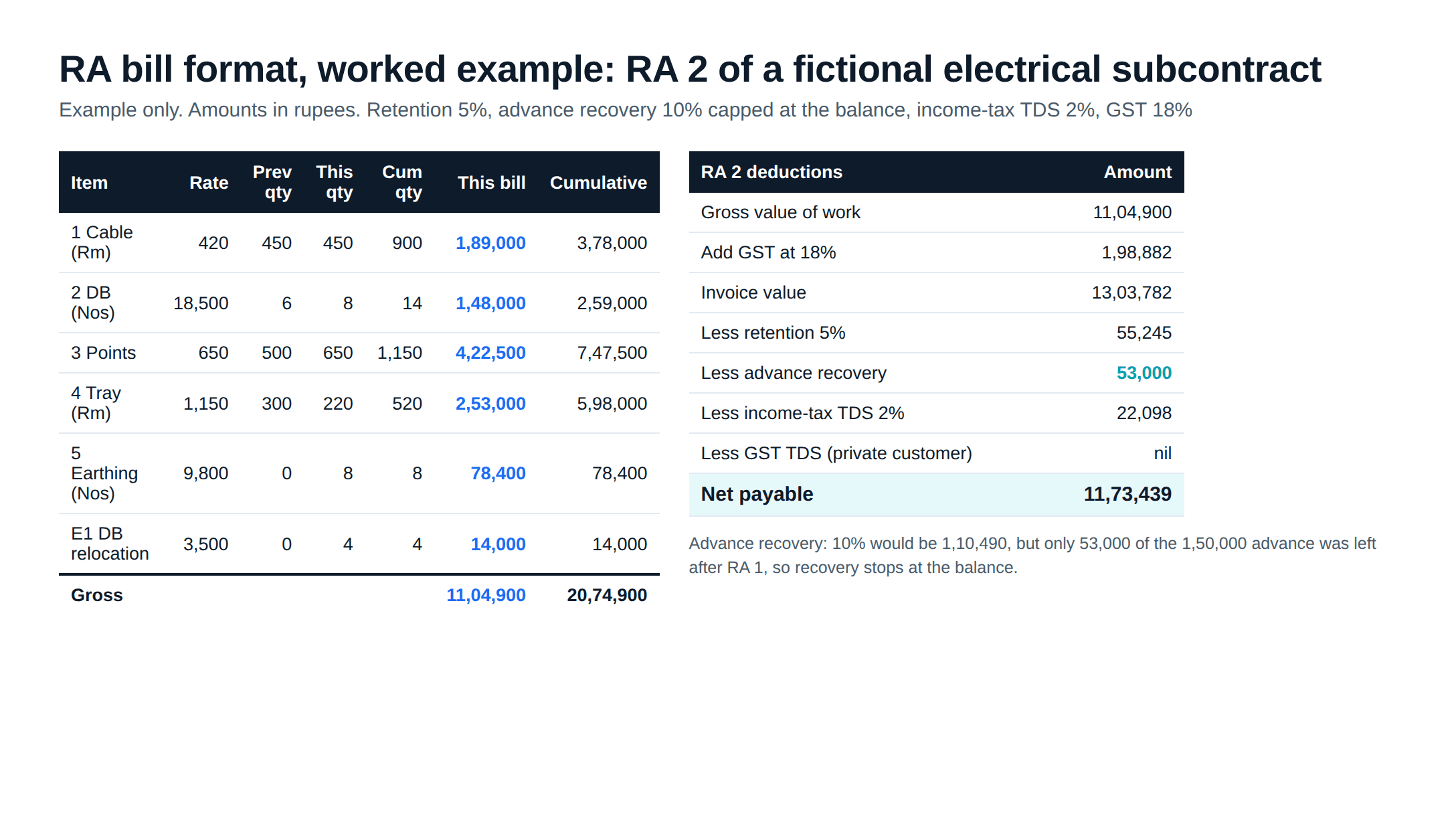
Look at the advance recovery in RA 2. Ten percent of 11,04,900 would be 1,10,490 rupees, but only 53,000 of the 1,50,000 advance was still outstanding after RA 1 recovered 97,000. Recovery stops at the balance. A spreadsheet copied from last month misses this unless someone remembers the balance, which is why it belongs in the system.
Two more checks belong on every bill. Item 4 is at 520 of 600 Rm; if RA 3 measures more than 80 Rm, the excess is a deviation to flag. And retention to date (1,03,745 rupees after RA 2) is money the business is owed later, so it should sit in its own receivable account, not vanish into "deductions".
Where the spreadsheet method breaks
Excel works as BOQ software for one site and one billing engineer. At four sites each bill is still a copy of the last one, and four things live outside the file: the signed measurement sheets, the running advance balance, the retention owed per contract, and the invoice the accountant keys into Tally. Some construction project management tools handle BOQs and leave accounts elsewhere; an ERP does the reverse. We compared the two in construction project management software vs ERP, and the wider picture is in our guide to construction ERP software in India.
BOQ software in ERPNext: running RA bills
Here is what ERPNext v16 does as standard, per the Frappe documentation.
- A Project links to a Sales Order, Timesheets, Purchase Orders, Expense Claims and Stock Entries. It shows the total billed from Sales Invoices, total purchase cost and consumed material cost, and computes % complete manually or from task completion, progress or weight.
- A Sales Invoice can carry the Project on the invoice and on each item row, allocate customer advances from its Payments tab, and split the amount into a payment schedule.
- A Payment Entry allocates a receipt against invoices and records withholding and other deductions against named accounts, so TDS deducted by the customer lands in a TDS receivable account.
- Material requests, stock issues to a site and purchase costs can all be tagged to the project, which our post on construction material management software covers.
What the ERPNext manual does not have is a BOQ, a measurement book, an RA bill with previous, this-bill and cumulative columns, or retention and advance recovery as running balances. Frappe forum answers suggest stretching a BOM or a Sales Order to stand in for a BOQ, which holds the rates but not the measurement history. Our view: build the missing piece rather than bend a manufacturing document to fit.
The pattern we recommend is a small custom Frappe app with a few DocTypes, linked to the standard Project:
BOQ
Measurement
RA Bill
Sales Invoice
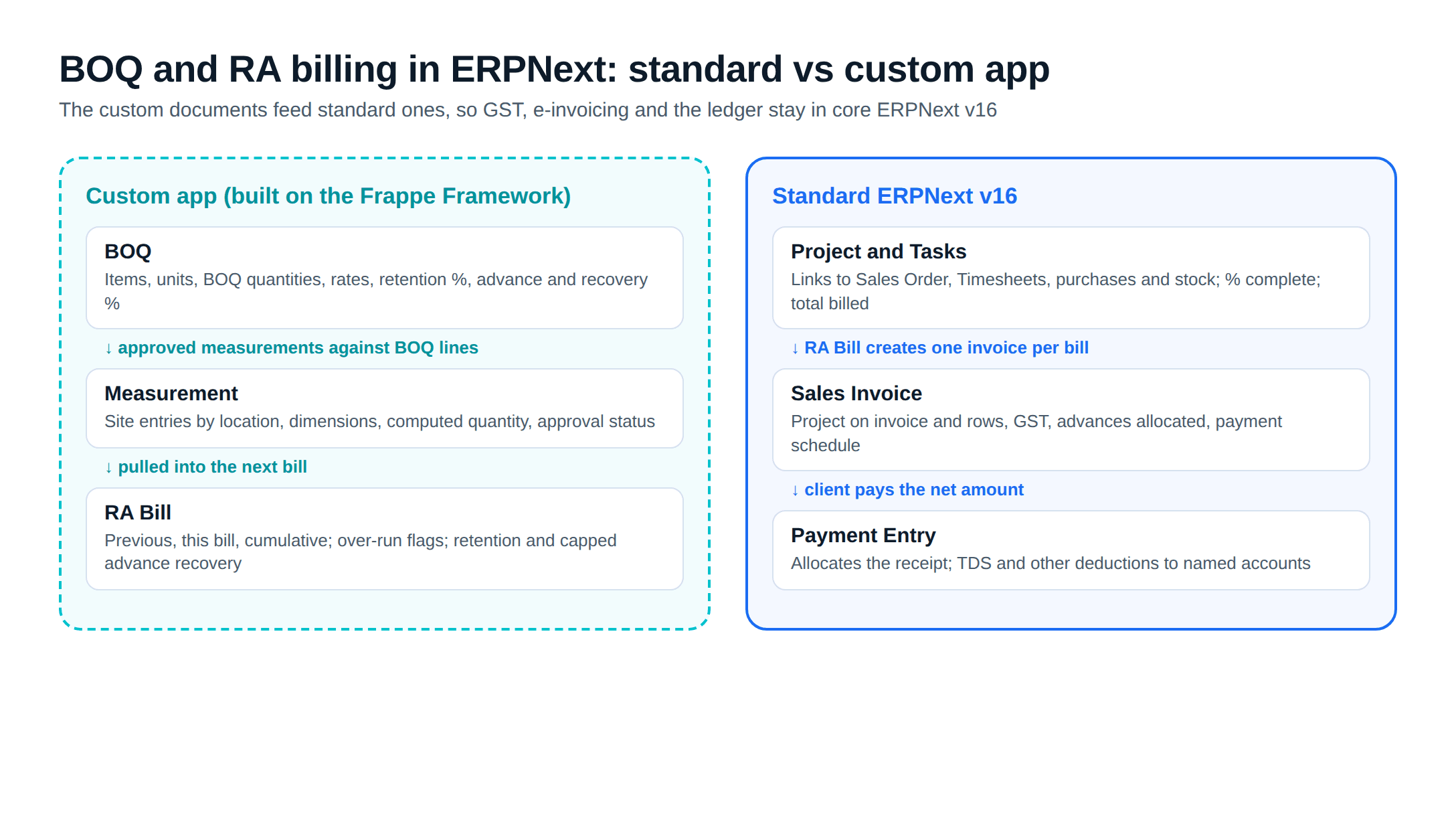
Keeping the invoice standard means GST e-invoicing works through the same path as any other sale (see e-invoice and e-way bill in an ERP), and the Project's billed amount updates on its own. Retention and advance recovery post to their own accounts through the invoice and the receipt, so the balance sheet shows what each client still owes you.
For an electrical or MEP firm the same app can grow a subcontractor side, mirroring the flow into Purchase Invoices for your own labour contractors; our post on software for electrical and MEP contractors covers that. Building the BOQ and RA bill app is ERPNext development work, and configuring Projects, accounts, GST and data migration around it is part of an ERPNext implementation. If you are coming off Tally, the Tally to ERPNext migration guide covers opening balances; retention your clients already hold comes across as an opening receivable.
- Load one real contract's BOQ, including any extra items already approved.
- Re-enter the last two RA bills from your Excel files and check the system reproduces the same cumulative figures and net amounts.
- Test an advance that runs out mid-bill and an item that passes its BOQ quantity.
- Confirm the Sales Invoice, the retention balance and the TDS receivable reconcile with what the client actually paid.
Frequently asked questions
What is an RA bill in construction?+
An RA (running account) bill is an interim bill a contractor raises during the job for work measured so far. It lists each BOQ item with the quantity billed in earlier bills, the quantity measured since, and the cumulative total, priced at the contract rates. Retention, advance recovery and tax deductions come off the gross amount, and the final bill settles the account when the work is complete.
What is the difference between a BOQ and a measurement sheet?+
The BOQ (bill of quantities) is part of the contract: each item, its unit, the estimated quantity and the agreed rate. The measurement sheet records what was actually executed on site, location by location, with dimensions and the computed quantity. RA bills are priced from the measurement sheet using BOQ rates, so the BOQ fixes the price and the measurement fixes the quantity.
Why are RA bills prepared on a cumulative basis?+
Because each bill restates the total work done to date and then subtracts what was billed before. If a measurement in an earlier bill was wrong, correcting the cumulative figure corrects the payment automatically, and the running total can be checked against the BOQ quantity at every bill. It also makes over-runs visible: an item whose cumulative quantity passes the contract quantity needs a variation before it is paid.
Does ERPNext have a BOQ or RA bill module?+
Not as standard. ERPNext has Projects, Tasks, Timesheets, Sales Orders, Sales Invoices, Payment Entries and stock tied to a project, but no BOQ, measurement book or RA bill document in its manual. The practical way to run RA billing in ERPNext is a small custom app: a BOQ and a measurement document linked to the Project, which generates one Sales Invoice per RA bill.
Is GST TDS deducted on every RA bill?+
Only when the customer is a deductor under section 51 of the CGST Act, such as a government department, local authority or government agency, and the contract value exceeds 2.5 lakh rupees excluding GST. A private developer or a private main contractor does not deduct GST TDS. Income-tax TDS on contract payments is a separate deduction, under section 393(1) of the Income-tax Act, 2025, with its own thresholds.
Related reading
- Construction ERP software in India: what a contractor needs from an ERP, and where ERPNext fits.
- GST and TDS on works contracts: rates, thresholds and the exceptions behind the deductions above.
- Construction project management software vs ERP: which one to start with.
- ERPNext implementation cost in India: market ranges for a project like this.
Free ERPNext fit check
Will ERPNext fit your factory?
Answer a few quick questions. On a short call we tell you whether ERPNext fits how you make, stock and sell, and what the rollout looks like.
Check my fit →About the author

- Tags
- erpnext
- erp
- construction
- india
- boq ra billing
Subscribe to Our Newsletter
The AI Build Brief: practical playbooks on how to build, price and ship AI features, in one short email every other week.