
Picture an MEP contractor in Gurugram with a hospital job for a state health department, two fit-outs for private developers and a subcontract under an EPC firm. Every RA bill raises the same questions: which SAC code, what GST rate, will the client deduct GST TDS, and how much income-tax TDS comes off. The rules changed twice in three years, most recently on 22 September 2025. Below are the current rules on GST on works contracts and TDS, with links to the notifications, one RA bill worked through, and the ERPNext setup.
TL;DR
- A works contract under GST is work on immovable property with a transfer of goods. It is a supply of services under SAC heading 9954.
- The rate is 18%. The last 12% entries moved to 18% from 22 September 2025.
- Contractors can claim input tax credit on materials and subcontracted works contracts; a client building its own office cannot.
- GST TDS at 2% comes only from government bodies and other notified recipients, on contracts above 2.5 lakh rupees. Income-tax TDS is separate, now under section 393(1) of the Income-tax Act, 2025.
- ERPNext with India Compliance handles SAC codes, GST, e-invoices and TDS. RA bills and retention need a custom app.
Free ERPNext fit check
Will ERPNext fit your factory?
Answer a few quick questions. On a short call we tell you whether ERPNext fits how you make, stock and sell, and what the rollout looks like.
Check my fit →Read this first
- Rates, thresholds and section numbers change with GST Council meetings and Finance Acts. Everything below is as at the time of writing.
- This is a general explanation, not tax advice. Confirm the rate, exemptions and TDS for each contract with your CA.
What counts as a works contract under GST
Section 2(119) of the CGST Act defines a works contract as a contract for "building, construction, fabrication, completion, erection, installation, fitting out, improvement, modification, repair, maintenance, renovation, alteration or commissioning of any immovable property" where transfer of property in goods is involved. The GST Council's own note on works contract services quotes the definition in full and points to paragraph 6(a) of Schedule II, which treats a works contract as a supply of services.
Three tests follow from that wording:
- Immovable property only: under the old VAT and service tax laws, contracts on movable goods could be works contracts. Under GST they cannot. Fabricating a skid in your own workshop and delivering it is a supply of goods.
- Goods must pass to the client: cable, conduit, DB panels or tiles that become part of the building are the transfer of goods. A contract with only labour and no material is not a works contract, though it is still a construction service (see the labour section below).
- One composite supply: you do not split material and labour into a goods invoice and a service invoice. The whole value is one service at one rate.
The place of supply is where the property is, under section 12(3) of the IGST Act, as the same Council note explains. A Delhi contractor working on a site in Haryana is making an inter-state supply, so that bill carries IGST.
Work contract HSN code: SAC 9954 and its groups
Services have SAC codes, not HSN codes, but the "work contract HSN code" people search for is heading 9954, construction services, in the classification annexed to Notification 11/2017-Central Tax (Rate). Its six-digit codes sit in groups:
| Group | Covers | Example six-digit codes |
|---|---|---|
| 99541 | Construction of buildings | 995411 residential, 995413 industrial buildings, 995414 commercial buildings |
| 99542 | Civil engineering works | 995421 highways, roads, bridges; 995423 pipelines, power lines |
| 99543 | Site preparation | 995431 demolition, 995433 excavation and earthmoving |
| 99544 | Prefabricated structures | 995441 erection of prefabricated buildings |
| 99545 | Special trade work | 995451 piling, 995453 waterproofing, 995455 structural steel erection |
| 99546 | Installation services | 995461 electrical, 995462 plumbing, 995463 HVAC, 995466 lifts |
| 99547 | Finishing work | 995472 plastering, 995473 painting, 995474 tiling |
Each group also has a code ending in 9 for repair and maintenance, such as 995469 for installations. The rate is usually the same 18% across the heading, so the code matters mainly for correct reporting. Keep it on the item master so nobody types it per bill.
Works contract GST rate after GST 2.0
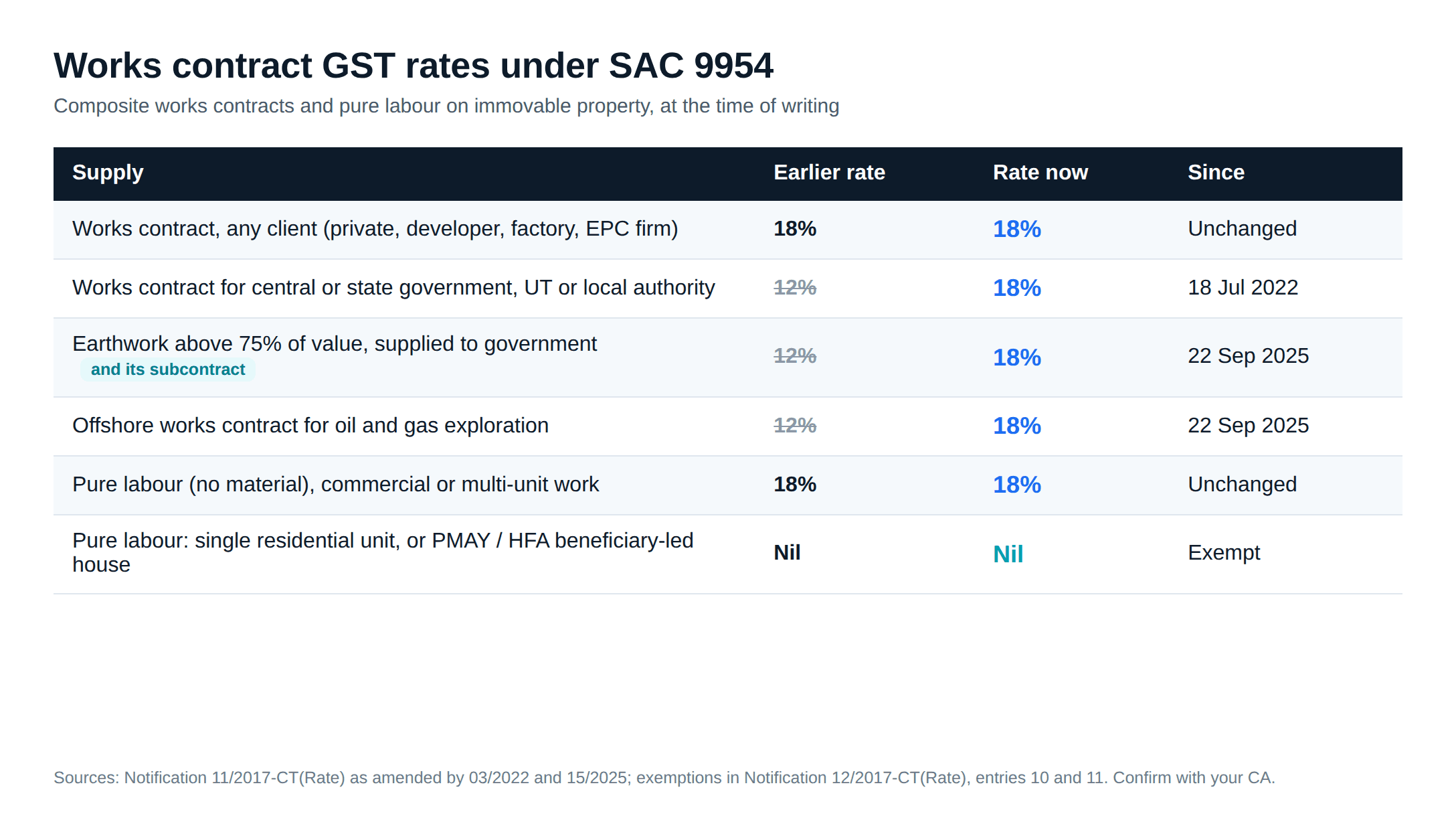
Heading 9954 in Notification 11/2017-Central Tax (Rate) had concessional works contract entries at 12% from 2017. They went in two steps. From 18 July 2022, works contracts for governments, union territories and local authorities that had 12% moved to 18% under Notification 03/2022-Central Tax (Rate), as the GST Council note records.
Three entries stayed at 12% after 2022: composite works contracts where earthwork is more than 75% of the value, supplied to government or a local authority; subcontracts under such contracts; and offshore works contracts for oil and gas exploration. The 56th GST Council meeting on 3 September 2025 recommended moving all three to 18%, and Notification 15/2025-Central Tax (Rate) did so from 22 September 2025.
That leaves the works contract GST rate at 18% for practically every building, MEP and civil contractor, whether the client is a developer, a factory owner, an EPC firm or a government department. If someone quotes you a lower contractor GST rate, ask which notification entry it comes from.
Three things still catch contractors out:
- Promoters selling flats are on a different scheme. The low rates for residential apartments in heading 9954 apply to a promoter's supply to a home buyer, not to a contractor's bill to the promoter. A contractor building an affordable housing project still charges 18%.
- For an RA bill that straddles 22 September 2025, the time of supply decides the rate: when the work was done, when the invoice was issued and when payment came in. The Council note has the table for each combination.
- A tax template set up years ago at 12% for "government work" will keep charging 12% until someone changes it. Check every template in your billing system.
Labour contractor GST rate
A pure labour contract has no transfer of goods, so it is not a works contract. It is still a construction service under heading 9954, taxed at 18% under the residual entry. The exemption notification 12/2017-Central Tax (Rate) makes it nil in two cases:
- Entry 10: pure labour on construction, repair or alteration of beneficiary-led individual houses under Housing for All (Urban) or Pradhan Mantri Awas Yojana.
- Entry 11: pure labour on construction, erection, commissioning or installation of original works of a single residential unit that is not part of a residential complex.
The linked copy is consolidated up to 1 April 2019, so ask your CA to confirm both entries against later amendments. Pure labour on a commercial building, a factory or a multi-unit housing project is taxed at 18%.
Input tax credit on works contracts: section 17(5)(c) and (d)
Section 17(5) of the CGST Act blocks credit in two cases that hit construction, as the Council note summarises:
- 17(5)(c): works contract services supplied for construction of immovable property, other than plant and machinery, except where the service is an input service for a further supply of works contract service.
- 17(5)(d): goods or services received for construction of immovable property, other than plant and machinery, on the taxpayer's own account.
For a contractor, the exception does most of the work. A subcontractor's works contract bill is an input for your works contract to the client, so its GST is creditable, and so is the GST on cement, steel and cable that go into the client's building, subject to the usual conditions. The block bites on the client: a company building its own office cannot claim the GST on your bill, unless the work is plant and machinery. It bites on you only when you build your own office or yard. Tag site purchases to the project so the credit trail is clear.
GST TDS on works contracts under section 51
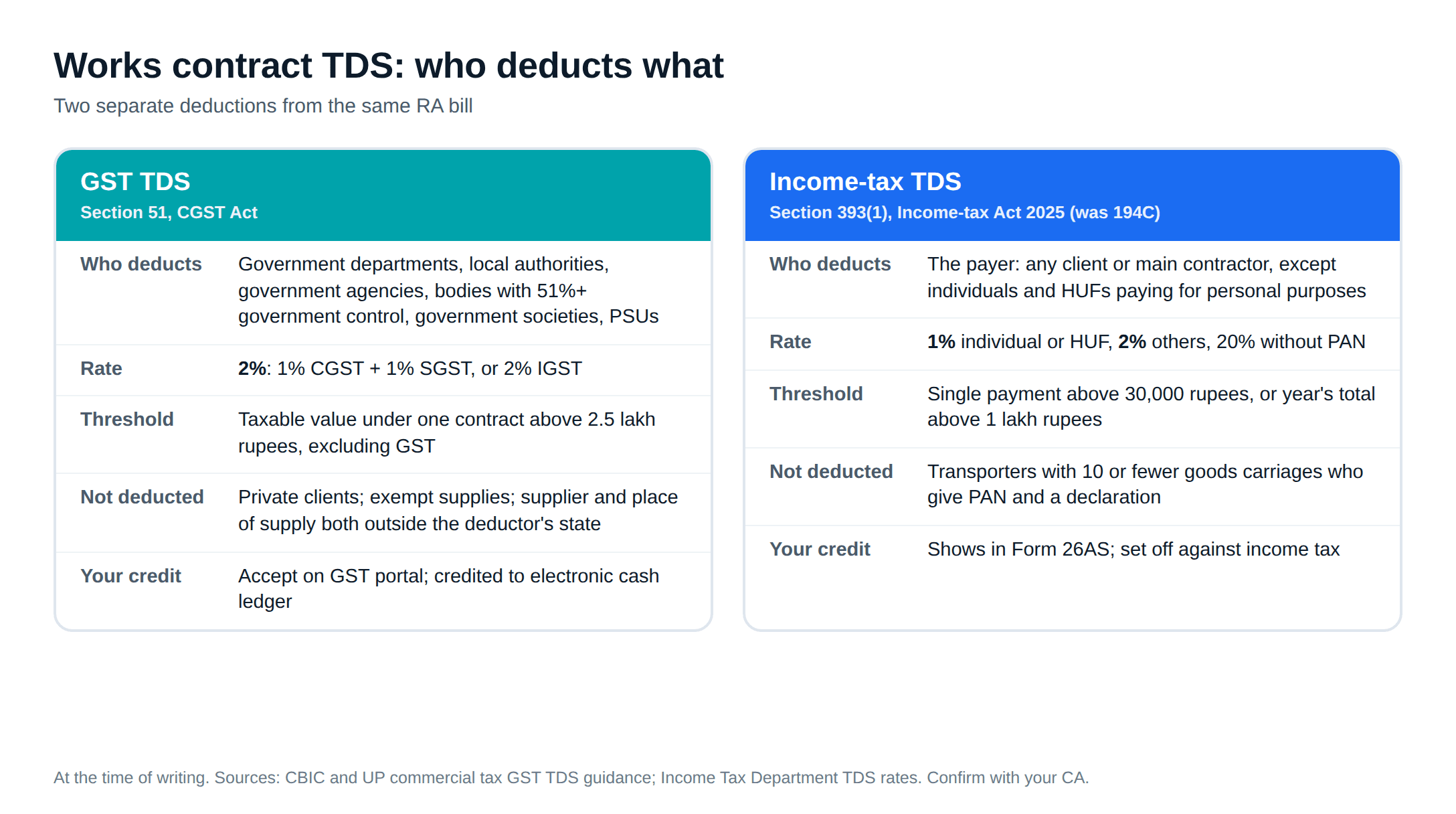
Section 51 of the CGST Act makes certain recipients deduct tax from payments to suppliers. It applies from 1 October 2018. Per the Uttar Pradesh commercial tax department's GST TDS booklet and CBIC's TDS flier, the deductors are:
- departments and establishments of the central or a state government
- local authorities and governmental agencies
- authorities, boards or bodies set up by an Act, or set up by a government with 51% or more equity or control
- societies set up by a government or local authority under the Societies Registration Act, 1860
- public sector undertakings
The rate is 2%: 1% CGST plus 1% SGST or UTGST on an intra-state supply, or 2% IGST on an inter-state one. The deductor deducts only when the taxable value under a single contract exceeds 2.5 lakh rupees, counted without GST and cess.
The same booklet lists the exceptions. There is no deduction on exempt supplies, such as a pure labour contract under entry 11 above, or when the supplier's location and the place of supply are both in a state other than the one where the deductor is registered.
The deductor files GSTR-7 within 10 days after the month ends and issues a GSTR-7A certificate. You accept the entries on the GST portal, and the amount lands in your electronic cash ledger to pay your own GST. Private developers and private main contractors are not on the list, so they do not deduct GST TDS.
Works contract TDS under the Income-tax Act
Income-tax TDS is a separate deduction, made by whoever pays you. From 1 April 2026 the Income-tax Act, 2025 replaced the 1961 Act, and contractor payments moved from section 194C to section 393(1). The rates are on the Income Tax Department's TDS rates page, and the ERPNext TDS setup guide for India gives the new payment codes: 1023 for individual and HUF contractors, 1024 for others. Per the TDSMAN summary of section 393(1):
- 1% when the contractor is an individual or HUF, 2% for a company, firm or anyone else
- no deduction if a single payment is up to 30,000 rupees and the year's payments to that contractor are up to 1 lakh rupees; cross either and TDS applies
- 20% if the contractor has no PAN
- transporters who own ten or fewer goods carriages and give their PAN with a declaration are exempt
- individuals and HUFs paying for personal purposes need not deduct
On the GST component: under the 1961 Act, CBDT Circular 23/2017 said TDS is worked out on the amount excluding GST on services when the GST is shown separately on the bill. Ask your CA whether your clients apply the same treatment under the 2025 Act.
Example: the tax on one RA bill
Example only, with these assumptions: a fictional electrical subcontractor, a private limited company, raises RA bill 3 for work valued at 8,00,000 rupees on a site in its own state. GST is 18% (9% CGST plus 9% SGST), retention is 5% of the work value, and income-tax TDS is 2% on the value before GST. The client is either a private main contractor or a state government department, both on contracts well above 2.5 lakh rupees.
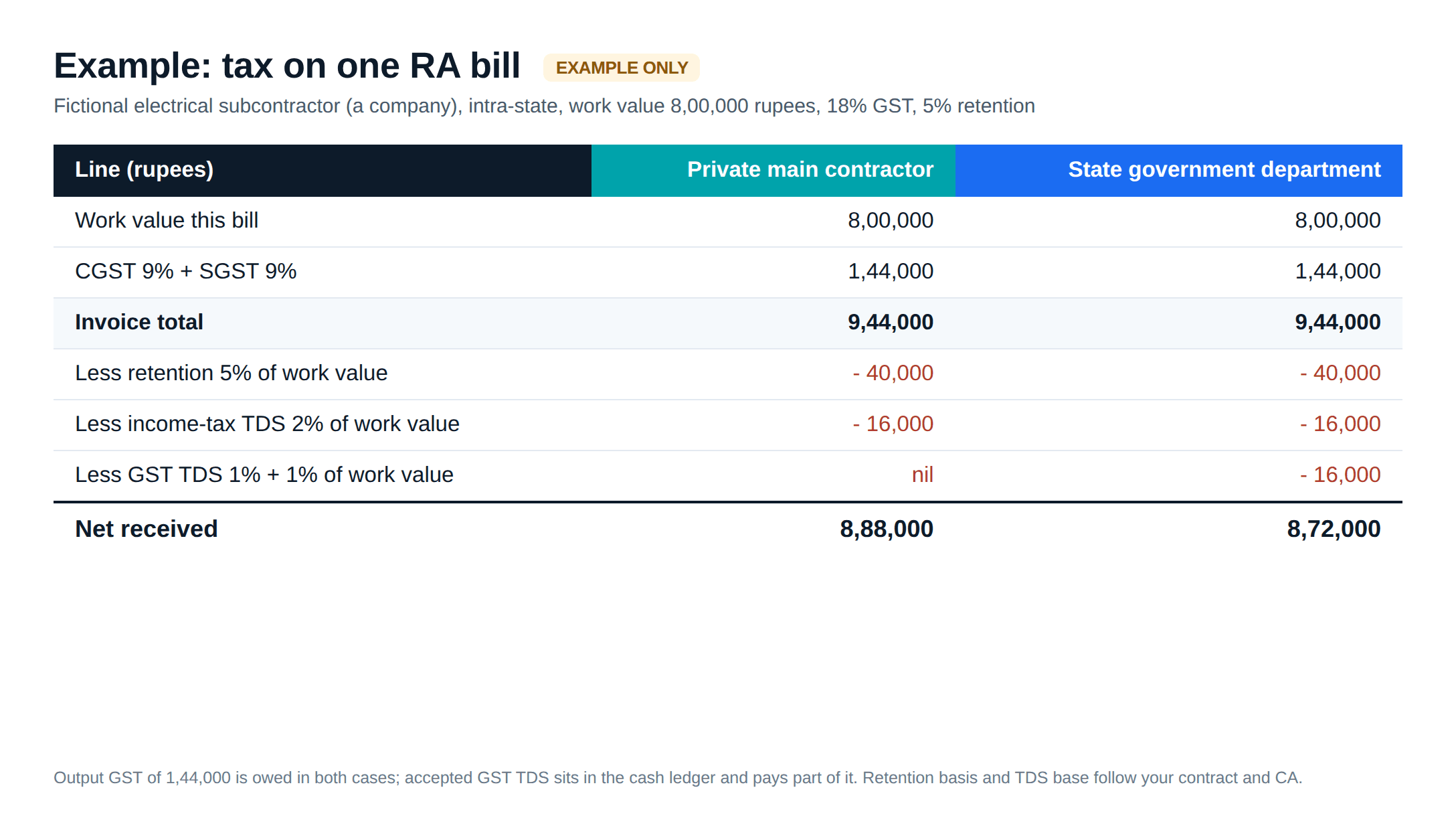
The government client pays 8,72,000 rupees against 8,88,000 from the private one; the difference is 16,000 rupees of GST TDS. The contractor still owes the full 1,44,000 rupees of output GST in both cases, but the GST TDS is not lost: once accepted on the portal, it sits in the cash ledger and pays part of that liability. The income-tax TDS shows in Form 26AS and is claimed against the company's income tax. Retention is money owed later, so it belongs in its own receivable account. Our BOQ to RA bill walkthrough carries the same idea across two bills with advance recovery.
Billing works contracts from ERPNext
Most of the tax side is standard in ERPNext with the free India Compliance app:
Items with SAC codes
Tax templates
TDS on what you pay
TDS taken from you
E-invoice
The place of supply follows the site address on the invoice, so set up a customer address for each site. If you send material to a fabricator and get it back, the ITC-04 job work rules apply as well.
What ERPNext does not have is the RA bill itself: BOQ quantities, cumulative measurement, and retention and advance recovery as running balances. We build those as a small custom app linked to the Project, which creates one Sales Invoice per RA bill with the taxes above applied. Our guide to construction ERP software in India maps what is standard and what is custom. For the custom RA bill, see ERPNext development. For setting up ERPNext with your projects, tax templates and TDS categories from day one, see ERPNext implementation.
A checklist before your next RA bill
- Every works contract item carries a six-digit 9954 code and an 18% tax template with a Valid From date, and no template is still at 12%.
- Each client is marked as a GST TDS deductor or not, and each contract value is checked against the 2.5 lakh rupee threshold.
- Each subcontractor has a Tax Withholding Category under the Income-tax Act, 2025 codes and a PAN on file.
- GST TDS, income-tax TDS and retention each have their own receivable account.
- Your CA has confirmed any exemption you rely on, such as a pure labour contract on a single residential unit.
Frequently asked questions
What is the GST rate on works contracts in 2026?+
18% under SAC 9954. The last 12% entries, for earthwork-heavy government contracts, their subcontracts and offshore oil and gas works, moved to 18% from 22 September 2025 under Notification 15/2025-Central Tax (Rate). Confirm your contract's rate with your CA.
What is the HSN or SAC code for a works contract?+
Heading 9954, construction services. Pick the six-digit code that matches the work, for example 995411 for residential buildings, 995461 for electrical installation, 995462 for plumbing, 995463 for HVAC or 995473 for painting.
What is the GST rate for a labour contractor?+
18%, as a construction service under heading 9954. Notification 12/2017-Central Tax (Rate) exempts pure labour on a single residential unit that is not part of a residential complex, and on beneficiary-led houses under Housing for All (Urban) or PMAY.
Who deducts GST TDS on a works contract?+
Government departments, local authorities, government agencies, government-controlled bodies and societies, and public sector undertakings, under section 51 of the CGST Act. They deduct 2% when one contract's taxable value exceeds 2.5 lakh rupees. Private clients do not deduct GST TDS.
What is the TDS rate on contractor payments under the new Income-tax Act?+
From 1 April 2026 it sits in section 393(1) of the Income-tax Act, 2025, which replaced section 194C. The rate is 1% for an individual or HUF contractor and 2% for others, above 30,000 rupees a payment or 1 lakh rupees a year. Without a PAN it is 20%.
Can ERPNext handle GST and TDS on RA bills?+
The tax side, yes: with the India Compliance app it carries SAC codes, applies GST, issues e-invoices and deducts TDS through Tax Withholding Categories. The RA bill itself, with BOQ quantities and retention, is not standard, so it is built as a small custom app.
Related reading
- Construction ERP software in India: what a contractor needs from an ERP, standard versus custom.
- From BOQ to RA bill in ERPNext: a worked RA bill with retention and advance recovery.
- E-invoice and e-way bill from your ERP: the GST portal side of invoicing.
- Job work and ITC-04 under GST: when material goes to a fabricator and comes back.
Free ERPNext fit check
Will ERPNext fit your factory?
Answer a few quick questions. On a short call we tell you whether ERPNext fits how you make, stock and sell, and what the rollout looks like.
Check my fit →About the author

- Tags
- erpnext
- erp
- construction
- india
- gst
Subscribe to Our Newsletter
The AI Build Brief: practical playbooks on how to build, price and ship AI features, in one short email every other week.