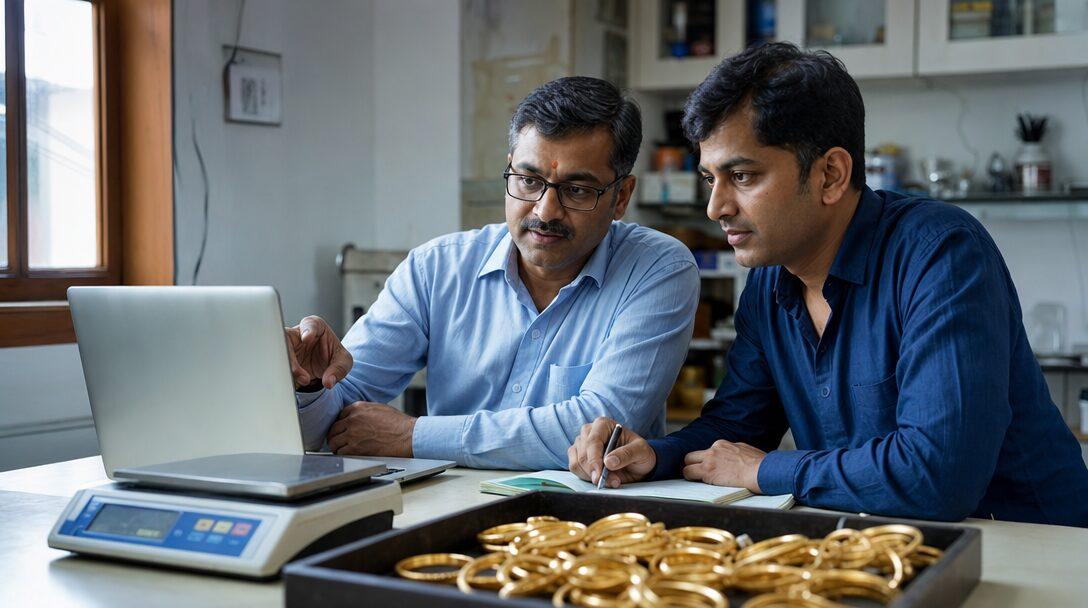

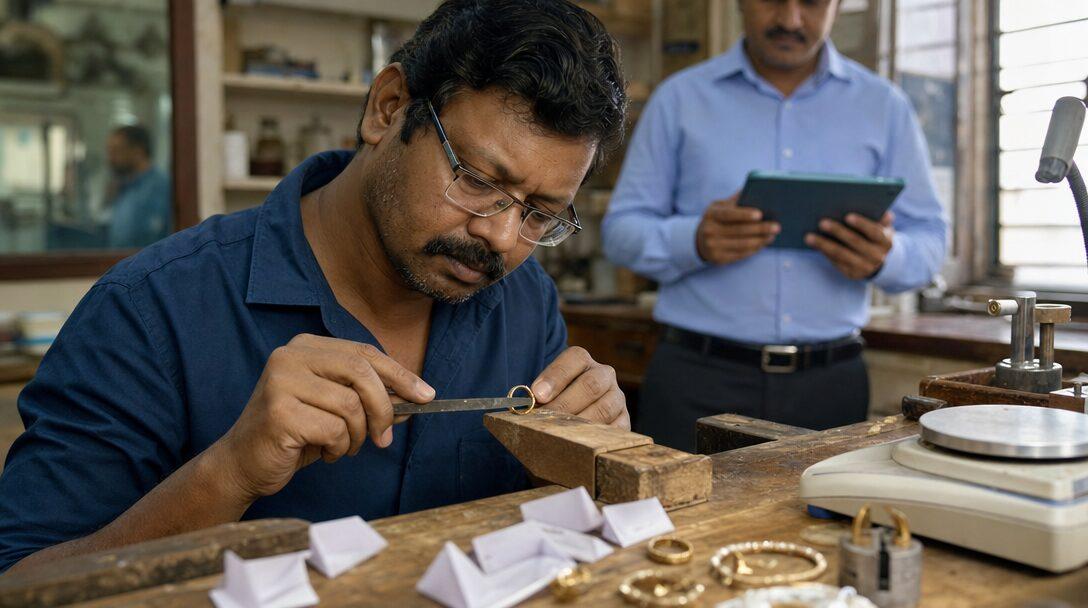
Picture a workshop in Mumbai with 40 karigars working on 22K and 18K orders for wholesale buyers. Gold goes out to the casting room in the morning, comes back as trees of rough castings, moves to filing, setting and polishing, and returns as finished pieces with a pile of filings, sprues and polishing sweeps. At the end of the month the vault is short by a few grams, and nobody can say which process or which karigar it went from. Jewellery manufacturing software is built to answer that question every day, not once a month. This post covers the production side; the buyer's guide to jewellery ERP software in India covers stock, pricing, GST and how to choose a system.
TL;DR
- Jewellery manufacturing software follows each order by job bag through design, wax, casting, filing, setting, polishing and hallmarking, weighing metal in and out at every step.
- Loss is computed per process and per karigar, compared with the limit the plant sets, and flagged when it runs over. Scrap comes back by type so it can go to refining.
- The metal balance (fine gold in the vault, at each process and with each karigar) should reconcile daily.
- Diamonds and stones are issued to the setter by count and carat weight and consumed into the piece. The HUID from hallmarking is stored against each finished piece.
- ERPNext supplies work orders, job cards and subcontracting, but weight-and-purity tracking and job bags are custom Frappe development.
Free ERPNext fit check
Will ERPNext fit your factory?
Answer a few quick questions. On a short call we tell you whether ERPNext fits how you make, stock and sell, and what the rollout looks like.
Check my fit →What jewellery manufacturing software has to track
Software for jewellery manufacturers has a different centre of gravity from a general manufacturing system. In a plastics plant, the question is "how many parts did we make and what did they cost". In a jewellery workshop, the question is "where is every gram of our gold right now". The metal is worth more than the labour, it changes form at every step, and some of it is lost by design.
So the system has to track, for every order:
- metal issued and returned at each process, by gross weight and purity, converted to fine weight
- stones issued and set, by count and carat weight
- scrap returned by type: sprues and buttons from casting, filings, polishing dust, broken pieces
- who did the work, on which process, and when
- the loss at each step against the limit the plant has set
A BOM with quantities and an operations list is a starting point. It is not enough on its own.
The production workflow, step by step
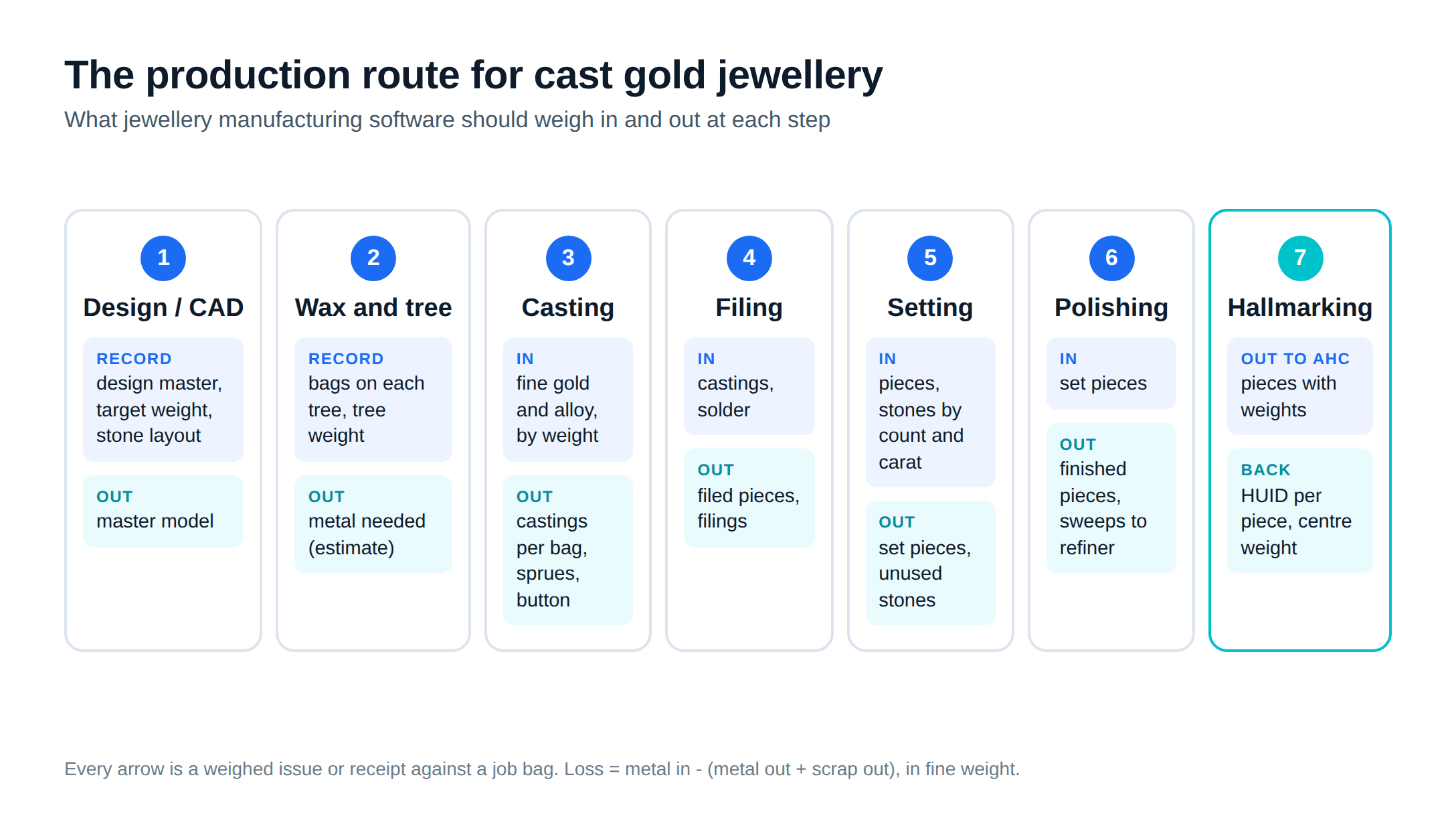
The process below is the common route for cast gold jewellery. Handmade, machine-chain and stamped work follow different routes, and your software should let you define routes per design rather than force one.
Design and CAD
Wax and tree
Casting
Filing and setting
Polishing
Hallmarking
What the software records at each step:
- Design and CAD: the design master, the expected metal weight per purity and the stone layout. This is the reference the rest of the process is measured against. File storage is fine; the weights and stone list should be data fields.
- Wax and tree: the wax tree's weight gives an estimate of the metal needed. The system should record which bags are on which tree, because one casting run serves several orders.
- Casting: fine gold and alloy are issued to the caster by weight. What comes back is rough castings per bag, plus the sprues and button, which go back to stock as scrap at a known purity. The gap is casting loss.
- Filing, assembly and soldering: each karigar receives rough castings by bag and returns filed pieces and filings. Solder adds metal at its own purity, so a good system records it as an issue.
- Setting: stones are issued to the setter by count and carat weight. Pieces come back with stones set, plus any broken or unused stones, and the gross weight goes up by the stone weight.
- Polishing: polishing removes metal as dust. Sweeps and polishing waste are collected and sent for refining, and the recovery comes back later as fine gold. The system needs to hold that as "pending recovery" until the refiner's report arrives.
- Hallmarking: covered in its own section below.
Job bags: one bag, one trail
Workshops run on job bags: a packet that holds one order or a set of pieces, with a card listing the design, the metal and stones issued, and each process the bag passes through. Bagging is what makes the paper trail physical. Your software should mirror it exactly:
- A bag number created from the sales order or the production plan, printed as a barcode on the card.
- Every issue and receipt scanned against the bag, with the weight captured from the scale where possible.
- The bag's current process and holder visible at a glance, so the owner can see that bag 1043 has been with the setter for three days.
- Splits and merges. A bag of twenty rings may split when five need rework, and the system has to carry weights into both halves.
Loss tracking per process and per karigar
Every process loses some metal, so zero loss is not a realistic target. The target is loss inside a known limit, with an explanation whenever it runs over. For that, loss has to be computed, not estimated:
loss = metal issued - (finished and part-finished metal returned + every kind of scrap returned)
The calculation runs in fine weight, because a karigar who receives 22K and returns pieces with 18K solder joints has not lost gold just because the gross numbers moved.
Then it is reported along two axes:
- Per process: average loss in casting, filing, setting and polishing, against the limit for each. A rising casting loss across all casters points at the furnace or the alloy, not the people.
- Per karigar: each karigar's loss on the same process, over the same period. One filer at twice the loss of the others on similar designs needs a closer look at that bench.
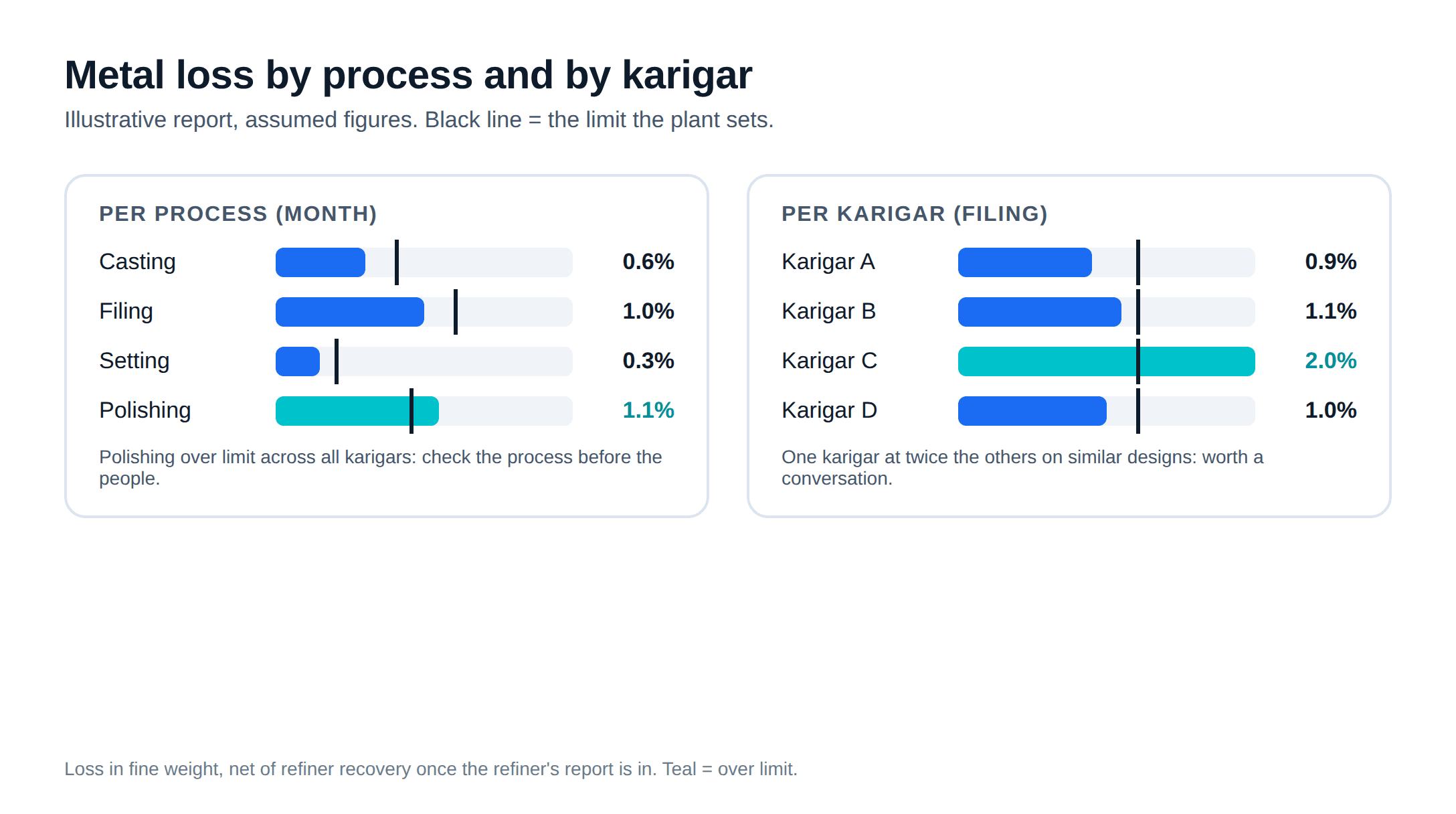
Recovery closes the loop. Sweeps, polishing dust and floor sweepings go to a refiner, and the fine gold that comes back reduces the net loss for the period. The software should track each lot sent for refining and match the refiner's return to it.
Metal balance: the daily reconciliation
The metal balance answers one question: where is our gold? At the end of each day, the fine weight in the vault plus the fine weight at every process and karigar, plus scrap awaiting refining, should equal opening stock plus purchases minus sales minus recorded loss.
If it does not, the difference is unexplained loss, and it is better found today than at the month-end count. This is also the report that makes a karigar's balance visible: if an outside karigar holds 400 g of your metal and has not returned work in two weeks, you see it.
Outside karigars bring GST into it. Metal sent to a job worker under a challan has to come back within the time limit and goes on your ITC-04 return; the karigar's labour charge on jewellery is job work at 5%. Both are covered in the jewellery ERP software guide.
Diamonds and stones: what diamond ERP software adds
For studded and diamond jewellery, the stone record matters as much as the metal record. Diamond ERP software, or a diamond module inside a jewellery system, needs:
- Stone lots in stock by type, shape, size, colour and clarity grade, with count and carat weight.
- Lab grading report numbers for graded stones, carried through to the finished piece.
- Issue to the setter by count and weight, with return of unused and broken stones.
- A stone list per finished piece, so gross weight minus stone weight gives the net metal weight used in pricing and in the metal balance.
Missing stones are a loss line of their own, and they should be reported the same way as metal loss: per setter, per period, against a limit.
The hallmarking step: what HUID software has to do
Since 1 July 2021, hallmarked gold jewellery carries the BIS standard mark, the purity, and a six-digit alphanumeric HUID, according to BIS's brief on hallmarking. The HUID is created in BIS's own system when an assaying and hallmarking centre marks the piece. The same brief says that from 8 June 2026, the centre's process captures photographs and weights of hallmarked articles for buyers to check in the BIS Care app.
For a manufacturer, this means the weight BIS records for your piece is now visible to the buyer, so your own receipt weight should match it. Hallmarking software, in the sense a manufacturer needs, is a step in your workflow:
- pieces selected for hallmarking, grouped into a dispatch to the centre, with weights
- pieces received back, each with its HUID entered or imported against the piece record
- the centre's weight stored next to your own, with any difference flagged
- the HUID printed on the tag and the invoice
Mandatory hallmarking applies in the districts listed in the Hallmarking Order: 392 districts after BIS's eighth phase on 3 August 2026, per its phase-wise coverage list. The order itself exempts articles that are not substantially complete and are meant for further manufacture, so work in progress inside the workshop is outside it until the piece is finished.
Building jewellery manufacturing software on ERPNext
ERPNext gives a jewellery workshop the production skeleton for free. A BOM holds the materials and operations, and records process loss when the scrap item is the item being made. A work order releases it to the floor. Job cards log each operation with time and the employee who did it. The subcontracting flow tracks material sent to an outside job worker. How these connect is in our post on ERPNext production planning, BOM and MRP.
What it does not do out of the box is count stock by gross weight, net weight and purity. ERPNext's stock is a quantity in a unit of measure, so job bags with weights at every step, fine-metal balances per karigar, loss limits per process, stone lists per piece and the hallmarking step all have to be built. That is a custom Frappe app on top of ERPNext, and it is the core of ERPNext development for a jewellery workshop.
Two design choices decide whether that app works:
- Weights are data, not remarks: gross, stone, net and fine weight need to be numeric fields that feed the stock and metal ledgers, captured from a scale wherever the floor allows.
- The app stays separate from ERPNext's core: building the jewellery logic as its own app, rather than editing ERPNext's code, keeps upgrades possible. It is the first thing we check when we look at any existing install.
Before you scope a build, test your process on paper: one job bag from casting to hallmarking, with every weight written down. If the numbers reconcile there, the software only has to capture them, and the ERPNext development page explains how we scope a custom app from that starting point. The jewellery ERP software guide has the full checklist for choosing a system.
Frequently asked questions
What is jewellery manufacturing software?+
It is software that follows each order through the workshop, from design and CAD through wax, casting, filing, setting and polishing to hallmarking. It records metal and stones issued to each process and karigar by weight and purity, what comes back, and the loss at each step, so the owner can see the metal balance at any moment.
What is a job bag in jewellery manufacturing?+
A job bag is the packet, physical and in the system, that carries one order or one batch of pieces through the workshop. It holds the design reference, the metal and stones issued, and a record of each process it passes through, with weights in and out. Tracking by bag is what makes loss traceable to a process and a karigar.
How do you track metal loss per karigar?+
Weigh metal out to the karigar against a job bag, weigh back finished pieces and every kind of scrap (filings, sprues, polishing dust), and compute the difference in grams and as a percentage of the metal issued. Compare that with the limit the plant sets for the process, flag anything over, and keep a running balance per karigar.
Is there HUID software for jewellery manufacturers?+
The HUID itself is generated through BIS's hallmarking system when an assaying and hallmarking centre marks the piece. What a manufacturer needs in its own software is a hallmarking step: pieces sent to the centre, received back with their HUIDs, the HUID stored against each piece and printed on tags and invoices, and the centre's weight compared with your own.
Can ERPNext be used as jewellery manufacturing software?+
Its work orders, job cards, BOMs and subcontracting cover the production skeleton, but standard ERPNext counts stock by quantity, not by gross weight, net weight and purity. Job bags, fine-metal balances, loss limits per process and karigar, and HUID per piece need a custom Frappe app built on top of it.
Related reading
- Jewellery ERP software in India: stock by weight and purity, GST and how to choose.
- ERPNext production planning, BOM and MRP: work orders and job cards in practice.
- ITC-04 and job work under GST: metal at outside karigars.
Free ERPNext fit check
Will ERPNext fit your factory?
Answer a few quick questions. On a short call we tell you whether ERPNext fits how you make, stock and sell, and what the rollout looks like.
Check my fit →About the author

- Tags
- erpnext
- erp
- india
- manufacturing
- jewellery
Subscribe to Our Newsletter
The AI Build Brief: practical playbooks on how to build, price and ship AI features, in one short email every other week.