
Picture a gold jewellery manufacturer in Jaipur with 25 karigars, three counters for wholesale buyers and a stock register that lives in two places: a ledger book that counts grams of 22K and 18K gold, and accounting software that counts rupees. Every month someone reconciles the two by hand, and every month the numbers are a few grams apart. Jewellery ERP software exists to close that gap. This guide is for manufacturers and wholesalers, not retail showrooms, and it is written by an independent ERPNext implementer, so read the ERPNext section with that in mind.
TL;DR
- Jewellery ERP software has to count stock the way the trade does: gross weight, net weight, stone weight and purity, rolled up to fine gold. A system that counts only pieces or rupees will not reconcile with the floor.
- The other must-haves for a manufacturer or wholesaler: making charges and wastage, karigar issue and receipt with metal loss limits, stone details, HUID numbers from hallmarking, and GST at 3% on jewellery and 5% on jewellery job work.
- Standard ERPNext tracks stock by quantity in a unit of measure. Weight-and-purity stock needs a custom Frappe app on top, which is development work, not configuration.
- To pick the best jewellery ERP software, score vendors on the checklist below and test them on your own job bags and invoices.
Free ERPNext fit check
Will ERPNext fit your factory?
Answer a few quick questions. On a short call we tell you whether ERPNext fits how you make, stock and sell, and what the rollout looks like.
Check my fit →What jewellery ERP software has to do that a general ERP does not
A general ERP assumes an item has a quantity and a cost. A 22K gold chain has both, but neither is what the business manages. What the owner wants to know is how many grams of fine gold the business holds, where they sit (vault, casting room, karigar, buyer on approval) and how much went missing between issue and receipt.
That shapes the whole system. A jewellery ERP, whether it is called jewellery ERP software, a jewelry ERP system or plain ERP for jewellery, needs to do five things a general ERP does not do by default:
Weight and purity stock
Making and wastage
Karigar issue and receipt
Stones and diamonds
Hallmarking and GST
Retail billing and POS software for showrooms is a different product category, and this guide does not cover it.
Jewellery inventory: gold and silver stock by weight and purity
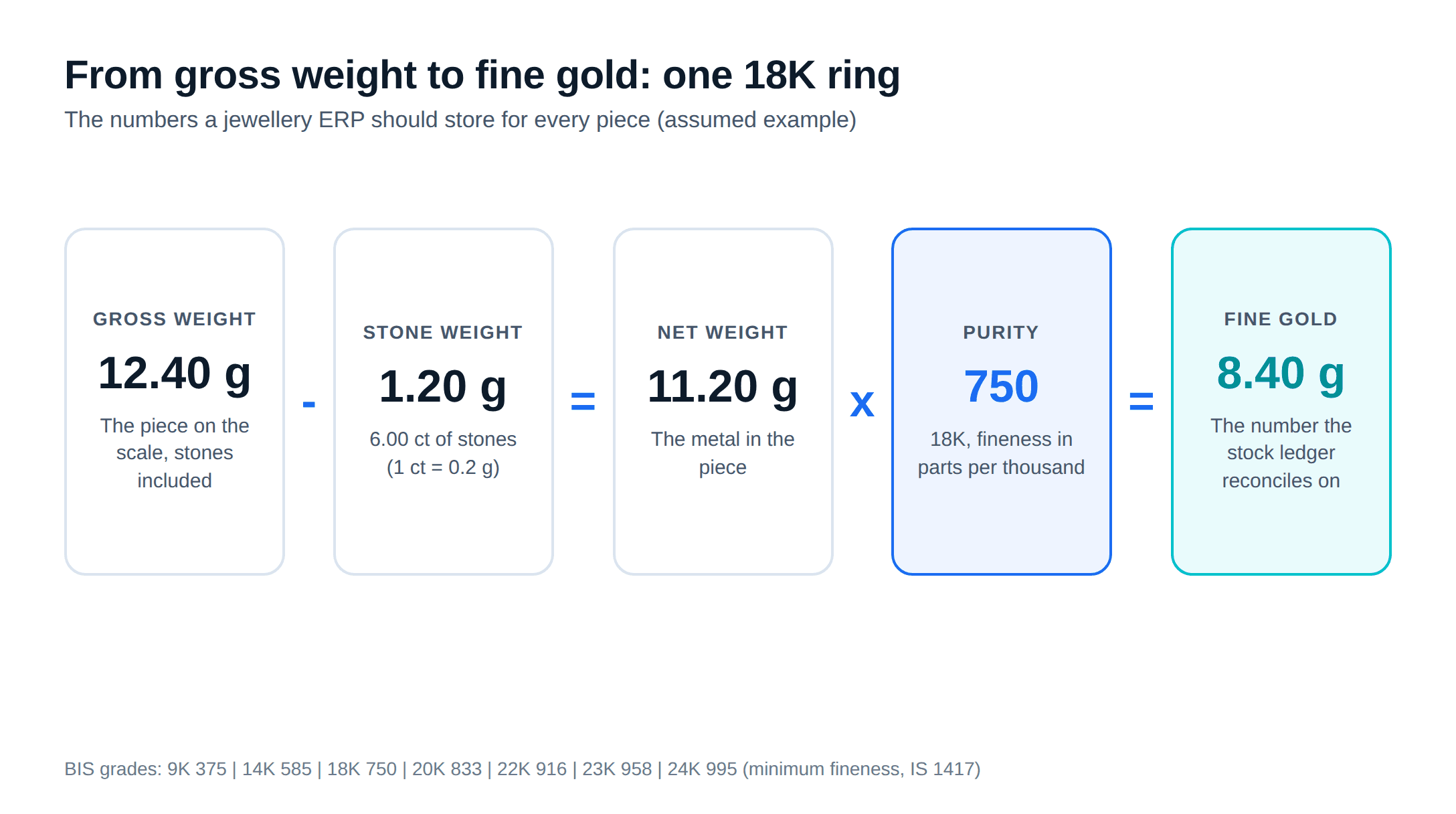
This is the core of jewellery inventory software. Each piece carries at least four numbers:
- Gross weight: the piece as it sits on the scale, stones included.
- Stone weight: diamonds and coloured stones, recorded in carats and converted to grams (1 carat is 0.2 g).
- Net weight: gross weight minus stone weight. This is the metal.
- Purity: the karat or fineness. BIS's hallmarking scheme covers seven gold grades: 9K, 14K, 18K, 20K, 22K, 23K and 24K, with minimum fineness of 375, 585, 750, 833, 916, 958 and 995 parts per thousand.
Net weight multiplied by fineness gives fine weight, the pure gold in the piece. Fine weight is the number that ties out across the business. You buy bullion in fine terms, issue alloyed metal to karigars, get back jewellery at a different purity, and sell to a wholesale buyer who may settle partly in metal. If every movement is booked in fine grams as well as gross grams, the stock ledger balances. If it is booked in pieces or rupees, it cannot.
A jewellery inventory system also needs locations that match the floor: the vault, each process department, each karigar, and stock out on approval (sent to a buyer to inspect before purchase). It also needs piece-level stock (a tagged necklace with its own weights) beside bulk stock (22K wire or findings held by weight only).
Making charges and wastage
The metal is only part of the price. Manufacturers and wholesalers add labour, and the trade quotes it in more than one way: a rate per gram of net weight, a fixed amount per piece, or a percentage of the metal value. Wastage, the allowance for metal lost in making, is often quoted separately as a percentage of net weight and billed as extra metal.
Your ERP needs to store the basis for each customer or design, apply the day's metal rate, and print the breakdown on the invoice: metal weight and rate, wastage, making charge, stone value, tax. If a buyer supplies the gold, the making charge becomes job work, which changes the GST rate (see the GST section below).
Karigar issue and receipt, with metal loss
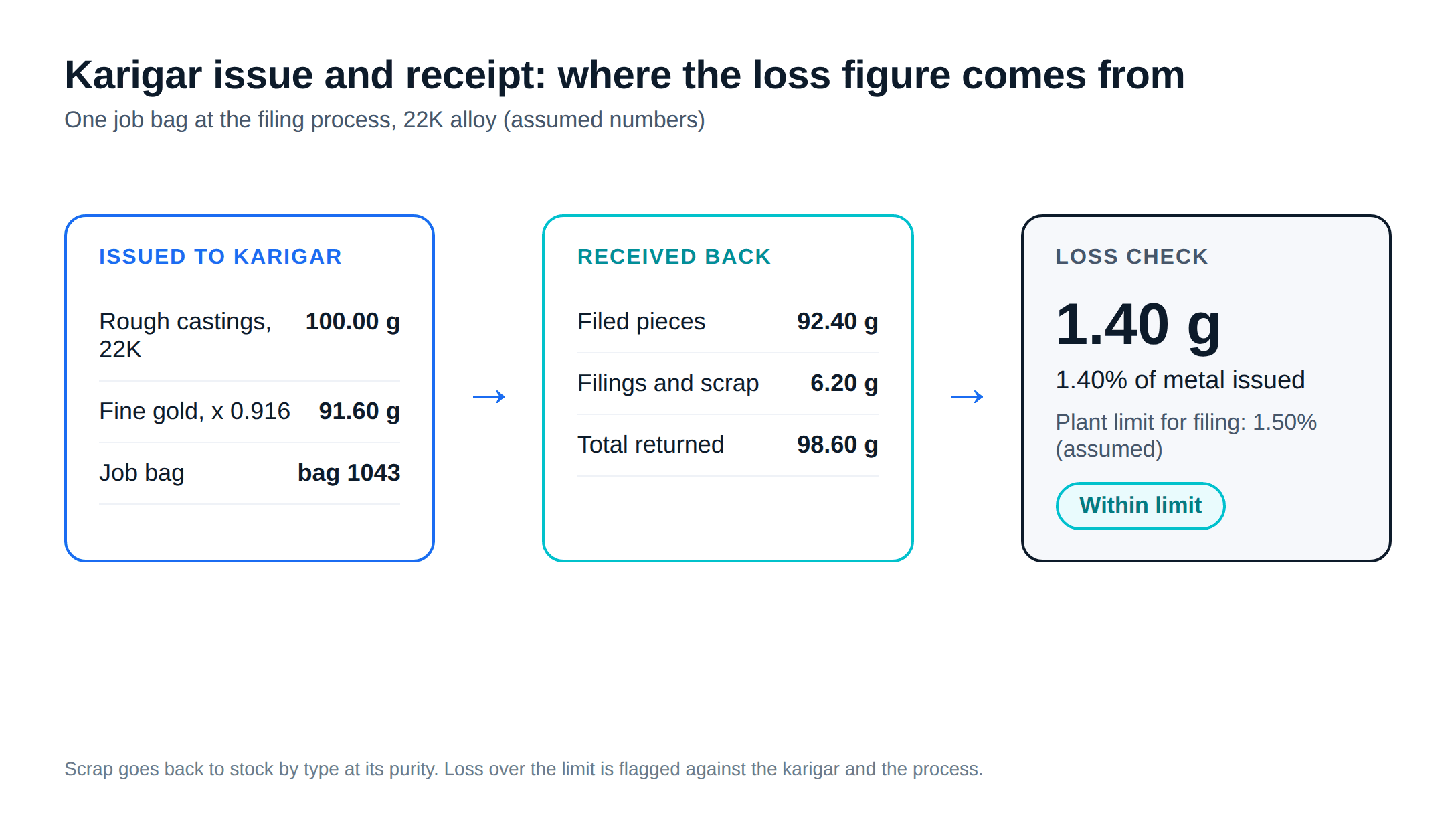
This is where the gram gaps come from. A karigar takes 100 g of 22K alloy and returns finished pieces plus filings, sprues and scrap. The difference is loss. Some loss is expected, because filing, polishing and melting all shed metal, and the plant sets a limit for each process. The ERP should:
- Issue metal against a job or bag, recording gross weight, purity and fine weight.
- Receive back finished pieces, partly finished pieces and each kind of scrap separately, all by weight.
- Compute loss in grams and as a percentage, compare it with the limit for that process, and flag anything over.
- Keep a running metal balance per karigar, so you know at any moment how much of your gold each one holds.
When the karigar is an outside job worker rather than an employee, the GST rules on job work apply too. Metal sent under a challan has to come back within the time limit, and the principal reports it on ITC-04. Our ITC-04 and job work guide covers the challans, the return limits and who files when. The manufacturing side, from wax to polishing, is in our post on jewellery manufacturing software.
Stones and diamonds
Studded jewellery needs a stone record per piece: stone type, count, carat weight, shape, size and quality grade, plus a certificate number for diamonds graded by a lab. Stones are valued separately from metal, and they are taxed differently when sold loose. Under the rate notification in force from 22 September 2025, rough diamonds sit at 0.25% and other diamonds at 1.5%, while finished jewellery sits at 3%.
For the ERP, that means loose stones are their own stock items, issued to the setter and consumed into the piece, with the stone weight subtracted from gross weight to get net weight.
HUID hallmarking: what the ERP needs to record
Mandatory hallmarking of gold jewellery started on 23 June 2021 in 256 districts. BIS has added districts in phases since then, and its phase-wise coverage list shows the eighth phase on 3 August 2026, bringing the total to 392 districts. Check that list for your own district, because it keeps growing.
Since 1 July 2021, the hallmark on gold jewellery has three parts, per BIS's brief on hallmarking: the BIS standard mark, the purity in carat and fineness, and a six-digit alphanumeric HUID that buyers can verify in the BIS Care app. For silver, HUID-based hallmarking became available on a voluntary basis from 1 September 2025.
The Hallmarking Order does not apply to every article. Its exemptions include articles meant for export that meet the foreign buyer's specification, articles under 2 grams, and "any manufactured article which is not substantially complete, and which is intended for further manufacture", which matters to manufacturers holding work in progress. BIS's brief also lists Kundan, Polki and Jadau articles and some turnover cases among the exemptions, subject to the conditions in the current orders.
What the ERP needs: a HUID field on each finished piece, a status for pieces sent to and back from the assaying and hallmarking centre, and the HUID printed on the invoice and the tag. Weight recorded at the centre should match your own receipt weight, so store both.
GST on gold jewellery and on job work
Two rates matter most for a jewellery manufacturer. Check both against the current notifications before you set up tax templates.
- 3% on jewellery: articles of jewellery of precious metal fall under heading 7113, listed at 3% in Notification 9/2025-Integrated Tax (Rate), which took effect on 22 September 2025. The 2025 rate rationalisation did not change it.
- 5% on job work for jewellery: entry 26 of Notification 11/2017-Central Tax (Rate) taxes job work on plain and studded jewellery of gold and other precious metals under Chapter 71 at 2.5% central tax, 5% in all. The 56th GST Council's job work changes moved umbrellas, printing, bricks, pharmaceuticals and leather to 5% and left Chapter 71 out of the list. Job work on diamonds has its own entry and rate.
The practical effect: when you sell jewellery made from your own gold, the whole invoice, making charges included, takes 3%. When a buyer or principal supplies the gold and you only do the work, your labour charge is job work at 5%. Your ERP should pick the right template from the transaction type, not leave it to the billing clerk.
Where ERPNext fits, and where it needs a custom Frappe app
ERPNext is a full ERP with no licence fee, and its accounting, GST compliance (through the India Compliance app), purchasing, sales and subcontracting flow all apply to a jewellery business. The gap is in how it counts stock.
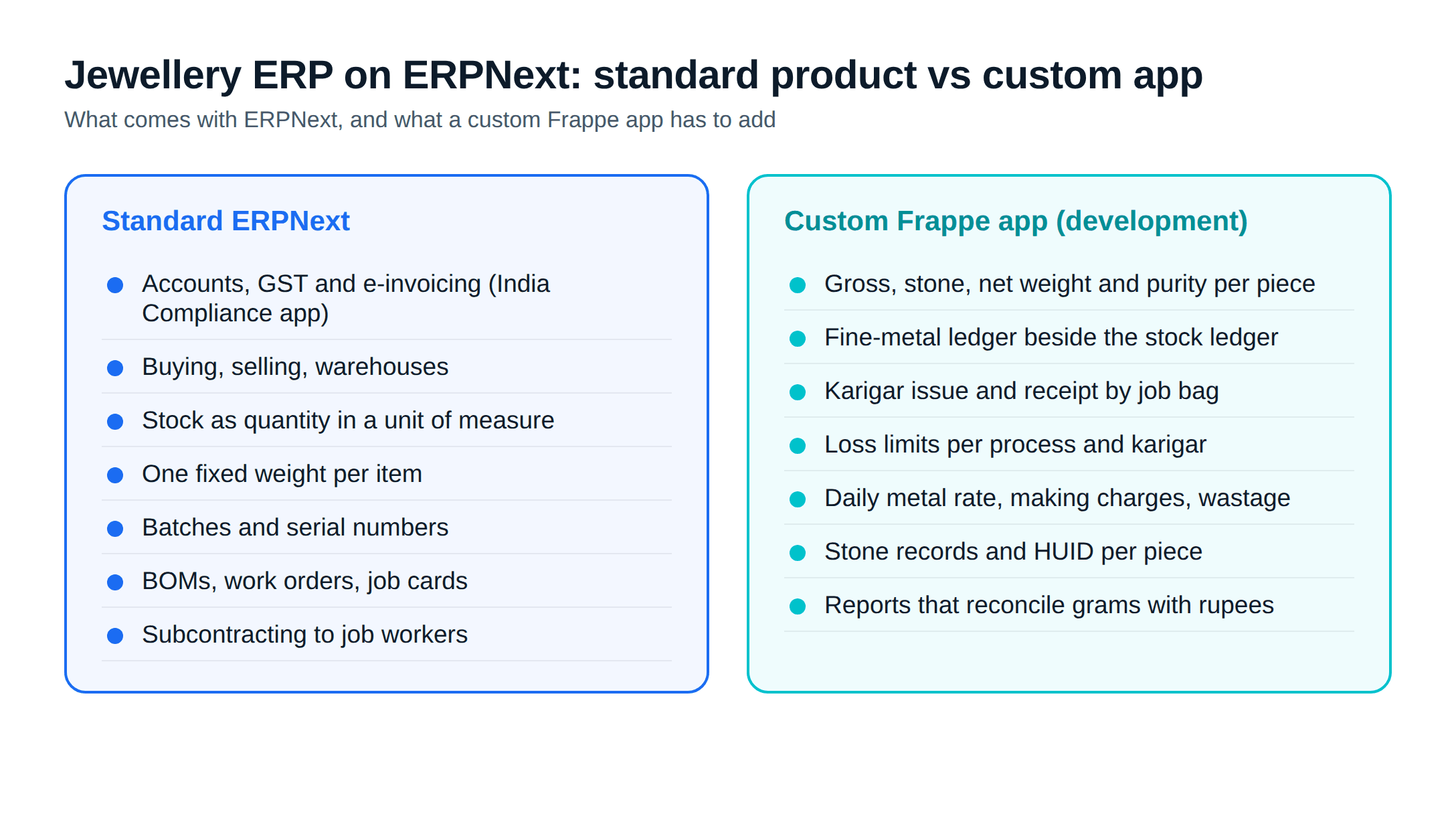
Standard ERPNext counts stock as a quantity in a unit of measure. Its Item has a default unit (Nos, Kg, gram), alternate units with fixed conversion factors, and a "Weight Per Unit" field that holds one fixed weight for the item. That works for screws. It does not work for jewellery, where every piece has its own gross, net and stone weight and every lot has a purity that has to roll up to fine weight. Batches and serial numbers help (a serial number per tagged piece, a batch per lot of alloy), but they do not compute fine weight, carry a metal balance per karigar, or price making charges and wastage.
Closing that gap takes a custom Frappe app: new fields and documents for weights and purity, a fine-metal ledger alongside the stock ledger, karigar issue and receipt with loss limits, metal rate and making charge pricing, stone records and HUID per piece, and reports that reconcile grams with rupees. That is custom ERPNext development, and it should be scoped and quoted as development, not hidden inside a "standard setup".
Keeping all of that in a separate app, rather than editing ERPNext's own code, is what keeps upgrades possible later. The standard modules, GST setup, data migration and training are ERPNext implementation work, and the two run together on a jewellery project.
Best jewellery ERP software: how to choose
We are not going to rank vendors. A ranked list from an implementer is an advert, and the right system depends on whether you make, trade or both. Use these criteria instead, and score every option, ERPNext included, on the same list.
- Stock by gross weight, net weight, stone weight and purity, with fine weight computed on every movement
- Separate locations for vault, each process, each karigar and stock on approval
- Karigar issue and receipt by bag, with scrap types, loss in grams and percent, and a limit per process
- Making charges per gram, per piece or as a percentage, plus wastage, on quotes and invoices
- Stone records per piece: type, count, carat weight, quality and certificate number
- HUID per piece, hallmarking status, and the HUID on tags and invoices
- GST templates for 3% sales and 5% job work, with job work challans and ITC-04
- Daily metal rate entry that drives pricing without manual edits
- Full data export and a clear answer to "what happens to my data if I leave"
- A reference you can call that runs a similar process, not just a demo account
Red flags in a jewellery ERP demo
- Weights appear only as text fields or remarks, not as numbers the stock ledger uses
- Karigar loss is a report someone fills in, not a calculation from issue and receipt
- The vendor cannot show a GST invoice that splits metal, making, stones and tax
- Purity is a product name ("22K Chain") rather than a field
- There is no export of your stock and ledger data
Then run the test that settles it: give each shortlisted vendor one real job bag, one karigar issue and receipt with scrap, and one wholesale invoice with stones, and watch them enter it.
If ERPNext is on your list, ERPNext implementation explains how we scope a project before setup starts, and the ERPNext development page covers the custom app side.
Frequently asked questions
What is jewellery ERP software?+
It is an ERP built around how jewellery businesses count stock: by gross weight, net weight and purity rather than by piece alone. For a manufacturer or wholesaler it also covers making charges and wastage, metal issued to and received from karigars, stone details, HUID numbers from hallmarking, GST and accounts in one system.
Can ERPNext be used as jewellery ERP software?+
Yes, with custom development. Standard ERPNext tracks stock by quantity in a unit of measure, and its weight per unit is a fixed item attribute, so it does not keep a running ledger of fine gold by purity out of the box. A custom Frappe app adds weight and purity fields, a metal ledger, karigar issue and receipt with loss limits, and making charge pricing on top of ERPNext's accounting and GST.
What is the GST rate on gold jewellery and on jewellery job work?+
Articles of jewellery of precious metal (heading 7113) are taxed at 3%, and the September 2025 rate changes left that rate in place. Job work on jewellery of gold and other precious metals under Chapter 71 is taxed at 5%. Job work on diamonds has its own entry, so check the current rate notification before you bill.
Is HUID hallmarking mandatory for all gold jewellery?+
It is mandatory for gold jewellery and artefacts sold in the districts listed in the Hallmarking Order, which BIS had expanded to 392 districts by its eighth phase on 3 August 2026. The order exempts some cases, including articles under 2 grams, articles for export that meet the buyer's specification, and articles that are not substantially complete and are meant for further manufacture.
What should I look for in the best jewellery ERP software?+
Check that it holds stock by gross weight, net weight and purity, converts to fine weight, records karigar issue and receipt with a loss limit per process, stores stone details and HUID per piece, handles making charges and wastage on invoices, files GST and ITC-04 correctly, and lets you take your data with you. Test it on your own bags and invoices before you sign.
Related reading
- Jewellery manufacturing software: the production workflow, job bags and loss per process.
- ITC-04 and job work under GST: tracking metal at outside karigars.
- ERPNext production planning, BOM and MRP: how work orders and job cards run.
Free ERPNext fit check
Will ERPNext fit your factory?
Answer a few quick questions. On a short call we tell you whether ERPNext fits how you make, stock and sell, and what the rollout looks like.
Check my fit →About the author

- Tags
- erpnext
- erp
- india
- manufacturing
- jewellery
Subscribe to Our Newsletter
The AI Build Brief: practical playbooks on how to build, price and ship AI features, in one short email every other week.