

In most businesses, automation removes work. In a practice built on judgment, automating the wrong thing removes the product. A consultant whose analysis reads like it could apply to anyone has nothing left to sell, which is why generic AI advice is more dangerous here than in almost any other business.
TL;DR
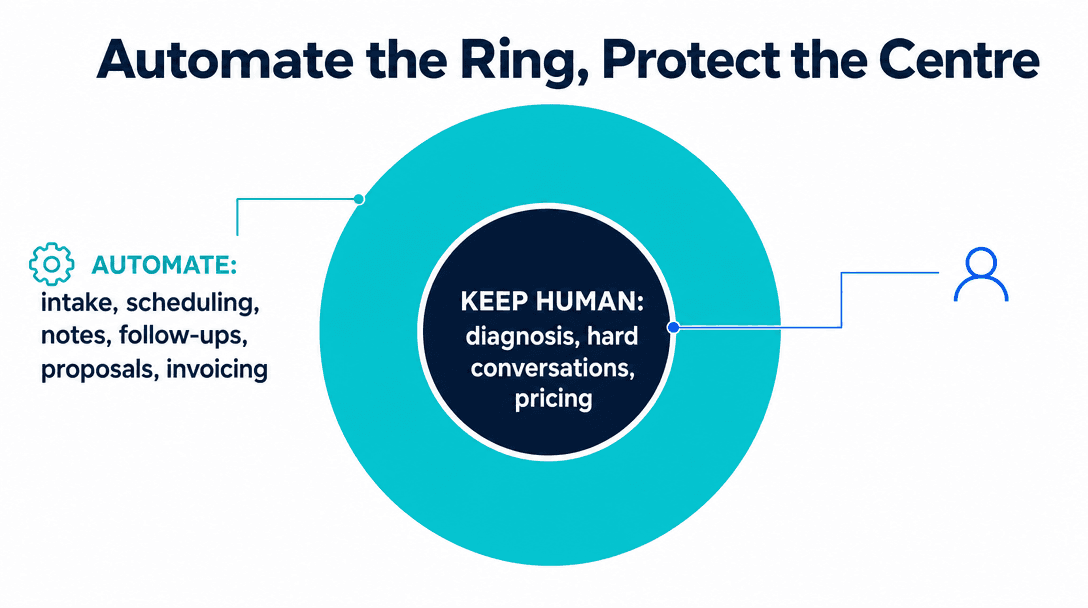
- The rule: automate everything around the engagement, nothing inside it.
- Safe to automate: intake, scheduling, notes, follow-ups, proposal drafting, invoicing, content repurposing.
- Never automate: diagnosis, the difficult conversation, pricing and scope decisions, the referral call.
- Realistic saving for a solo practitioner is five to ten hours a month, not a transformed practice.
- Tell clients if AI processes their session conversations, and check whether the vendor trains on that data.
- Clients do not object to automated admin. They object to automated judgment, and they detect it faster than you expect.
The line
If a client would be annoyed to learn a machine did it, do not let a machine do it. If a client would be relieved it happened fast, automate it. That test resolves almost every case, and it is more reliable than any list because it centres the person paying you.
Why this industry is different
Most AI advice assumes the work is the bottleneck and the output is standardised. In coaching and consulting, neither holds.
Your product is a specific person's judgment. Clients are not buying a framework, they can download frameworks. They are buying your read on their situation, informed by the hundred situations you have seen before. Anything that dilutes that dilutes what they bought.
Trust is the delivery mechanism. A client acts on advice because they trust the person giving it. That trust is fragile in a way that a support ticket queue is not.
The economics are capacity-bound, not volume-bound. You cannot serve 10,000 clients. You have a finite number of hours and the question is what share of them is billable. That reframes automation entirely: the goal is not scale, it is converting administrative hours into billable or personal ones.
That last point is the useful one. Every automation decision in a practice should answer: does this give me back an hour, without touching the hour clients pay for?
Automate: the work around the engagement
Intake and pre-session context. Structured intake forms, plus a summary of what the client has said before, assembled before you walk in. This is preparation you should do and often do not, and it makes you better in the room rather than replacing you in it.
Scheduling, rescheduling, reminders. Pure administrative overhead with no relationship value. Automate it entirely.
Session notes and summaries. The highest-value automation available to most practices. Transcribing and summarising a session, extracting agreed actions, and drafting the follow-up saves 20 to 40 minutes per session and produces a better artifact than the notes you would have written from memory three hours later. Disclose it, and check the vendor's data policy first.
Follow-up emails. Drafted from the session summary, reviewed and sent by you. The review step is not optional.
Proposal and contract drafting. From your own past proposals and your notes on the conversation. Saves an hour or two each. You still decide scope and price.
Invoicing and payment chasing. Nobody's relationship improves because you personally wrote the reminder about the overdue invoice.
Content repurposing. Turning a talk into an article, an article into a newsletter, a session insight into a post. The thinking is already yours; this is reformatting.
Keep human: the work that is the product
The diagnosis. Working out what is wrong is the job. A model can suggest hypotheses from your notes, and that is a fine input. It cannot be accountable for the conclusion, and accountability is what the fee is for.
The difficult conversation. Telling a founder their hire is not working, telling a client the project should stop, telling someone their plan is wrong. These require presence and the willingness to be personally accountable for the discomfort.
Pricing and scope decisions. These encode your read on risk, on the client, and on your own capacity. Nobody else has that information, including a model that has read your past proposals.
The referral. Deciding this client needs someone else is a judgment about fit and about your own limits. It is also the decision that most builds long-term trust.
Anything where you are the reason they hired you. If a client chose you over three alternatives, the differentiator is the part you must keep.
The grey zone
Three areas where reasonable practitioners disagree, and where the answer depends on how you work.
Content and thought leadership. Your published thinking is a hiring signal. Using AI to draft from your own notes and edit heavily is reasonable. Publishing generated commentary you have not really thought about is a slow erosion of the only asset that generates inbound work. The test: would you defend every claim in it on a call tomorrow?
Outreach and prospecting. Personalisation at scale is the pitch, and it is also how you become indistinguishable from the automated outreach everyone already ignores. Selective and personal beats volume in a referral-driven business.
Client check-ins. An automated "how is it going" is worse than nothing, because it looks like care and is not. If the check-in matters, do it. If it does not matter, stop doing it rather than automating it.
Disclosure and data handling
If a tool processes recordings or transcripts of client conversations, tell clients and get their agreement. Then check two things in the vendor's terms: whether your data is used for model training, and how long it is retained. Coaching and consulting conversations frequently contain commercially sensitive or personal material, and clients who discover after the fact that it was processed by an undisclosed third party will treat it as a trust breach, correctly.
What this is actually worth
Honest arithmetic for a solo practitioner:
| Task | Time saved | Frequency |
|---|---|---|
| Session notes and follow-up | 20-40 min | Per session |
| Proposal drafting | 60-90 min | Per proposal |
| Scheduling and reminders | 2-3 hrs | Per month |
| Invoicing and chasing | 1-2 hrs | Per month |
| Content repurposing | 1-2 hrs | Per piece |
For a practitioner running eight sessions a week and two proposals a month, that lands around five to ten hours a month. Tooling costs $50 to $200 a month for most of it.
Five to ten hours is a real gain. It is also considerably less than the category's marketing implies. If those hours become billable, the return is obvious. If they become evenings, that is also a legitimate answer and it is worth being explicit about which one you are buying.
What it is not is a route to serving twice as many clients. The constraint in a judgment practice is your attention in the room, and no admin automation relieves that.
Where to start
- Session notes. Highest saving, lowest risk, immediate quality improvement in what clients receive. Disclose it and check the data policy.
- Scheduling. Pure overhead removal, no relationship cost.
- Proposal drafting from your own templates. Meaningful per-proposal saving, and you keep every decision that matters.
Then stop and measure for a month before adding anything. In a practice this size, tool sprawl costs more in attention than it saves in hours, and four subscriptions at $80 a month is real money against a solo practitioner's overhead.
The bottom line
The rule is simple and it holds across every practice of this shape: automate the ring, protect the centre. Everything surrounding the engagement is administrative drag that quietly consumes your capacity. The engagement itself is the entire reason a client chose you rather than a cheaper alternative or a template.
Clients do not object to a fast, clear summary arriving an hour after a session. They object, immediately and permanently, to advice that could have been written for anyone. Keep that boundary and AI is straightforwardly useful here. Blur it and you automate away the only thing you were selling.
Next step: To pick and prove your first automation properly, see the 30-day rollout plan. For the wider process view, see AI workflow automation.
Frequently asked questions
What should coaches and consultants automate with AI?+
Automate the work surrounding the engagement, never the engagement itself. That means intake forms and pre-session context gathering, scheduling and rescheduling, session notes and summaries, follow-up emails with agreed actions, proposal and contract drafting from your own templates, invoicing and payment chasing, and repurposing your existing material into other formats. All of these are administrative work that consumes billable capacity without being the thing clients pay for.
What should a consultant never automate?+
The diagnosis, the difficult conversation, and the judgment call. Clients are paying for a specific person's read on their specific situation, so anything that substitutes generic analysis for that read removes the product. Also keep the moment of delivering bad news, any conversation involving conflict, and the decision to refer someone elsewhere. If a task requires you to be accountable for the outcome, you should be doing it rather than reviewing a machine's version of it.
Is it ethical for a coach to use AI for session notes?+
It is common and generally accepted, with two conditions. Tell your clients, because recording and processing a confidential conversation through a third-party service is something they have a right to know about and consent to. And check the vendor's data handling, specifically whether conversations are used for model training and how long they are retained. Coaching and consulting conversations are frequently sensitive, and quiet processing through an undisclosed tool is a trust problem long before it is a legal one.
Can AI write proposals for consulting work?+
It drafts them well from your own past proposals and your notes from the discovery conversation, which typically saves an hour or two per proposal. It cannot decide scope, price, or whether to take the work, and those are the parts that determine whether the engagement succeeds. The productive pattern is dictating the shape of the engagement after the call, letting AI produce the document, then editing the sections where your judgment appears.
How much time does AI actually save a solo consultant?+
Realistically five to ten hours a month for a solo practitioner across notes, follow-ups, scheduling, proposals, and invoicing. That is meaningful when it converts into billable capacity or recovered evenings, and it is far below what most tooling vendors imply. Treat it as removing administrative drag rather than as a transformation, and be sceptical of claims that AI will double your practice's capacity.
Will clients think less of me for using AI?+
They mind automated judgment and generic-feeling output. They do not generally mind automated admin. A client who receives a clear session summary within an hour experiences better service, whatever produced it. The same client receiving advice that reads like it could apply to anyone loses confidence quickly. The distinction clients respond to is not whether AI was involved, it is whether the thinking was yours.
Free PDF
The 2026 AI Development Rate Sheet
Build, agent, RAG and consulting rates by tier, in one PDF, so you can check a quote before you sign it.

Written by
Pankaj Kumar
Founder · Metageeks Technologies
Metageeks builds software and AI products for growing businesses. Every build is scoped in writing before it starts, and you see progress every week. We write about what holds up once it reaches production.
Connect on LinkedInThe AI Build Brief
Ship AI that holds up in production.
Practical playbooks on how to build, price and ship AI features, in one short email every other week.