

Every appointment-booking vendor sells the same thing: smarter reminders. But reminders only address customers who forgot, and forgetting is not why most people miss appointments. The revenue is in what happens in the 24 hours after a slot opens up, and that is exactly where most salons, spas, and clinics do nothing at all.
TL;DR
- The cost of a no-show is not the service price, it is the service price you failed to resell. Your backfill rate is the variable.
- Reminders help the "forgot" segment and do nothing for the "changed my mind" segment. Most businesses already run them.
- The biggest lever is automated waitlist backfill: filling the empty slot within hours, not preventing the cancellation.
- Deposits change behaviour more than any message, and suppress some bookings. Apply selectively, not universally.
- Industry no-show ranges are too wide to be useful. Pull 90 days from your own booking system.
- If you handle identifiable patient data, get a signed BAA before a trial, not after.
The short answer
Stop optimising the reminder and start optimising the backfill. If a cancelled slot currently goes empty, the automation that fills it from a waitlist recovers real revenue immediately, whereas a better reminder recovers a fraction of one segment. Measure your no-show rate and your current backfill rate. The gap between them is your opportunity.
The number that actually matters
Most businesses track no-show rate. Very few track backfill rate, and backfill rate is what turns a no-show into a cost.
Cost of a no-show = service price x (1 - backfill rate)
If a $180 facial no-shows and you refill that slot, the cost is close to zero. If it goes empty, the cost is $180 of capacity you can never resell, because time is perishable inventory.
Worked example for a small med spa:
| Input | Value |
|---|---|
| Average service price | $180 |
| Monthly appointments | 300 |
| No-show and late-cancel rate | 10% (30 appointments) |
| Current backfill rate | 20% |
| Cost per unfilled slot | $144 |
| Monthly loss | $3,456 |
| Annual loss | $41,472 |
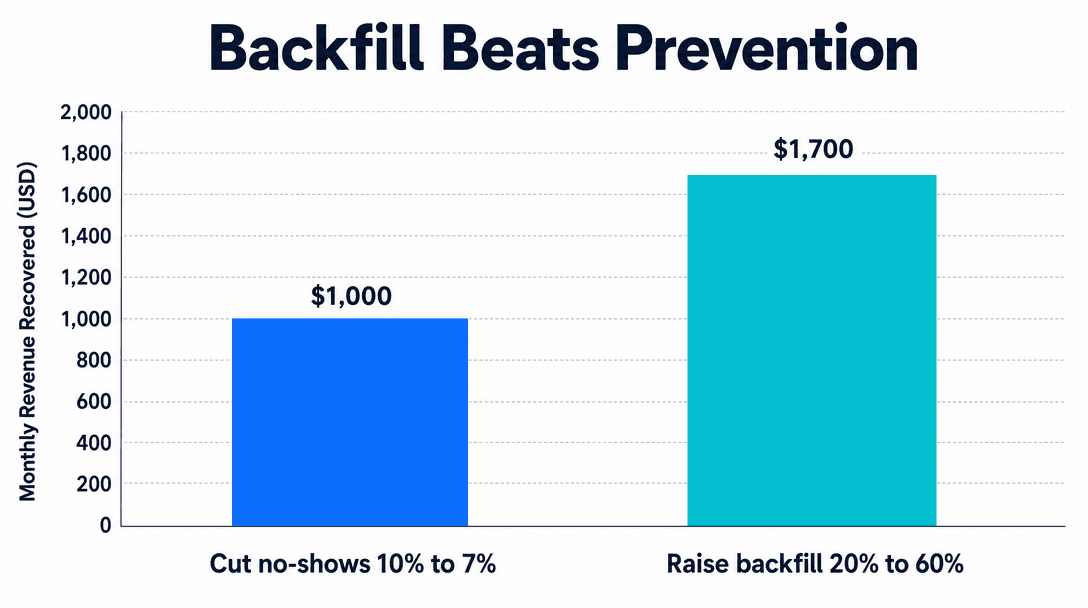
Now change one variable. Raising backfill from 20 percent to 60 percent, without touching the no-show rate at all, cuts that monthly loss to $1,728. You have recovered over $20,000 a year without persuading a single customer to behave differently.
That is the case for prioritising backfill, and it is why reminder-focused tooling underperforms its pitch.
Why reminders underperform
No-shows have at least four distinct causes, and reminders address one of them.
| Cause | Roughly what it looks like | Does a reminder help? |
|---|---|---|
| Forgot | Booked weeks ago, life happened | Yes, this is the reminder's job |
| Conflict | Something came up, meant to call | Only if rescheduling is one tap |
| Changed mind | Cooled off, or found somewhere else | No |
| Never intended | Booked speculatively, low commitment | No, deposits address this |
Most businesses have run reminders for years, which means the "forgot" segment is already largely captured. Adding AI to a reminder you already send moves a small number. That is not nothing, but it is not the project.
Where message design helps is the conflict segment, and the mechanism is not persuasion, it is friction. A reminder that requires a phone call to reschedule converts a conflict into a no-show. A reminder with a one-tap reschedule link converts it into a retained booking on a different day. That single change is usually worth more than any AI in the message copy.
The three levers that actually move the number
1. Automated waitlist backfill. The highest-return automation available to an appointment business, and the one most are not running. When a slot opens, the system immediately contacts waitlisted clients who match that service and time window, first to confirm takes it, and the calendar updates itself. Speed is the whole game: a slot released at 9am for a 2pm appointment has hours of sale time, and a slot released manually at lunchtime has almost none.
This is where AI adds real value beyond a rules engine, because matching is fuzzy. Who on the waitlist wants this service, at this time, with this provider, and is likely to say yes on short notice? That is a ranking problem, and ranking is something models do well.
2. Selective deposits or card on file. The strongest behavioural intervention and the one with a real cost. Deposits suppress some bookings, including from customers who would have shown up. The usual resolution is to apply them selectively: high-value services, new clients, peak slots, or anyone with a previous no-show. That captures most of the effect without deterring your reliable regulars. Test it on one segment, and watch booking volume alongside no-show rate, because a lower no-show rate on 30 percent fewer bookings is a loss dressed as a win.
3. Confirmation with frictionless rescheduling. Ask for an explicit confirm 48 hours out, and make rescheduling a single tap. Unconfirmed bookings become your backfill signal, so the slot goes to the waitlist before it is empty rather than after. This converts a reactive process into a predictive one.
Sequence matters
Run these in order. Backfill first, because it recovers revenue immediately with no customer behaviour change and no risk of suppressing bookings. Confirmation and easy rescheduling second, because it feeds the backfill system earlier. Deposits last, because they are the only one that can reduce your top line.
The compliance line for clinics and medical aesthetics
If you handle identifiable patient information, appointment tooling is not a purely commercial decision.
Any vendor processing appointment data tied to identifiable patients on your behalf needs to sign a Business Associate Agreement and support appropriate technical and administrative safeguards. Get it in writing before a trial, not after you have loaded a client list into a system.
Two specific traps. First, SMS and email reminders containing treatment details are disclosures, and the content of the message matters. "Your appointment is confirmed for Tuesday at 2pm" is very different from naming a procedure. Second, med spas offering medical treatments frequently assume they are outside HIPAA's scope because they feel like a retail business. That assumption belongs with your own counsel, not with a vendor's marketing page or with this article.
What a working setup looks like
- Waitlist capture at booking. When someone cannot get their preferred slot, capture the alternative they would accept. Without this input, backfill automation has nothing to work with, and this is the step most businesses skip.
- Confirmation 48 hours out, with one-tap confirm and one-tap reschedule.
- Unconfirmed at 24 hours triggers the waitlist, quietly, before the slot is technically empty.
- Instant backfill on any cancellation, ranked by fit and likelihood to accept, contacted in sequence rather than all at once so you do not oversell the slot.
- Selective deposits on the segments your data says are the problem.
- Monthly review of no-show rate and backfill rate as a pair. Neither means much alone.
None of this requires a large build. Most modern booking platforms handle steps one to three, and the AI value concentrates in step four. For a business running several hundred appointments a month, off-the-shelf tooling at $100 to $400 a month is usually the right answer. A custom build only earns its cost when your matching logic is unusual or your systems will not integrate.
What most appointment businesses get wrong
They measure no-shows and not backfill. So they buy the tool that lowers the metric they watch, which is the less valuable one.
They send more reminders. Past two, additional reminders produce diminishing returns and start reading as nagging.
They apply deposits universally after a bad month. This is an emotional decision that reliably costs more in suppressed bookings than it saves in no-shows.
They keep the waitlist in someone's head. A waitlist that exists as a receptionist's memory cannot be automated against, and it disappears when that person is off.
They treat late cancellations as fine. A cancellation at 8am for a 10am slot is a no-show with better manners. Track them together, because the backfill window is what separates recoverable from lost.
The bottom line
The no-show problem is usually framed as a customer behaviour problem, which makes it feel unfixable. Reframed as a capacity resale problem, it becomes an automation problem with a clear number attached.
Pull 90 days of booking data. Calculate no-show rate and backfill rate. If backfill is under 30 percent, that is your project, and it will return more than any reminder system you could buy, without asking a single customer to change what they do.
Next step: For the general method of proving an automation before you commit, see the 30-day first automation plan. For inbound call capture, which is the adjacent leak in most appointment businesses, see missed calls in home services.
Frequently asked questions
What is a normal no-show rate for a med spa or salon?+
Commonly reported ranges sit around 10 to 20 percent for salons and med spas, and healthcare no-show rates vary far more widely by specialty, from single digits to 30 percent or higher in some outpatient settings. These ranges are wide enough that industry figures are close to useless for your decision. Pull 90 days from your booking system, count no-shows and late cancellations separately, and use your own number. It takes an afternoon and it is the only figure that matters.
Do AI appointment reminders actually reduce no-shows?+
Reminders reduce forgetting, which is only one cause of no-shows. They work well on the segment that lost track of the date and poorly on the segment that changed their mind, had a conflict, or never intended to come. Most businesses already run reminders, so the marginal gain from making them AI-powered is small. The larger opportunity is what happens after someone cancels or fails to confirm, which is where most businesses do nothing at all.
What actually reduces no-shows the most?+
Three levers, in order of impact for most appointment businesses. Backfilling the empty slot from a waitlist, which recovers revenue rather than preventing loss. Deposits or card-on-file for high-value or repeat-offender bookings, which changes behaviour more than any message does. And confirmation with an easy reschedule path, since a customer who reschedules is retained revenue and a customer who ghosts is not. Reminders alone are the weakest of the common interventions.
How much does a no-show actually cost?+
Multiply the slot's service price by the share of slots you cannot rebook. If a facial is $180 and you fill 20 percent of no-show slots today, each no-show costs about $144 of lost revenue. At 30 no-shows a month that is roughly $4,300 monthly, or about $52,000 a year. The important variable is your current backfill rate, because the cost of a no-show is not the price of the service, it is the price of the service you failed to resell.
Is AI appointment software HIPAA compliant?+
Some are and many are not, and the distinction matters legally if you are a covered entity. Any vendor handling appointment details tied to identifiable patients needs to sign a Business Associate Agreement and support appropriate safeguards. Ask for the BAA in writing before any trial, not after. Med spas offering medical treatments should assume they are in scope rather than assume they are not, and take that question to their own counsel rather than to a vendor's marketing page.
Should I charge deposits to stop no-shows?+
Deposits are the most effective single intervention and the one with the clearest downside, since they suppress some bookings outright. The usual compromise is applying them selectively: to high-value services, to new clients, to peak slots, or to clients with a prior no-show. That captures most of the behavioural benefit without discouraging your reliable regulars. Test it on one segment and measure booking volume alongside no-show rate, because a lower no-show rate on far fewer bookings is not a win.
Free PDF
The 2026 AI Development Rate Sheet
Build, agent, RAG and consulting rates by tier, in one PDF, so you can check a quote before you sign it.
Written by
Pankaj Kumar
Founder · Metageeks Technologies
Metageeks builds software and AI products for growing businesses. Every build is scoped in writing before it starts, and you see progress every week. We write about what holds up once it reaches production.
Connect on LinkedInThe AI Build Brief
Ship AI that holds up in production.
Practical playbooks on how to build, price and ship AI features, in one short email every other week.