

A missed call in most industries is a delayed conversation. In the trades it is usually a lost job, because the customer with no hot water is not leaving a voicemail. They are dialling the next company on the list. That single behavioural difference makes answer rate the most under-measured revenue lever in home services.
TL;DR
- Home-service callers rarely leave voicemail. A missed call is usually a job that went to a competitor, not a delayed one.
- Expected value of a missed call = average job value x your booking rate on answered calls. Run it before deciding the problem is small.
- Your phone system already logs the answer rate. Pull 30 days split by hour and weekday. Most owners are surprised.
- AI handles the known-shape parts well: capture details, check availability, book standard jobs, take after-hours callbacks.
- It must never attempt emergencies or diagnosis. Build and test the emergency transfer path before the booking path.
- Off-the-shelf usually pays for itself within two or three captured jobs a month. Custom builds need field-service integration to justify the cost.
The short answer
Pull your last 30 days of call logs and find your answer rate by hour. Multiply the missed calls by your average job value and your booking rate. If that number is more than a few thousand dollars a month, AI call capture is one of the highest-return automations available to a trades business, and it is one of the few where the payback is measurable inside 60 days.
Why missed calls cost more in the trades
Three things make home services different from most industries that buy phone automation.
The call is urgent. No heat in February, no water, no power. The caller's tolerance for waiting is close to zero because the problem is actively getting worse.
The caller has a list. They searched, they got a map pack with three to five local companies, and they are dialling in order. You are not competing for a callback slot, you are competing for who picks up first.
Voicemail behaviour is terrible. Because of the first two, the dominant response to voicemail is to hang up and dial the next number. In industries where customers wait for a callback, a missed call is a delay. Here it is usually a transfer of revenue to a competitor, and it is invisible on your books because you never knew the job existed.
The compounding problem: the times you are most likely to miss calls are exactly the times demand spikes. Heat wave, cold snap, storm. Every tech is on a job, the phone is ringing constantly, and one person is trying to answer it.
The math nobody runs
This calculation takes ten minutes and it decides whether the rest of this post matters to you.
Expected value of a missed call = average job value x booking rate on answered calls
Then:
Monthly leak = missed calls per month x expected value per call
Worked example for a small HVAC company:
| Input | Value |
|---|---|
| Average job value | $450 |
| Booking rate on answered calls | 40% |
| Expected value per inbound call | $180 |
| Missed calls per month | 25 |
| Monthly revenue leak | $4,500 |
| Annual revenue leak | $54,000 |
Use your own numbers. The point is not the example, it is that the figure is almost always larger than owners assume, because the missed calls were never counted as anything. There is no line in the P&L labelled "jobs we did not know about."
Where to find your real numbers: your phone provider or call-tracking system logs every unanswered inbound call. Export 30 days. Split by hour of day and day of week. Two patterns almost always appear, and both are fixable.
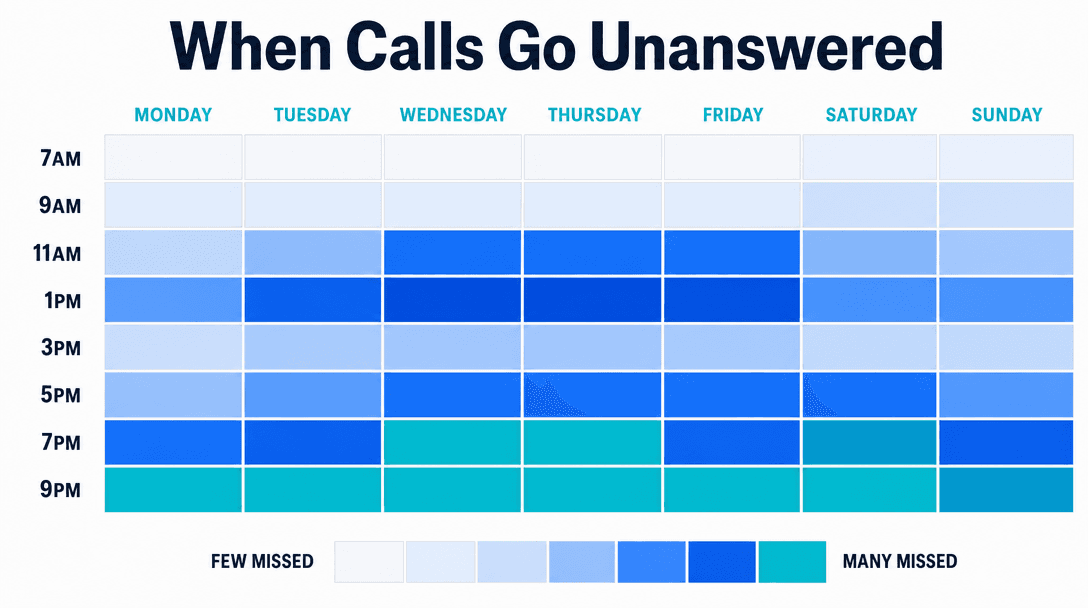
The two gaps, and what fixes each
Gap one: after hours. Evenings, nights, weekends. For most trades businesses this is 60 percent or more of the week by clock time, and a meaningful share of emergency-priority calls. The fix is not a full AI receptionist, it is reliable capture: get the name, address, phone number, and a description of the problem, tell the caller honestly when someone will call back, and put a structured job record in front of your dispatcher first thing. If you offer genuine emergency service, route those straight to the on-call tech instead.
Gap two: the midday crush. Everyone is on a job, the office is at lunch, calls stack up. This is harder because the calls are live and the caller expects a person. The fix is overflow: the AI picks up on the third or fourth ring when nobody else has, handles booking if the job is standard, and transfers immediately if it is not.
Both are capture problems, not conversation problems. That distinction matters because it sets the bar for what the technology has to be good at, and the bar is much lower than "replace my dispatcher."
What AI should and should not handle
Should handle:
- Capturing name, service address, callback number, and problem description
- Checking availability and booking a standard, priced service call
- Confirming, rescheduling, or cancelling an existing appointment
- Answering hours, service area, call-out fee, and basic pricing questions
- Taking after-hours details and setting an honest callback expectation
Should never handle:
- Anything the caller signals as an emergency: gas smell, burst pipe flooding, burning smell, sparking, no heat with an infant or elderly person in the home
- Diagnosis of an unfamiliar problem
- Quoting a price on non-standard work
- Negotiating, or handling an angry callback about existing work
Build the emergency path first
The failure that ends a deployment is not a missed booking, it is an AI agent cheerfully offering a Tuesday appointment to someone reporting a gas smell. Define the emergency keyword and intent set, route those calls to a human immediately with no conversational attempt, and test that path harder than anything else you test. If a vendor cannot show you exactly how emergency detection works, that is disqualifying for this industry.
What a working setup looks like
The version that produces results in a trades business is unglamorous:
- Ring your team first. AI picks up only after three or four rings, or outside business hours. It is a safety net, not a gatekeeper. Callers who would have reached a person still do.
- Emergency detection on entry. Screened in the first few seconds, transferred immediately if triggered.
- Structured capture. Name, address, phone, problem, urgency. Written into your field-service software as a real job record, not an email.
- Booking for standard jobs only. A defined list of service types with known durations and prices. Everything else becomes a callback request.
- Honest callback promises. "Someone will call you before 8am" beats a vague reassurance, and it is a promise your dispatcher can keep.
- Daily review for the first month. Listen to the calls it handled and the ones it transferred. This is where you find the intents you did not think of.
The integration into your field-service software is usually the part that determines whether this sticks. A capture system that emails your dispatcher creates a second inbox to monitor and gets abandoned within a month. One that writes a job into ServiceTitan, Jobber, Housecall Pro, or whatever you run becomes part of the workflow.
Cost, and where the break-even sits
Usage-based voice pricing generally runs $0.05 to $0.30 per minute, so a four-minute booking call costs under a dollar. Platform fees typically add $50 to $500 a month. A custom agent with real write-integration into your field-service system runs $15,000 to $50,000 to build, and the integration work, not the voice layer, is most of that.
Against a $180 expected value per captured call, an off-the-shelf setup at $300 a month pays for itself on roughly the second captured job. That is an unusually fast payback, and it is why this specific automation tends to work in the trades even when other AI projects do not. The technical bar is low, the revenue per success is high, and the baseline is voicemail rather than a good employee.
Custom builds only make sense once volume is high and the field-service integration is doing real work, such as checking live tech availability and routing by territory. The broader benchmark data on what voice agents can and cannot do is in do voice AI agents actually convert.
The bottom line
Missed calls are the rare business problem that is large, measurable, and cheap to fix. The measurement takes an afternoon with your existing call logs. The fix costs a few hundred dollars a month and pays back within a couple of captured jobs.
The mistake is scoping it as "an AI receptionist," which invites a project. Scope it as call capture with an emergency escape hatch, wire it into the software your dispatcher already uses, and let it pick up only when nobody else did.
Next step: For the underlying performance data on voice agents, see inbound call benchmarks. Appointment businesses lose revenue at the other end of the booking, which is the same no-show problem in med spas and clinics. To find your biggest process leak before committing to a build, a 20-minute scoping call does the measurement work.
Frequently asked questions
How many calls do home-service businesses actually miss?+
Most owners underestimate it badly. Between calls arriving while techs are on jobs, during the lunch rush, after hours, and while the one person answering the phone is already on another line, it is common for a small trades business to miss a quarter or more of inbound calls. The number is knowable rather than a guess: your phone system or call tracking already logs every unanswered call. Pull 30 days, split by hour and weekday, and you will have your real figure in twenty minutes.
Do people actually leave voicemails for HVAC and plumbing companies?+
Rarely, and that is the core of the problem. Home-service calls are usually urgent and the caller has a list of local companies. When a call goes to voicemail, the common behaviour is to hang up and dial the next result rather than leave a message. That means a missed call is usually not a delayed job, it is a job that went to a competitor. This is why answer rate matters far more in the trades than in industries where customers wait for a callback.
How much revenue does one missed call cost an HVAC company?+
Multiply your average job value by your booking rate on answered calls. If a typical job is $450 and you book 40 percent of the calls you answer, each missed call carries roughly $180 of expected revenue. Twenty-five missed calls a month is about $4,500 in expected revenue walking to a competitor, or around $54,000 a year. Use your own numbers rather than these, but run the calculation before you decide the problem is small.
Can AI answer calls for a plumbing or HVAC business?+
It can reliably handle the parts of a service call that follow a known shape: capturing the caller's name, address, and problem description, checking availability, booking a standard appointment, confirming or rescheduling, and taking after-hours details for a morning callback. It should not attempt diagnosis, quoting on unfamiliar problems, or anything that sounds like an emergency. The design goal is capturing the job and routing the caller, not replacing your dispatcher's judgment.
What should an AI call agent never do for a home-service company?+
It should never triage a gas leak, a burst pipe actively flooding, an electrical burning smell, or anything a caller signals as an emergency. These need immediate transfer to a human with no attempt at conversation. It should also avoid quoting prices on anything non-standard, because a wrong number quoted by your phone system is a number you will be held to. Build the emergency detection path first and test it harder than the booking path.
How much does AI call capture cost for a small trades business?+
Usage-based voice services generally run $0.05 to $0.30 per minute in 2026, so a typical four-minute booking call costs well under a dollar, plus a platform fee usually between $50 and $500 a month. A custom-integrated agent that writes directly into your field-service software runs $15,000 to $50,000 to build. For most small trades businesses an off-the-shelf answering service with booking integration clears its cost within the first two or three captured jobs a month.
Free PDF
The 2026 AI Development Rate Sheet
Build, agent, RAG and consulting rates by tier, in one PDF, so you can check a quote before you sign it.

Written by
Pankaj Kumar
Founder · Metageeks Technologies
Metageeks builds software and AI products for growing businesses. Every build is scoped in writing before it starts, and you see progress every week. We write about what holds up once it reaches production.
Connect on LinkedInThe AI Build Brief
Ship AI that holds up in production.
Practical playbooks on how to build, price and ship AI features, in one short email every other week.