

Every e-commerce tool now has an AI tab, and almost none of them will tell you the volume at which their AI stops costing more than it makes. That number exists for every use case, and it is usually the only thing worth knowing before you buy. Here is the actual arithmetic on the three automations stores buy most: cart recovery, review generation, and support deflection.
TL;DR
- Order volume, not revenue, decides whether e-commerce AI pays. Under ~300 orders/month most of it loses money.
- Cart abandonment runs about 70% industry-wide (Baymard). Good recovery sequences get 5-15% back, and AI moves that by a few points, not by double.
- Support deflection is the best first automation because you already have a baseline: ticket volume times cost per ticket.
- Review automation is legitimate for requesting reviews and illegal for writing them. The FTC rule on fake reviews carries real penalties.
- Off-the-shelf beats custom until per-resolution pricing outgrows a fixed monthly cost, usually somewhere past 2,000 support conversations a month.
- Measure escalation satisfaction alongside deflection rate, or you will optimise your way into worse customer experience.
The short answer
Start with support deflection because it is the only one of the three with a baseline you already have. Add cart recovery once you can attribute it honestly. Use AI for review requests, never for review content. And check your order volume against the break-evens below before you take any vendor's ROI slide seriously.
Why order volume decides everything
AI automation in e-commerce has a fixed cost and a variable benefit. The fixed cost is the tool subscription or the build. The variable benefit scales with how many times the automation runs. That means every use case has a volume below which it simply loses money, and the vendor's ROI calculator never starts there.
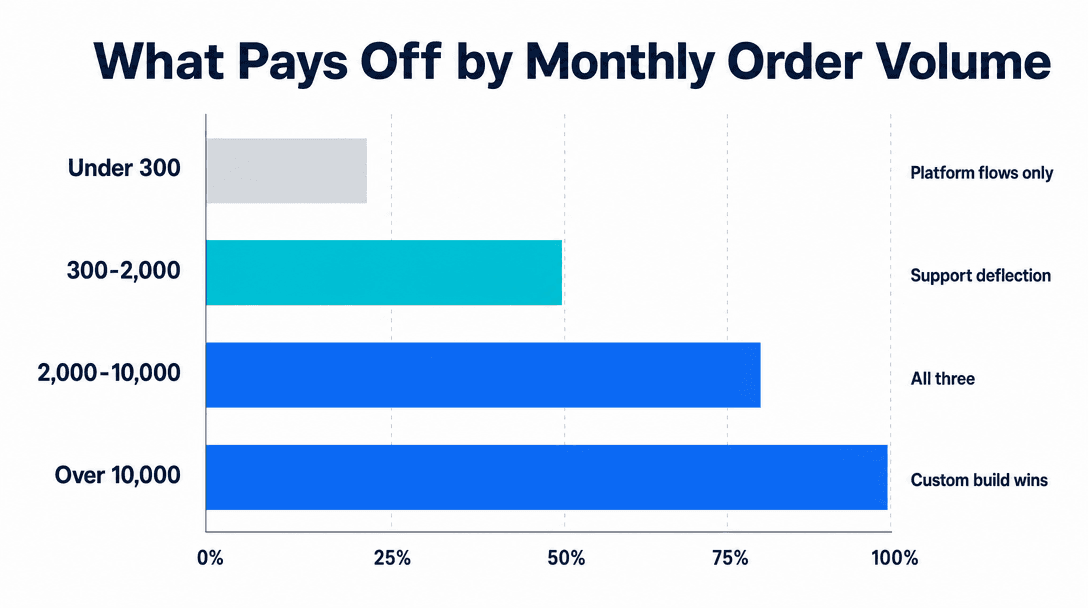
The rough thresholds, assuming a typical store with an average order value between $40 and $150:
| Monthly orders | What usually pays for itself |
|---|---|
| Under 300 | Built-in platform flows only. Shopify, Klaviyo, and your helpdesk already include enough. |
| 300 - 2,000 | Support deflection, then cart recovery. Off-the-shelf tools. |
| 2,000 - 10,000 | All three, plus review automation. Per-resolution support pricing starts to sting. |
| Over 10,000 | Custom builds start beating tool pricing, especially on support. |
This is the part most stores skip. If you are doing 200 orders a month, the honest answer is that your time is better spent on conversion rate and product, and no amount of AI tooling changes that.
Cart recovery: the math behind the biggest claim
Cart abandonment averages roughly 70 percent across the industry, a figure Baymard Institute has maintained across dozens of aggregated studies. That number is why cart recovery is the most-pitched AI use case in e-commerce, and why the claims around it are the least reliable.
Here is the honest structure of the calculation:
Recoverable revenue = abandoned carts x cart value x recovery rate x margin
The variable everyone inflates is recovery rate. Well-executed email and SMS recovery sequences typically bring back 5 to 15 percent of abandoned carts. Critically, that range predates AI. It is what good segmentation and good timing already achieved. What AI adds is better timing, tighter segmentation, and message content matched to the specific product. That is a real improvement, and it is worth a few percentage points, not a doubling.
Work an example. A store doing 1,000 orders a month with a $90 average order value and 70 percent abandonment has roughly 2,330 abandoned carts. At a 10 percent recovery rate, that is 233 recovered orders, about $21,000 in recovered revenue. If AI lifts recovery from 10 percent to 13 percent, that is 70 extra orders, roughly $6,300 in revenue, and at a 40 percent margin, about $2,500 in actual gross profit per month. Against a $200/month tool, that clears comfortably. Against a $25,000 custom build, it takes ten months to pay back.
Two cautions. First, attribution is hard here, because a meaningful share of "recovered" customers were coming back anyway. Hold out a control group of 10 percent who receive nothing, or you are measuring your own optimism. Second, the marginal gain shrinks as your baseline improves. If your recovery sequence is already good, AI has less room to add.
Support deflection: the one with a real baseline
Support is the best first automation in e-commerce for an unglamorous reason: you already know both numbers.
You know your monthly ticket volume. You know roughly what a ticket costs you, whether that is an hourly rate divided across tickets or a per-ticket outsourced fee. Most small e-commerce teams land somewhere between $2 and $6 of fully-loaded cost per ticket. Multiply those and you have a baseline that took ten minutes to produce and that nobody can argue with in month six.
Then the question is simple: what share of tickets are repetitive enough to resolve automatically, and what does resolving them cost?
In most stores, 50 to 70 percent of inbound support volume is four questions: where is my order, what is your returns policy, can I change or cancel this, and does this item fit or work with that item. Those are highly automatable because the answer is deterministic and lives in a system you already have.
The pricing trap is per-resolution billing. At $0.99 per resolution, a store deflecting 800 conversations a month pays about $792, which is fine when your fully-loaded cost per ticket was $4. At 5,000 conversations it is roughly $4,950 a month with no ceiling, and that is where a fixed-cost custom build starts winning. We broke that crossover down in detail in what $0.99 per resolution actually costs, and the general payback method is in AI chatbot ROI.
Deflection rate is a vanity metric on its own
A rising deflection rate with a falling escalation satisfaction score means you have made it harder to reach a human, not easier to get help. Track both. The automation should be resolving the repetitive questions and handing off everything else instantly with full conversation context, not standing in the doorway.
Review generation: legitimate uses and one hard line
Reviews are the highest-leverage social proof in e-commerce and the area where AI advice gets most dangerous.
What is legitimate: using AI to decide who to ask, when to ask them, and what to say. Timing a request to actual delivery plus product-specific usage time rather than a fixed 14 days. Writing the request in language that matches what the customer bought. Detecting which customers are likely to leave a detailed review rather than a one-liner. Routing unhappy customers to support instead of to a review form. All of this reliably lifts response rates and none of it invents anything.
What is not: generating review content, generating reviewer personas, or using AI to write "sample" reviews that get published. The FTC's rule on fake consumer reviews and testimonials, in force since 2024, makes fabricated reviews and undisclosed insider reviews subject to civil penalties per violation. Every major marketplace independently bans it. This is not a grey area and no ROI calculation survives it.
The realistic gain from better request timing and personalisation is a lift in review response rate from a typical 1 to 3 percent baseline into the 5 to 8 percent range. On a store doing 1,000 orders a month, that is roughly 20 to 50 additional genuine reviews a month, which compounds into conversion rate over quarters rather than showing up next week.
What most e-commerce stores get wrong
They buy the automation with the best story instead of the best baseline. Cart recovery pitches better than support deflection. Support deflection is easier to prove.
They skip the holdout group. Without a control, every recovery number you report includes customers who were returning anyway, and you will over-invest for a year before anyone notices.
They stack tools that each take a cut. Four AI tools at $150 a month each is $7,200 a year, which is a meaningful share of the profit the automations are supposed to generate. Consolidate before you add.
They automate the front door and not the back office. Returns processing, supplier email, inventory reconciliation, and order exception handling are less exciting and often have better arithmetic, because the labour they replace is fully loaded and internal.
They treat per-resolution pricing as fixed. It scales with your success. Model it at twice your current volume before you sign, because the whole point is that volume goes up.
Running your own numbers
Three calculations, in the order worth doing them:
- Support: monthly tickets x fully-loaded cost per ticket = your ceiling. Multiply by the share that is repetitive (start with 50 percent) to get realistic savings. Compare against the tool's cost at your ticket volume, not their example volume.
- Cart recovery: orders ÷ 0.3 x 0.7 gives you approximate abandoned carts. Multiply by average order value, by a 3 percentage point improvement over your current recovery rate, by your gross margin. That is your monthly gross profit gain.
- Reviews: treat it as a conversion rate play with a two-quarter lag, not a revenue line. If you cannot wait two quarters to see it, do it last.
If all three come out marginal, that is a real answer. It usually means volume, not tooling, is your constraint.
The bottom line
E-commerce AI automation is not a strategy, it is three or four specific arithmetic problems with different break-even points. Support deflection pays first because you already have the baseline. Cart recovery pays well but needs a control group to be believed. Review automation is a slow compounding play with one bright legal line you do not cross.
Check your monthly order volume against the thresholds before you take a demo. If you are under 300 orders a month, the honest recommendation is to skip all of it and come back when volume makes the math work.
Next step: If support is your biggest cost centre, the payback method for chatbots walks through the full calculation. For the broader process view, see AI workflow automation.
Frequently asked questions
Is AI automation worth it for a small e-commerce store?+
It depends almost entirely on order volume, not on store size or revenue. Below roughly 300 orders a month, most AI automation costs more than the labour it replaces, and you are better off with the built-in flows in Shopify or Klaviyo. Between 300 and 2,000 orders a month, support deflection and cart recovery usually clear their cost. Above 2,000, the math gets straightforward and the question shifts from whether to automate to whether to buy a tool or build something custom. Run your own numbers on order volume before anyone quotes you a price.
How much revenue does AI cart abandonment recovery actually recover?+
Industry cart abandonment sits around 70 percent, per Baymard Institute's ongoing research across dozens of studies. Well-run recovery email and SMS sequences typically recover somewhere in the 5 to 15 percent range of abandoned carts, and that number was already achievable before AI. What AI adds is timing, segmentation, and per-customer message content, which realistically moves recovery by a few percentage points rather than doubling it. Be very skeptical of any vendor claiming AI recovers 30 percent or more of abandoned carts.
What is the best first AI automation for an e-commerce store?+
Support deflection, in most cases. It has the clearest baseline because you already know your ticket volume and your cost per ticket, the work is repetitive enough for a model to handle reliably, and errors are cheap because a human catches them in the same inbox. Cart recovery is more attractive on paper but harder to attribute honestly, since some of those customers would have returned anyway. Start where you can measure, not where the upside sounds biggest.
How much does e-commerce AI automation cost?+
Off-the-shelf tools generally run $50 to $500 a month for cart recovery and review automation, and support AI is usually priced per resolution or per seat, often around $0.99 per resolution at the volume-based end. A custom build for a store with unusual logic runs $10,000 to $40,000 plus $100 to $600 a month to operate. For most stores under a few thousand orders a month, off-the-shelf wins clearly. Custom starts making sense when per-resolution pricing outgrows a fixed monthly cost.
Can AI write product reviews or review requests?+
AI can write and time review requests, and that is legitimate. AI must not write the reviews themselves. Fabricating reviews violates the FTC's rule on fake consumer reviews and testimonials, which carries civil penalties, and it violates the terms of every major marketplace. The honest use is asking the right customer at the right moment with a message that matches what they bought, which reliably lifts response rates without inventing anything.
Will AI support automation hurt my customer experience?+
It does when it is deployed to deflect rather than resolve. The failure pattern is an AI layer that makes reaching a human hard, which converts a two-minute question into a bad review. The version that works answers the repetitive questions instantly, order status, shipping timelines, returns policy, and hands off anything else immediately with full context. Measure escalation satisfaction, not just deflection rate. A high deflection rate with falling satisfaction means you are hiding from customers, not serving them.
Free PDF
The 2026 AI Development Rate Sheet
Build, agent, RAG and consulting rates by tier, in one PDF, so you can check a quote before you sign it.

Written by
Pankaj Kumar
Founder · Metageeks Technologies
Metageeks builds software and AI products for growing businesses. Every build is scoped in writing before it starts, and you see progress every week. We write about what holds up once it reaches production.
Connect on LinkedInThe AI Build Brief
Ship AI that holds up in production.
Practical playbooks on how to build, price and ship AI features, in one short email every other week.