The honest answer is: it depends. But "it depends" isn't useful, so here's what you're looking at: broken down by what you're building and who's building it.
TL;DR
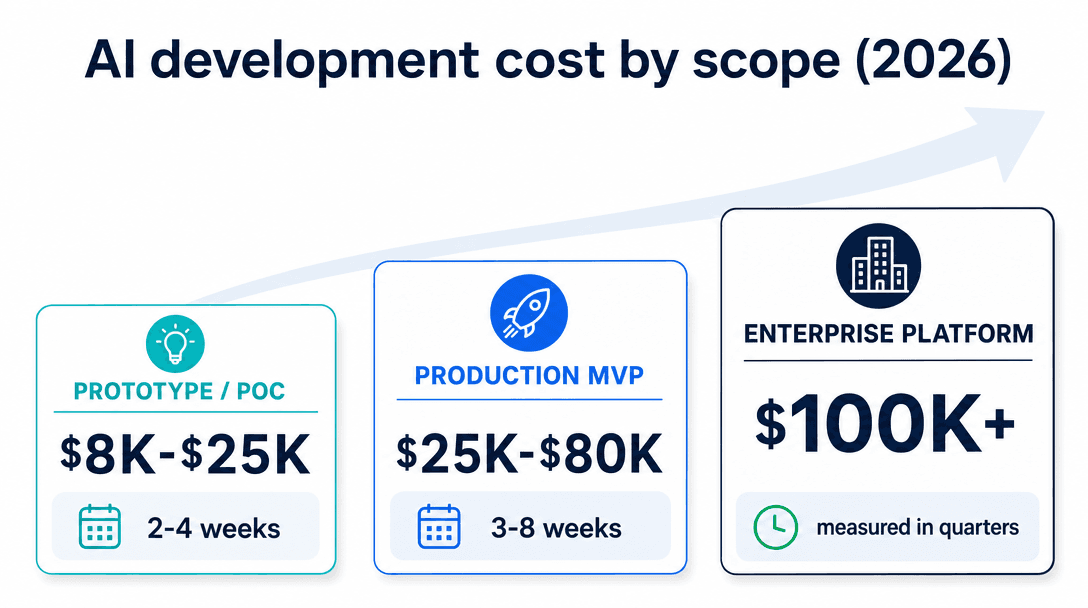
- Prototype: $8K-$25K, 2-4 weeks. Production MVP: $25K-$80K, 3-8 weeks. Enterprise platform: $100K+, measured in quarters.
- Fixed-price boutique agencies deliver the best ROI for $1M-$15M businesses: specialized, fast, on the hook for scope.
- The biggest cost drivers: model API spend at scale, RAG pipeline complexity, and integration surface area.
- A US AI engineer costs about $15K/month fully loaded and takes 3-6 months to hire: that, not zero, is the number to compare any build quote against.
- Delaying 6 months to hire in-house typically costs $90-120K before you see a single output.
The three buckets
Every AI development engagement falls into one of three categories, and the pricing differs by 10x between them.
1. A prototype / proof of concept
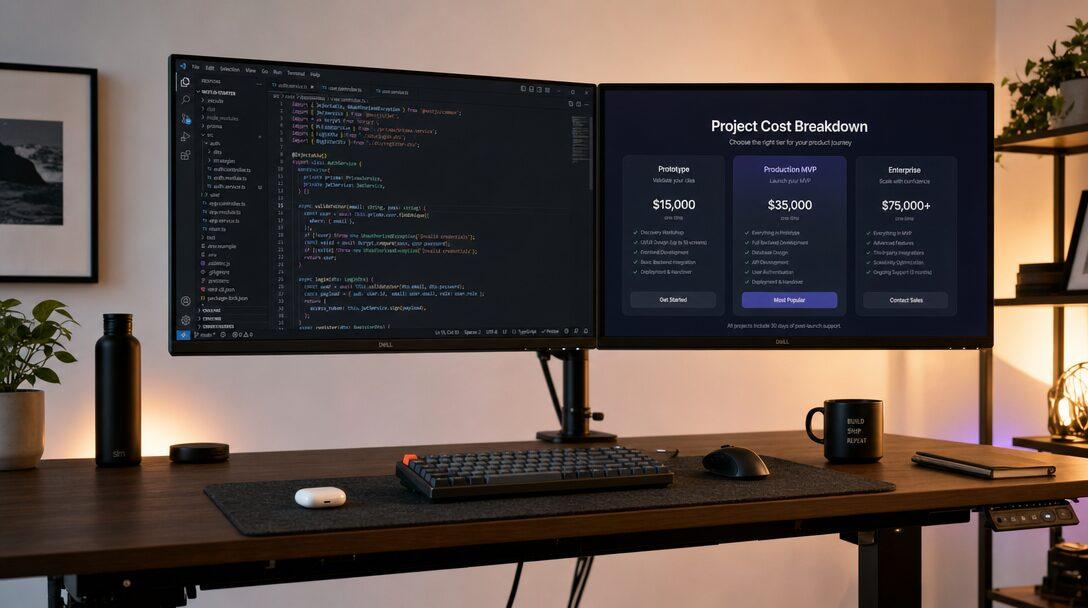
You want to validate that the AI approach works before committing budget. A working prototype (RAG system, AI agent, LLM-powered feature) should take 2-4 weeks and cost $8,000-$25,000 with a focused boutique team.
What you get: a working demo, architecture decision, and a clear picture of what full build costs. What you don't get: production-ready code, error handling, auth, or billing.
2. A production-ready MVP
This is a full working product: multi-tenant if needed, with auth, proper prompt engineering, monitoring, and the UI to use it. This is the most common type of engagement.
Timeline: 3-8 weeks. Cost: $25,000-$80,000.
The wide range is real. A single-tenant internal tool is $25K. A multi-tenant SaaS with Stripe, SSO, and a polished UI is $80K.
3. An enterprise AI platform
Custom model training, complex multi-agent orchestration, compliance requirements, existing systems integration. These engagements start at $100K and go up from there, with timelines measured in quarters.
The comparison table
| Option | Cost | Timeline | Risk |
|---|---|---|---|
| In-house AI engineer (US) | $150-200K/year salary + 3-6 months to hire | Months before first output | High: wrong hire = $300K wasted |
| Large agency | $200-400K project cost | 6-12 months | High: enterprise overhead, slow cycles |
| Boutique AI agency | $25-80K fixed price | 3-8 weeks | Low: specialized, fast, fixed scope |
| Offshore dev team | $8-30K | 3-6 months | High: LLM expertise rarely deep |
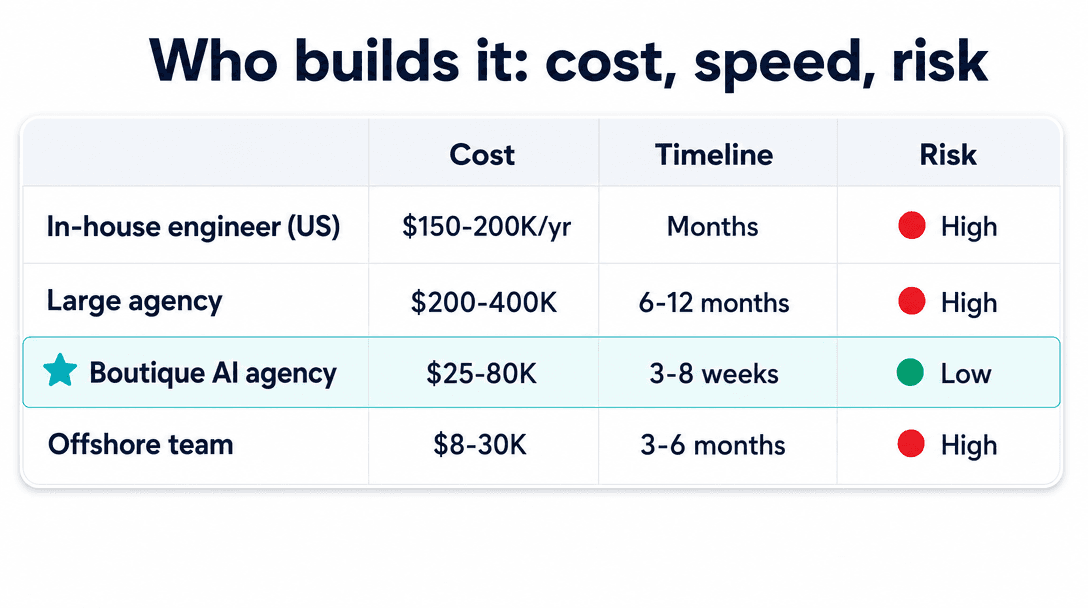
For most small and mid-sized businesses, the boutique column is the practical middle: specialized and fast, without a permanent salary or enterprise overhead.
Free PDF
The 2026 AI Development Rate Sheet
Build, agent, RAG and consulting rates by tier, in one PDF, so you can check a quote before you sign it.
What drives the cost up
Model choice is the first variable. GPT-4o API calls at scale cost real money. A system with 10K daily users hitting GPT-4o for every request can run $5-15K/month in API costs alone. Architecture decisions (caching, RAG instead of full context, model routing) can cut this by 70%.
RAG complexity is the second. A basic vector search over 1,000 documents is a weekend project. A production RAG system with reranking, citation tracking, hybrid search, and guardrails is a 3-week build.
Evaluation infrastructure is often underestimated. Getting LLM outputs that are consistently good requires eval pipelines. Teams that skip this ship fast and then spend 6 months fixing quality issues.
Integration surface area is the last. Connecting to your CRM, your internal database, your Slack, your support inbox all adds scope. Each integration adds 1-3 days.
Our pricing: how Metageeks scopes and bills sprints
We don't start work on an open meter. Every engagement begins with a written scope: the deliverables, the milestones and an estimate of the effort. Billing follows the work, as time-and-materials against that scope, or a monthly retainer once the work is ongoing. You see progress every week, and anything outside the scope needs a written change order before it gets built, so there are no surprise invoices.
Our model:
- Discovery Sprint: 1 week. Architecture, stack decisions, scope definition, working prototype of the core AI feature.
- Pilot Sprint: 3 weeks. Production-ready MVP. Deployed, monitored, documented.
- Scale Sprint: 3 weeks. Added features, performance optimization, additional integrations.
Most clients start with a Discovery Sprint. If the architecture is clear going in, we skip straight to Pilot.
If you need a tightly scoped build with written acceptance criteria and a fixed price, that's ClearShip.
The real cost of waiting
A US AI engineer costs $180K/year fully loaded. That's $15K/month. They take 3-6 months to hire and 2 months to onboard. By the time they ship something, you've spent $90-120K and 5-8 months.
A focused pilot can ship in 3 weeks. While an in-house hire would still be in recruiting, you've validated your AI approach and shipped something real.
The ROI question isn't "can we afford this?" It's "what does delaying 6 months cost us?"
How to scope your project
If you're trying to estimate before talking to anyone, here's a rough formula:
- Core AI feature complexity: 1-3 points (1 = chat over docs, 2 = multi-step agent, 3 = custom model)
- Integration count: each external system adds 0.5 points
- Multi-tenancy: add 1 point if yes
- Auth/billing/SSO: add 0.5-1 point
Score of 2: $15-25K. Score of 4: $35-55K. Score of 6+: $60K+.
This is a rough market estimate, not a quote. A real estimate needs someone to look at your actual systems, data and integrations.
AI development in 2026 doesn't have to be expensive or slow if you find a team with repeatable processes (stack decisions, prompting patterns, eval pipelines) that compresses 6-month builds into 6-week ones.
Get a written scope and estimate for your AI project →
Free PDF
The 2026 AI Development Rate Sheet
Build, agent, RAG and consulting rates by tier, in one PDF, so you can check a quote before you sign it.

Written by
Pankaj Kumar
Founder · Metageeks Technologies
Metageeks builds software and AI products for growing businesses. Every build is scoped in writing before it starts, and you see progress every week. We write about what holds up once it reaches production.
Connect on LinkedInThe AI Build Brief
Ship AI that holds up in production.
Practical playbooks on how to build, price and ship AI features, in one short email every other week.